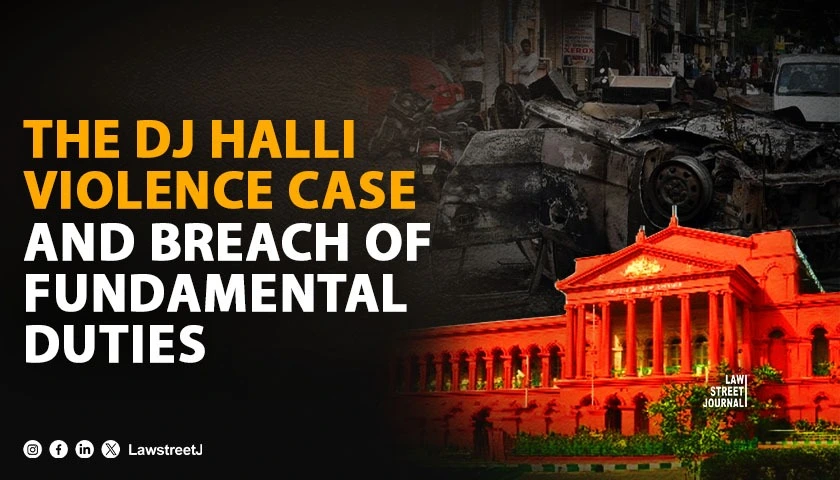
Karnataka: In a strongly worded judgment emphasizing the primacy of fundamental duties over fundamental rights in cases involving violence and public disorder, the Karnataka High Court has dismissed the bail appeal of an accused in the infamous 2020 DJ Halli–KG Halli violence case. The Court held that the accused, having allegedly violated constitutional duties by participating in mob violence and damaging public property, cannot seek the benefit of Article 21 rights when they themselves have caused delay in trial proceedings.
The order was passed by a Division Bench comprising Hon’ble Justice K.S. Mudagal and Hon’ble Justice Venkatesh Naik T during the hearing of Criminal Appeal No. 1425/2025, filed by Afzal Basha, who is the fifth accused in the case being prosecuted by the National Investigation Agency (NIA).
This judgment is significant as it comes nearly five years after the violent incident that shook Bengaluru on August 11, 2020, and represents the continuing judicial scrutiny of one of the city’s worst incidents of mob violence in recent times. The case has seen 146 accused persons charged with serious offences under the Unlawful Activities (Prevention) Act, 1967 (UAPA), the Indian Penal Code, and other special statutes.
Background of the DJ Halli–KG Halli Violence
The violence erupted on the night of August 11, 2020, following a provocative social media post allegedly made by Naveen, the nephew of then Congress MLA Akhanda Srinivas Murthy of the Pulakeshinagar constituency. The post, perceived as insulting to Prophet Mohammed, triggered a massive violent response that targeted both the MLA’s residence and two police stations in the area.
According to the prosecution’s case, the prime accused, with political aspirations and motivated to exploit religious sentiments for electoral gains, conspired to create unrest in society on religious lines. Accused No. 19 allegedly made a Facebook post belittling Hindu deities to provoke a reaction from Naveen. When Naveen responded with a post about Prophet Mohammed, it provided the pretext for the orchestrated violence that followed.
At 7:45 pm on August 11, 2020, Moulvi Firdous Pasha lodged a complaint at the DJ Halli Police Station against Naveen, alleging blasphemy and hurting religious sentiments. Despite the registration of an FIR, by 8:00 pm, Accused No. 4, K.M. Wajid Pasha, accompanied by around 50 persons, gathered at the police station demanding Naveen’s arrest.
The Violent Escalation
The appellant, Afzal Basha (Accused No. 5), allegedly played a crucial role in mobilizing the mob through social media platforms such as WhatsApp and phone calls, instigating others to assemble at the DJ Halli Police Station. The gathering swelled to between 800 and 1,500 people, with the mob shouting slogans and threatening to pour petrol and burn down the police station.
At around 8:45 pm, the aggressive group forcibly entered the DJ Halli Police Station armed with weapons, stones, sticks, and rods, and began damaging the building and attacking police personnel. Despite the proclamation under Section 144 of the Code of Criminal Procedure and public announcements requesting dispersal, the mob refused to comply.
The violence reached its peak when the mob overpowered the police and proceeded to the cellar, setting fire to 67 government vehicles, including both four-wheelers and two-wheelers. Even police measures such as lathi charge and tear gas failed to control the situation. Ultimately, the police were forced to open fire to disperse the mob. Several people were injured in the firing, and two persons died on the spot. Many police personnel also suffered injuries at the hands of the attackers.
Allegations Against the Appellant
Specific allegations against Afzal Basha (Accused No. 5) include that, upon learning about the derogatory Facebook post, he reached the DJ Halli Police Station in conspiracy with Accused No. 3 and others, mobilized a large number of people at the scene, provoked them, and participated in violent acts such as damaging property inside the police station, obstructing police personnel from performing their duties, and pouring petrol on vehicles and setting them on fire.
The appellant was charged under Sections 16, 18, and 20 of the UAPA; Sections 120B, 34, and 149 read with Sections 143, 145, 147, 188, 427, 436, and 353 of the IPC; and Section 2 of the Karnataka Prevention of Destruction and Loss of Property Act.
Court’s Analysis on the Prima Facie Case
The High Court, applying the principles laid down by the Supreme Court in Zahoor Ahmad Shah Watali, examined whether there were reasonable grounds for believing that the accusation against the accused was prima facie true.
The trial court had relied upon statements of protected witnesses LWs 25 and 27 (head constables of the DJ Halli Police Station) and LWs 122 and 124 (other eyewitnesses). These witnesses spoke about the incident, the presence of the appellant along with other accused, the appellant instigating other members of the mob, vandalizing the police station, pouring petrol and burning vehicles, and obstructing the police from performing their duties.
The Court noted that the Investigating Officer had collected call detail records of the appellant showing that he contacted other accused persons during the incident, and that the tower location of his mobile phone indicated his presence in the DJ Halli Police Station area. Forensic analysis of the appellant’s seized mobile phone revealed that he had received voice messages from Accused No. 21 exhorting Muslims to gather at the DJ Halli Police Station and “even to be ready to martyr themselves.” The call detail records further revealed that he received 14 calls and made 28 outgoing calls during the relevant time.
The Court held that the trial court was justified in finding prima facie material against the appellant, observing that “the name of the appellant not appearing in the first information report is not fatal,” as it is settled law that an FIR is not an encyclopedia and that other materials must also be examined.
The Critical Issue of Delay in Trial
One of the most significant aspects of the judgment is the Court’s analysis of delay in trial. The appellant had been in custody for five years without trial, which would ordinarily constitute a strong ground for bail. However, the Court’s examination revealed a disturbing pattern of calculated delay tactics by the accused.
The Special Public Prosecutor submitted a detailed statement showing that the accused collectively filed:
- 130 bail applications and interim bail applications between February 2021 and September 2025
- Multiple applications seeking examination of sanction orders
- Applications for transfer of cases
- Applications under Section 229 of the CrPC to plead guilty (currently pending)
- Applications for discharge
- 24 petitions and appeals before the High Court between 2020 and 2025
The Court observed that “the accused themselves are delaying the proceedings, strategically to make such delay a ground to seek bail.” The judgment noted that since 2021, although matters were posted for framing of charges, the accused filed one application or another causing obstructions. Individual accused filed bail or discharge applications consecutively instead of collectively, even when represented by common advocates. They also repeatedly changed advocates, with new lawyers seeking adjournments. Non-bailable warrants and proclamations had to be issued repeatedly due to the non-appearance of accused persons.
The Court concluded:
“Therefore, delay cannot be attributed either to the prosecution or the trial court. The accused, being themselves the cause of the delay, cannot be permitted to reap the benefit of their own mistake on the ground of delay.”
Court’s Observations on Fundamental Duties
In a powerful section of the judgment invoking Mahatma Gandhi’s philosophy, the Court held that fundamental rights flow from the performance of fundamental duties. Justice Mudagal quoted Gandhi:
“The true source of rights is duty. If we all discharge our duties, rights will not be far to seek,” and “Right is duty well performed.”
The Court observed that while the appellant seeks protection of his fundamental right to liberty under Article 21 of the Constitution, he is entitled to that right only when he adheres to his fundamental duties encapsulated in Article 51A of the Constitution.
The judgment specifically invoked Article 51A(c), (e), and (i), which mandate every citizen’s duty:
- (c) to uphold and protect the sovereignty, unity, and integrity of India;
- (e) to promote harmony and the spirit of common brotherhood among all the people of India, transcending religious, linguistic, and regional or sectional diversities;
- (i) to safeguard public property and to abjure violence.
The Court held:
“Since there is prima facie material to show that the appellant indulged in vandalizing the police station, assaulted police personnel, obstructed them from discharging their duties, caused injuries, attempted to damage public property, indulged in violence, and dented communal harmony on religious lines in breach of the above-referred fundamental duties—and since the accused themselves have delayed the proceedings—they cannot seek the benefit of Article 21 of the Constitution.”
Rejection of Parity Argument
The Court noted that a similarly situated accused (Accused No. 6, Suhail Basha) had approached the High Court in Criminal Appeal No. 1631/2023 challenging the rejection of his bail application, which was dismissed on January 25, 2024, and the order had attained finality.
Regarding other accused who were granted bail, the Court observed that those accused were not facing allegations under the UAPA. The prosecution successfully demonstrated that all accused facing UAPA charges had consistently been denied bail by both the trial court and the High Court.
The Court also rejected the medical ground concerning the appellant’s mother, noting that the ration card produced showed that she was living with her husband (the appellant’s father) and five other siblings of the appellant, thereby negating the claim of sole dependence.
Ongoing Proceedings and Recent Convictions
The DJ Halli–KG Halli violence case has seen some progress in 2025. In July 2025, the NIA Special Court sentenced three accused—Syed Ikramuddin alias Syed Naveed (A-14), Syed Asif (A-16), and Mohammad Atif (A-18)—to seven years of rigorous imprisonment each, along with fines of ₹36,000 each. The three had pleaded guilty to charges of criminal conspiracy for their involvement in setting fire to the KG Halli Police Station.
Currently, 138 persons have been charge-sheeted in the case. Out of 199 persons named as accused, 187 were arrested, four surrendered, and one died. The NIA’s probe has revealed links between some accused and the now-banned Popular Front of India (PFI) and its political wing, the Social Democratic Party of India (SDPI).
Case Details
Case Name: Afzal Basha vs. National Investigation Agency
Criminal Appeal No.: 1425/2025
Citation: NC: 2025:KHC:50025-DB
Coram: Hon’ble Justice K.S. Mudagal and Hon’ble Justice Venkatesh Naik T
Date of Judgment: December 2, 2025
Date of Hearing: November 10, 2025
Advocates for the Appellant:
Sri Akarsh S. Kanade, Advocate, for Smt. Divya A.V., Advocate
Advocates for the Respondent:
Sri P. Prasanna Kumar, Special Public Prosecutor

![Karnataka High Court: Cabinet Rank Status Not Equivalent to Ministerial Position [Read Order]](/secure/uploads/2023/09/lj_2318_fc1b99b7-aeed-472b-836e-33750bedb394.jpg)


![Woman living in adultery cannot claim maintenance: Karnataka High Court [Read Order]](/secure/uploads/2023/10/lj_3083_Women_living.jpg)