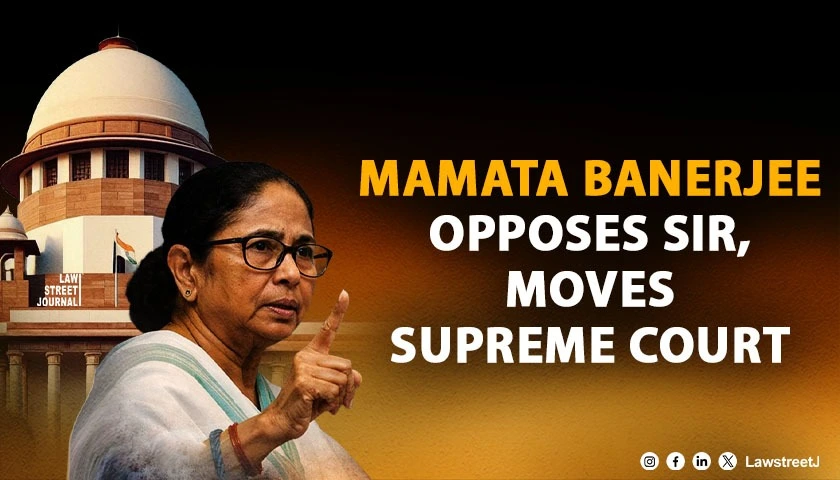
Kolkata: West Bengal Chief Minister Mamata Banerjee has approached the Supreme Court of India challenging the ongoing Special Intensive Revision (SIR) of electoral rolls in the State and seeking a direction that the forthcoming West Bengal Assembly elections be conducted on the basis of the existing electoral rolls instead of the revised rolls prepared under the SIR exercise.
In her petition, Banerjee has questioned the timing, scope, and manner of the SIR being undertaken by the Election Commission of India in the run-up to the 2026 Assembly elections. She has contended that the exercise is unprecedented at this stage of the electoral cycle and has the potential to disenfranchise a large number of genuine voters, particularly marginalised and vulnerable sections of society.
According to the petition, the ongoing revision process goes beyond routine updating of electoral rolls and involves extensive verification of existing voters, including those who have already been enrolled and have participated in previous elections. Banerjee has argued that such a wide-ranging exercise so close to elections undermines the principle of electoral certainty and disrupts the level playing field between political parties.
The petition raises concerns over voters being flagged under categories such as “logical discrepancy”, which allegedly include minor inconsistencies in names, addresses, or family details. It has been argued that subjecting such voters to fresh verification and quasi-judicial proceedings creates an unreasonable burden and exposes them to the risk of wrongful deletion from electoral rolls without adequate safeguards.
“The Petitioner reasonably apprehends that elections to the Legislative Assembly of West Bengal will be immediately declared thereafter, as the term of the Assembly comes to an end on or about 07.05.2026. This is the ultimate act of injustice, as it will practically freeze the voters’ list for West Bengal with large-scale disenfranchisement, errors, and omissions caused due to the opaque, hasty, unconstitutional, and illegal actions of the ECI described hereinbelow, without any time for grievance redressal in view of the shortage of time,” the plea states.
Banerjee has also alleged that the SIR is being conducted through informal instructions and administrative practices that lack transparency and uniformity. The petition claims that there is no clear statutory framework governing several aspects of the current revision process, including the deployment of personnel and the manner in which objections and verifications are being carried out on the ground.
Importantly, the petition seeks a writ of mandamus directing the Election Commission to conduct the West Bengal Assembly elections on the basis of the electoral rolls that were already in force prior to the commencement of the SIR, while permitting only limited and routine corrections as contemplated under the Representation of the People Act, 1950.
The challenge is situated against the backdrop of broader scrutiny by the Supreme Court of electoral roll revision exercises across the country. The apex court has, in recent hearings in other matters relating to SIR, emphasised the need for procedural safeguards, transparency, and adequate opportunity for voters to respond before any adverse action is taken. However, Banerjee’s petition is distinct in that it seeks to halt the use of SIR-based rolls altogether for the West Bengal elections.
The Election Commission of India, on its part, has consistently maintained that Special Intensive Revision is a statutory exercise undertaken to ensure the accuracy and integrity of electoral rolls, and that it is empowered to do so under Article 324 of the Constitution and the provisions of the Representation of the People Act. The Commission has also stated in public communications that safeguards are built into the process to prevent arbitrary deletion of voters.
The matter is yet to be listed for hearing before the Supreme Court. Given the constitutional importance of free and fair elections and the proximity of the West Bengal Assembly polls, the case is expected to attract close judicial scrutiny. The outcome is likely to have significant implications not only for West Bengal but also for how large-scale electoral roll revision exercises are conducted across India in the future.
Case Details
- Case Title: Mamata Banerjee v. Election Commission of India and Others
- Court: Supreme Court of India
- Jurisdiction: Original jurisdiction under Article 32 of the Constitution
- Petitioner: Mamata Banerjee, Chief Minister of West Bengal
- Respondents: Election Commission of India and Chief Electoral Officer, West Bengal