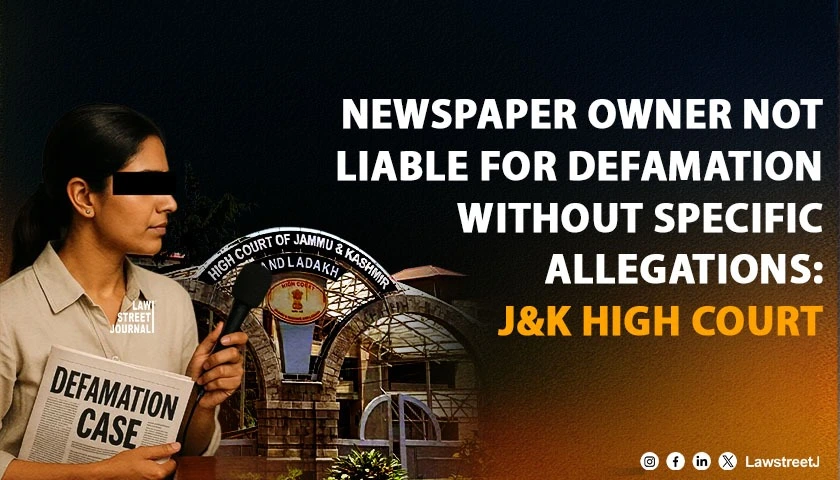
Jammu: The High Court of Jammu and Kashmir and Ladakh at Jammu has partly allowed a petition challenging a defamation complaint filed against the owner and editor of a newspaper, holding that while the editor of the Jammu edition of Dainik Jagran is liable to face trial for publication of an allegedly defamatory news item, the owner of the newspaper cannot be prosecuted in the absence of specific allegations regarding his role in the selection or publication of the offending content.
Justice Sanjay Dhar, pronouncing the judgment on March 12, 2026, in a petition filed under Section 482 of the Code of Criminal Procedure, partly allowed the petition and quashed the complaint and proceedings to the extent of Petitioner No. 1, Sanjay Gupta, while dismissing the petition insofar as it concerned Petitioner No. 2, Abhimanyu Sharma, directing that proceedings against him shall continue before the Judicial Magistrate First Class, Samba.
The respondent, Prem Kumar, a businessman engaged in computer repair and running a shop at Ramgarh, Samba, had filed a complaint before the trial Magistrate alleging commission of an offence under Section 500 of the Ranbir Penal Code. The complaint alleged that the petitioners, without verifying the truth of the matter, published a news item stating that the respondent was an overground worker of militants, that he had been taken into custody, and that he had direct links with top militants, including Azhar Masood.
It was further alleged that despite service of a legal notice, the petitioners did not tender any apology. The trial Magistrate, after recording the statement of the complainant and one witness, passed an order dated April 24, 2017, taking cognizance of the offence and issuing process against the petitioners on the ground that there were sufficient grounds to proceed.
The petitioners challenged the complaint and proceedings on the ground that Petitioner No. 1 was responsible only for the general policy of the newspaper, while separate Resident Editors were responsible for the selection and publication of news items. It was further contended that Petitioner No. 2, as printer and editor, was responsible for every act and omission with respect to the publication of news items.
It was also contended that the offending news item was already in the public domain and was based on information received from the investigating agency probing the Nagrota attack, and that issuance of process interfered with the right to freedom of speech and expression.
The Court examined the translated headline of the news item, which read: “OGW Prem has made a big disclosure upon his questioning.” The content of the news item stated that the respondent was an overground worker of militants, had provided a vehicle to terrorists of Lashkar-e-Taiba for carrying out the attack at Nagrota, Jammu, and that his shop had been subjected to search.
The Court held that the contents of the news item were per se defamatory, as the respondent had been projected as an overground worker of terrorists having deep connections with them and as having rendered assistance in an attack on security forces. The Court observed that branding a person as an overground worker of terrorists or stating that a person has links with terrorists ex facie lowers the image of such person in the estimation of those who know him.
The Court referred to the Supreme Court’s decision in Subramanian Swamy v. Union of India, (2016) 7 SCC 221, which held that for constituting an offence of defamation, mens rea is a condition precedent, and there must be intention or knowledge on the part of the accused that the imputation would harm the reputation of the complainant.
The Court held that even if there was no intention on the part of the petitioners to harm the reputation of the respondent, having regard to the nature of the news item, it could prima facie be stated that they had knowledge that the news item would harm his reputation. Section 499 RPC, the Court noted, brings within its purview not only cases where there is intention to harm but also cases where a person has knowledge or reason to believe that the imputation will harm the reputation of the person concerned.
On the contention that the offending news item was already in the public domain and was based on briefings by investigating agencies or security forces, the Court observed that the news item nowhere suggested that it was based on any such briefing, and no particulars of any investigating agency or institution were mentioned or disclosed therein. The Court held that this question, as well as the question of the truth of the imputations, could be decided only during trial and not in the present proceedings.
On the liability of Petitioner No. 1, the owner of the newspaper, the Court examined the provisions of the Press and Registration of Books Act, 1867, particularly Sections 1, 5, and 7, which provide for a statutory presumption against the editor whose name is printed in the newspaper, holding him responsible for the selection of content.
The Court referred to the Supreme Court’s decision in K.M. Mathew v. K.A. Abraham and Others, (2002) 6 SCC 670, which held that while the Act of 1867 creates a rebuttable presumption against the editor named in the newspaper, there is no statutory immunity against Managing Editors, Resident Editors, or Chief Editors, who can be proceeded against only if there are specific allegations made against them.
The Court held that the Act of 1867 recognizes only the editor for the purpose of holding a person responsible in civil or criminal proceedings in respect of the publication of a newspaper. Since the complaint contained no specific allegations regarding the role of Petitioner No. 1 in selecting the offending news item, and it was nowhere alleged that he was in any manner associated with its selection or publication, the prosecution against him could not be sustained.
As regards Petitioner No. 2, the Court found that, as per the declaration made by the Jammu edition of Dainik Jagran, he was shown as its editor, and the petitioners themselves had admitted in the petition that he was looking after the affairs of publication of the Jammu edition. The Court held that the statutory presumption under Section 7 of the Act of 1867 arose against him and that he could not escape liability in respect of the offending news item.
The petition was accordingly partly allowed.
Case Details
- Case Title: Sanjay Gupta & Anr. v. Prem Kumar
- Case Number: CRM(M) No. 124/2020
- Court: High Court of Jammu and Kashmir and Ladakh at Jammu
- Bench: Hon’ble Mr. Justice Sanjay Dhar
- Date of Pronouncement: March 12, 2026
- Advocate for Petitioners: Mr. Atul Raina
- Advocate for Respondent: Ms. Meenakshi S. Salathia

![J&K and Ladakh HC upholds preventive detention, confirms validity beyond criminal proceedings [Read Order]](/secure/uploads/2024/09/lj_7116_WhatsApp_Image_2024-09-11_at_11.36.56_AM.webp)
![High Court of J&K and Ladakh clarifies dress code rules for Advocates, dismisses domestic violence petition [Read Order]](/secure/uploads/2024/12/lj_1748_Women_lawyers_cant_appear_before_court_with_face_covered.jpg)
![Jammu & Kashmir High Court limits scope of Judicial Review in Tender disputes [Read Judgment]](/secure/uploads/2025/01/lj_8309_0f418c46-349d-4866-907b-bcd34c9236a3.jpg)
![Jammu & Kashmir and Ladakh High Court rules Section 27 statements insufficient to prove knowledge in NDPS cases [Read Order]](/secure/uploads/2025/02/lj_9406_Jammu_&_Kashmir_and_Ladakh.webp)