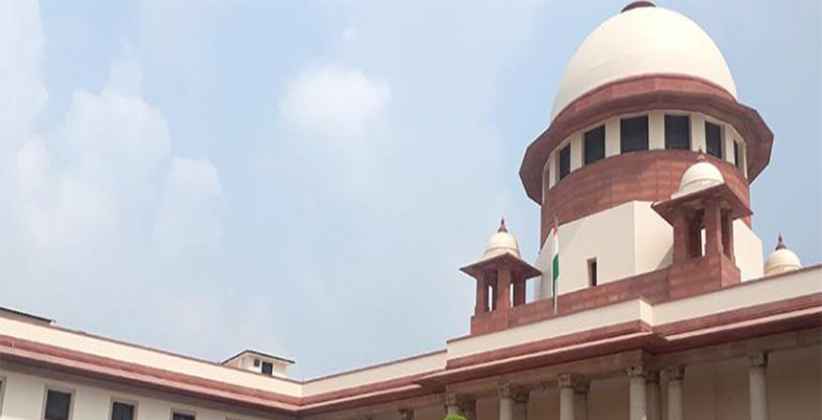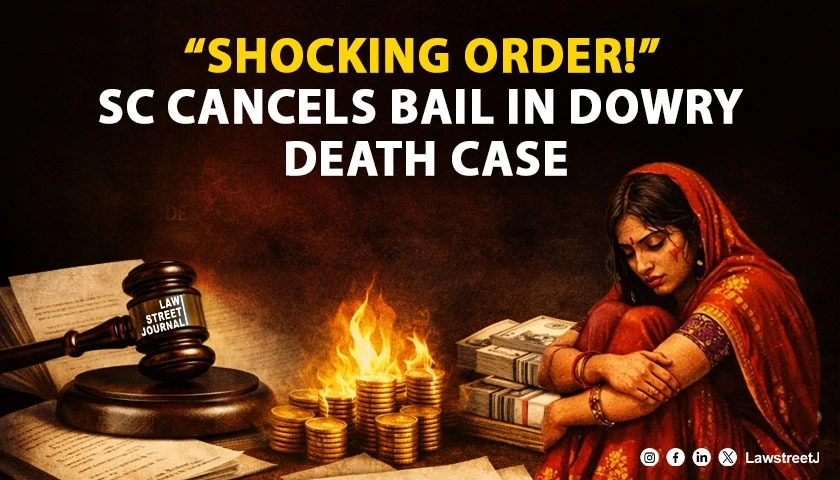
New Delhi: The Supreme Court, on February 9, 2026, set aside a bail order passed by the Allahabad High Court in a dowry death case, describing the impugned order as “one of the most shocking and disappointing orders” it had come across in recent times. The Court directed the accused husband to immediately surrender before the Trial Court and be remanded to judicial custody.
A Bench comprising Justice J.B. Pardiwala and Justice K.V. Viswanathan allowed the appeal filed by the father of the deceased, Chetram Verma, challenging the High Court’s order dated October 10, 2025, granting bail to the accused in FIR No. 188/2025 registered at Kotwali Bhinga Police Station, District Shrawasti, Uttar Pradesh.
The FIR was registered for offences under Sections 85 and 80(2) of the Bharatiya Nyaya Sanhita, 2023, and Sections 3 and 4 of the Dowry Prohibition Act, 1961. The prosecution case is that the deceased, who had been married for barely three months, died under mysterious circumstances at her matrimonial home in the early hours of April 25, 2025. The FIR lodged by her father alleged that despite payment of ₹3.5 lakh in cash and other dowry articles at the time of marriage, the accused and his family members were dissatisfied and demanded a four-wheeler as additional dowry. It was alleged that the deceased was subjected to physical and mental harassment and was ultimately killed for dowry.
The post-mortem report recorded the cause of death as asphyxia due to strangulation. After investigation, a chargesheet was filed and the case was committed to the Sessions Court, where charges were framed. At the time of consideration by the Supreme Court, one prosecution witness, namely the father of the deceased, had already been examined.
The High Court, while granting bail, had recorded the submissions of the defence, including a contention that the hyoid bone was intact and that strangulation was not possible in such circumstances as per Modi’s Textbook of Medical Jurisprudence and Toxicology. The High Court observed that the accused had been in custody since April 27, 2025, had no criminal history, and, without commenting on the merits, granted bail subject to conditions.
Taking strong exception to the manner in which bail was granted, the Supreme Court observed that it failed to understand what weighed with the High Court in exercising its discretion in favour of the accused in a serious offence such as dowry death. The Bench noted that the High Court had merely recorded the submissions of the defence and, apart from referring to custody and absence of criminal antecedents, had not undertaken any meaningful analysis.
The Court emphasised that in cases of alleged dowry death, the High Court is required to consider several crucial factors, including the nature and gravity of the crime, the punishment prescribed under the Bharatiya Nyaya Sanhita, 2023, the relationship between the accused and the deceased being that of husband and wife, the place of occurrence being the matrimonial home, the post-mortem findings indicating death by strangulation, and most importantly, the statutory presumption under Section 118 of the Bharatiya Sakshya Adhiniyam, 2023.
Referring to Section 118, the Court reproduced the provision which mandates that where it is shown that, soon before her death, a woman was subjected to cruelty or harassment in connection with dowry demands, the Court shall presume that such person caused the dowry death. The provision corresponds to the erstwhile Section 113-B of the Indian Evidence Act, 1872.
While clarifying that it was not expressing any opinion on the merits of the case in view of the ongoing trial, the Bench held that the impugned bail order was unsustainable in law and had resulted in a travesty of justice. The Court accordingly directed the accused to surrender immediately before the Trial Court and ordered that upon surrender, he be remanded to judicial custody. The Trial Court was directed to proceed with the trial expeditiously.
The appeal was allowed, and the High Court’s order granting bail was set aside. The Registry was further directed to forward a copy of the order to the Registrar General of the Allahabad High Court to be placed before the Chief Justice.
Case Details:
- Case Title: Chetram Verma v. State of U.P. & Anr.
- Court: Supreme Court of India
- Coram: Justice J.B. Pardiwala and Justice K.V. Viswanathan
- Decision Date: 09 February 2026
- Case Number: Criminal Appeal No. 770 of 2026 arising out of SLP (Crl.) No. 19237 of 2025
- Impugned Order: Allahabad High Court order dated 10.10.2025 in Criminal Miscellaneous Bail Application No. 8097 of 2025
Counsel for the Appellant:
Gaurav Yadava, Chand Qureshi, Mohammad Usman Siddiqui, Aisha Siddiqui, Sakeena Quidwai, Mohammad Salman Siddiqui, Tasleem Siddiqui, Rajat Baijal
Counsel for the State of U.P.:
Apoorva Agarwal, Namit Saxena, Abhishek Kumar Singh
Counsel for Respondent No. 2 (Accused):
Ajay Kumar Singh, Yatharth Singh, Manindera Dubey, Shrishti Gautam, Divyansh Singh, Vikash Singh