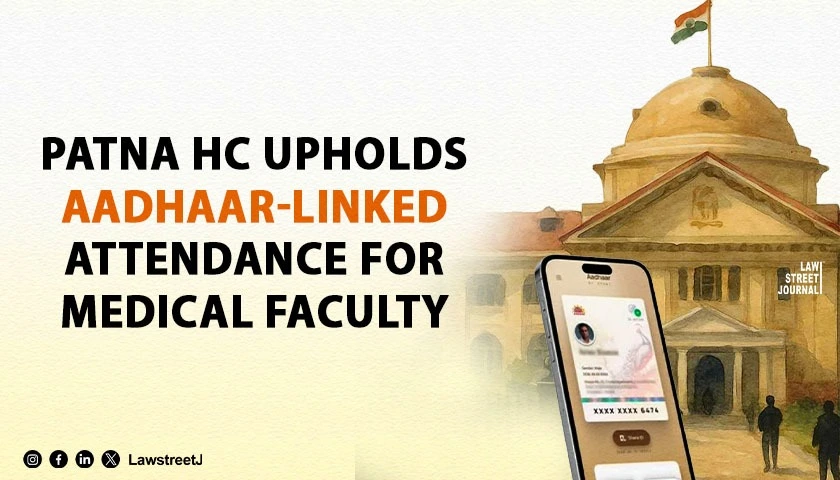
Prayagraj: In a significant ruling on the scope of State regulation over educational institutions and professionals, the Patna High Court has upheld the mandatory implementation of Aadhaar-linked facial recognition and GPS-based attendance for medical faculty, holding that the measure does not violate the fundamental right to privacy and serves a legitimate public purpose in regulating medical education.
The judgment, delivered by Justice Bibek Chaudhuri, assumes importance when read alongside a recent decision of the Allahabad High Court (Lucknow Bench), which struck down a State order directing the closure of an unrecognised madarsa, holding that regulatory non-compliance cannot justify executive overreach, particularly where constitutional protection applies.
Together, the two rulings delineate the constitutional boundary between permissible regulation and impermissible interference in the education sector.
Patna High Court: No Absolute Right Against Attendance Monitoring
The Patna High Court was dealing with a challenge by eight doctors employed as faculty members in government medical colleges across Bihar, who questioned the legality of a public notice issued by the National Medical Commission mandating face-based Aadhaar authentication and GPS location sharing for marking attendance.
The petitioners argued that compulsory facial recognition violated their rights under Articles 14, 19 and 21, relying heavily on the Supreme Court’s privacy jurisprudence in K.S. Puttaswamy. They contended that Aadhaar authentication under Section 7 of the Aadhaar Act is confined to welfare schemes and cannot be extended to employment attendance systems.
Rejecting these submissions, the Court held that:
- Privacy rights are not absolute and are subject to reasonable restrictions
- Aadhaar-linked biometric attendance is already prevalent across the country
- Mere apprehension of data misuse, without demonstrable violation, cannot attract constitutional remedies
The Court emphasised that public servants, particularly in critical sectors such as healthcare, are subject to reasonable regulatory oversight, including attendance mechanisms designed to address faculty shortages and institutional discipline.
Strong Institutional Justification Accepted:
The Court took judicial notice of the dilapidated state of public healthcare, chronic faculty shortages, and irregular attendance in medical colleges. It held that the NMC, as a statutory regulator, is well within its powers to introduce technology-driven mechanisms to ensure accountability.
Importantly, while dismissing the writ petition, the Court also directed the NMC to press State Governments to initiate time-bound recruitment drives, noting that attendance systems alone cannot cure systemic failures in healthcare delivery.
Allahabad High Court: Regulation Cannot Become Suppression
In contrast, the Allahabad High Court (Lucknow Bench), in WRIT–C No. 307 of 2026, took a markedly different view while dealing with the closure of an unrecognised madarsa by the District Minority Welfare Officer.
A Bench led by Justice Subhash Vidyarthi held that lack of recognition does not empower the State to shut down an educational institution, particularly where the institution neither seeks aid nor recognition.
Relying on the Supreme Court’s ruling in Anjum Kadari v. Union of India and the classic Kerala Education Bill opinion, the Court reiterated that minority institutions which do not seek State aid or recognition enjoy complete protection under Article 30(1).
While permitting the madarsa to function, the Court clarified that:
- It would not be entitled to government grants
- Its students could not claim State-recognised benefits
- The Madarsa Board was not obliged to allow participation in Board examinations
The distinction, the Court held, lies between denial of benefits and denial of existence, the latter being constitutionally impermissible.
The Constitutional Thread Connecting Both Rulings
Read together, the two judgments articulate a consistent constitutional principle:
- Where the State acts as an employer or regulator of public services, reasonable technological controls may be imposed
- Where the State deals with constitutionally protected minority institutions, regulation cannot cross into coercive suppression
The Patna High Court upheld surveillance-backed regulation because it applied to public employment in a vital sector and was backed by statutory authority. The Allahabad High Court intervened because the executive action attempted to extinguish an institution’s functioning without statutory backing, infringing constitutional autonomy.
Why These Rulings Matter:
These decisions collectively clarify that:
- Privacy claims must be contextual and evidence-based, not abstract
- Executive convenience cannot override constitutional guarantees
- Regulation must remain proportionate, lawful, and purpose-specific
At a time when technology-driven governance is rapidly expanding, the judgments underscore that constitutional scrutiny will turn on the nature of the relationship between the State and the regulated entity, not on technology alone.
Case Details:
Patna High Court
Case Title: Dr. Shyam Kumar Satyapal & Ors. v. National Medical Commission & Ors.
Case No.: CWJC No. 11111 of 2025
Coram: Justice Bibek Chaudhuri
Decision: Writ petition dismissed
Date: 17 January 2026
Appearances:
For the Petitioners:
- Saurabh Sunder, Advocate
- Ashish Gaurav, Advocate
For the State of Bihar:
- P. K. Sahi, Advocate General
- P. N. Sharma, Counsel assisting the Advocate General
For the National Medical Commission:
- Kumar Priya Ranjan, Senior Standing Counsel
- Sudarshan Bharadwaj, Advocate
For the Union of India:
- K. N. Singh, Additional Solicitor General
- Amit Kishore Sinha, Central Government Counsel

![Immediately stop caste-based survey: Patna High Court to Bihar Government [Read Order]](/secure/uploads/2023/05/lj_2614_70fde4fe-1b94-4360-a3d2-e162d6022c46.jpg)

![Supreme Court refuses pre arrest bail to IPS officer accused of creating fake WhatsApp account of HC's CJ [Read Order]](/secure/uploads/2023/11/lj_1575_Fake_WhatsApp_account_of_Patna_HC_Chief.jpg)