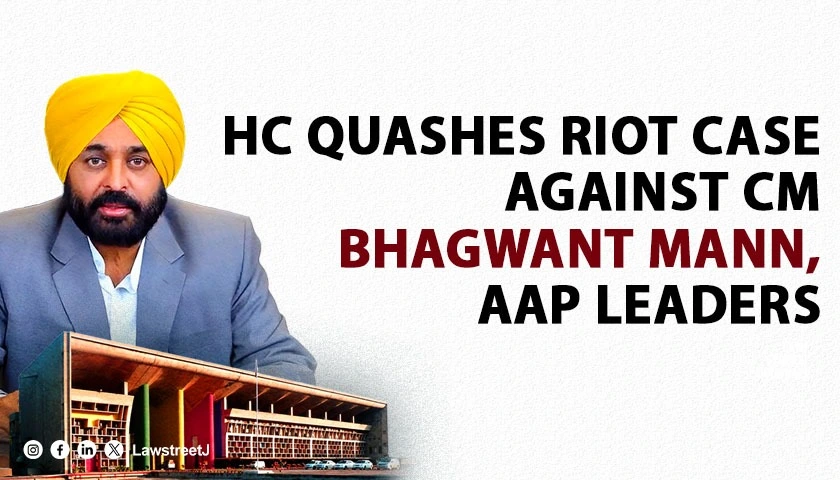
Punjab: The Punjab and Haryana High Court has quashed the criminal case registered against Punjab Chief Minister Bhagwant Mann and several senior leaders of the Aam Aadmi Party (AAP) in connection with a protest held outside the Punjab Chief Minister’s residence in Chandigarh.
Justice Tribhuvan Dahiya pronounced the judgment on November 29, 2025, while allowing multiple petitions filed under Section 482 of the Code of Criminal Procedure seeking quashing of FIR No. 01 dated January 10, 2020, registered at Police Station Sector 03, Chandigarh, under Sections 147, 149, 332, and 353 of the Indian Penal Code. The petitions were decided together as they arose from the same FIR.
The FIR had alleged that AAP leaders led a crowd of approximately 750–800 party workers towards the Chief Minister’s residence after staging a protest against electricity tariff hikes, despite alleged prohibitory orders. According to the police version, protestors pushed past barricades, pelted stones, and several police officers sustained injuries during the incident.
After completion of investigation, a chargesheet was filed on July 15, 2021. However, Section 188 IPC (disobedience to order promulgated by a public servant) was deleted from the case as no valid prohibitory order under Section 144 CrPC had been issued by the Deputy Commissioner, Chandigarh.
The petitioners contended that no overt act, specific role, or injury was attributed to any of the accused. They argued that mere presence at a protest does not constitute rioting or unlawful assembly unless use of force is established, and that no credible material existed showing that the accused instigated or committed any violent act.
The Court examined medical records and found that the injuries suffered by police officials were simple abrasions and swellings sustained during crowd-control operations, which did not establish intentional assault by the petitioners. The Court further noted that there were no allegations of the accused carrying weapons, delivering instigatory speeches, or personally using force.
On the legal requirement of unlawful assembly, the Court observed that for offences under Sections 147 and 149 IPC to be attracted, the assembly must itself be unlawful. In this case, since no valid prohibitory order under Section 144 CrPC had been issued, the gathering could not automatically be termed illegal or unlawful.
Justice Dahiya further held that there was a complete absence of material to establish offences under Sections 332 and 353 IPC, which pertain to voluntarily causing hurt and use of criminal force against public servants while discharging official duties. No independent witness identified the petitioners as having assaulted any police official.
Accordingly, finding that the prosecution was based on generalized allegations without legal foundation, the Court held that continuation of the proceedings would amount to an abuse of the process of law.
The Court thus quashed the FIR and all consequential proceedings insofar as they related to the petitioners.
Case Title: Bhagwant Mann & Ors. v. U.T. Chandigarh

![Police protection to fund manager alleging threat from Kirron Kher & aide: Punjab & Haryana HC [Read Order]](/secure/uploads/2023/12/lj_9007_Police_Kirron_Kher.jpg)
![Most interested witness being the father of deceased, SC upholds acquittal of 6 accused for murder [Read Judgment]](/secure/uploads/2023/12/lj_9904_df2c02a2-d8c5-4dd6-8b58-a59e17b8635b.jpg)
![Supreme Court Collegium approves new Chief Justices for five key High Courts in India [Read Recommendations]](/secure/uploads/2023/12/lj_8000_380d1135-6f3a-4988-a00a-4d5cd5901815.jpg)