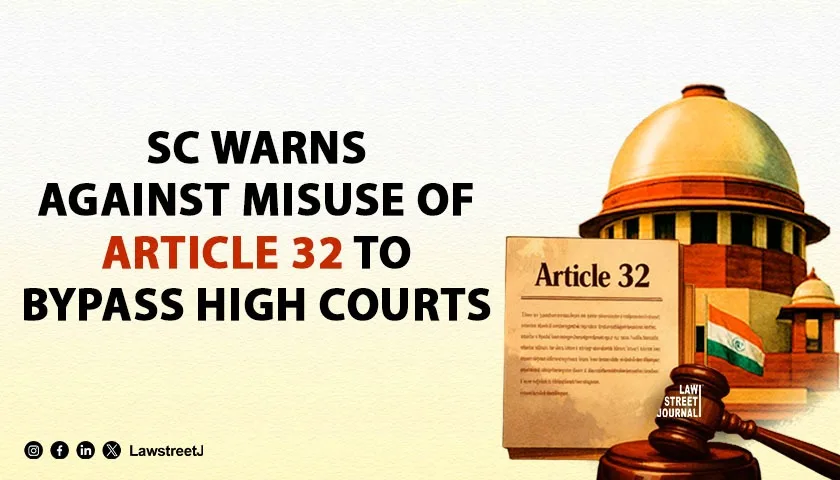
New Delhi: The Supreme Court of India has strongly cautioned litigants against the growing tendency to directly approach it under Article 32 of the Constitution even when similar or connected proceedings are already pending before High Courts, observing that such practice amounts to a misuse of the Court’s extraordinary writ jurisdiction.
The observations were made on 16 January 2026 by a Bench comprising Justice B. V. Nagarathna and Justice Ujjal Bhuyan, while dismissing a writ petition filed under Article 32 despite an identical issue being under consideration before the Bombay High Court.
The Bench remarked that Article 32, which guarantees the right to move the Supreme Court for enforcement of fundamental rights, is increasingly being invoked as a procedural shortcut. The Court noted that litigants are approaching the Supreme Court merely because a matter before a High Court has been adjourned or is not proceeding at the desired pace. Such conduct, the Bench observed, undermines judicial discipline and the hierarchical structure of constitutional courts.
Justice Nagarathna pointedly observed that for every minor delay or adjournment before a High Court, parties are rushing to file Article 32 petitions before the Supreme Court. The Court emphasised that Article 32 is not meant to be used as an appellate or supervisory forum over High Courts, particularly when those courts are already seized of the matter.
Justice Bhuyan reiterated that Article 32 is meant for genuine and direct violations of fundamental rights and not for circumventing available remedies under Article 226 of the Constitution. Where a High Court is already hearing a case, approaching the Supreme Court under Article 32 was described as an abuse of the process of law.
The Bench also declined to entertain requests from counsel seeking guidance on procedural strategy, making it clear that the Supreme Court would not advise litigants on where or how to file applications when no substantial constitutional issue warranted its intervention.
The Court stressed that such practices not only burden the apex court unnecessarily but also weaken the role of High Courts, which are constitutionally empowered to enforce fundamental rights within their jurisdictions. Judicial self-restraint, the Court noted, is essential to preserve the effectiveness of Article 32 as a constitutional remedy of last resort.
By dismissing the petition, the Supreme Court reaffirmed its long-standing position that while Article 32 is a fundamental right in itself, its invocation must be disciplined, bona fide, and reserved for exceptional circumstances where High Court remedies are either unavailable or ineffective.
Case Details:
- Case Title: Adil Ali Khalil Sulaiman v. State of Maharashtra
- Court: Supreme Court of India
- Bench: Justice B. V. Nagarathna and Justice Ujjal Bhuyan
- Date of Order: 16 January 2026
- Diary No.: 55989/2025