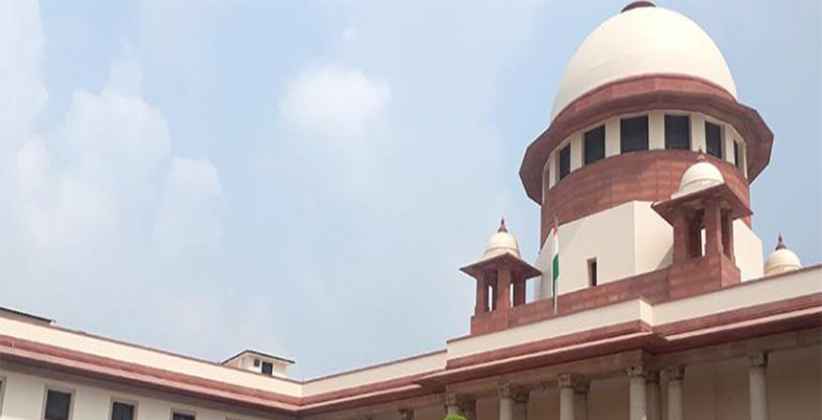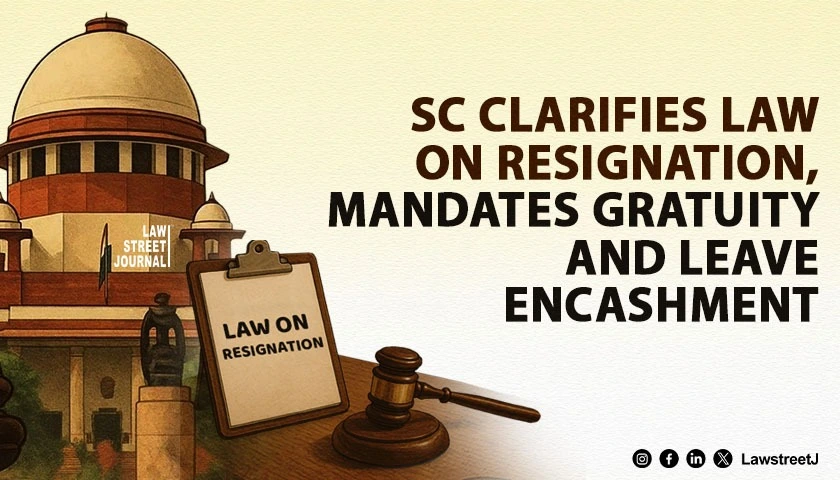
New Delhi: The Supreme Court of India, in a significant ruling delivered on December 9, 2025, partly allowed a civil appeal, providing clarity on the distinction between “resignation” and “voluntary retirement” under the Central Civil Services (Pension) Rules, 1972, as applicable to the Delhi Transport Corporation (DTC). The apex court upheld the forfeiture of the deceased employee’s past service—thereby denying pension—but ruled that his legal heirs were unequivocally entitled to gratuity and leave encashment, including interest, despite the resignation.
The deceased employee, Ashok Kumar Dabas, was appointed as a conductor with the Delhi Transport Corporation in 1985 and had opted for the new pension scheme introduced in 1992. After rendering about 30 years of service, he resigned from his job on August 7, 2014, citing family circumstances. His resignation was accepted on September 19, 2014. A later request to withdraw the resignation was declined by the competent authority on April 28, 2015.
The core of the dispute arose when the Corporation, vide order dated October 23, 2015, informed the employee that he was entitled only to the provident fund and “no other benefit” due to his resignation. Aggrieved, the employee approached the Central Administrative Tribunal (CAT), and subsequently the High Court of Delhi, both of which dismissed his claim for pensionary benefits.
Before the Supreme Court, the counsel for the appellant argued that the employee’s resignation letter should not be “literally construed” but should be treated as voluntary retirement, particularly since he had completed over 20 years of service, making him eligible for pension under Rule 48 or Rule 48-A of the 1972 Rules. The counsel submitted that “Pension is not a bounty. It is earned by an employee after putting in long service.” It was further contended that it would be “too harsh to forfeit his entire service benefits merely because of a minor error in the resignation letter submitted by him.” The appellant relied on previous Supreme Court judgments, including Reserve Bank of India and another v. Cecil Dennis Solomon and another and Shashikala Devi v. Central Bank of India & others.
The Corporation, represented by its counsel, strongly countered these arguments, relying on Rule 26(1) of the Central Civil Services (Pension) Rules, 1972, which explicitly states: “Resignation from a service or a post, unless it is allowed to be withdrawn in the public interest by the Appointing Authority, entails forfeiture of past service.” The counsel argued that since the deceased employee admittedly resigned, “entire service will be forfeited and no second opinion on that can be formed.” The respondent also cited the Supreme Court’s recent judgment in BSES Yamuna Power Limited v. Ghanshyam Chand Sharma and another, which drew a clear distinction between resignation and voluntary retirement. The respondent further highlighted the employee’s chequered service record—he had been suspended on five occasions and subjected to major and minor punishments seven times—suggesting that this was the reason for his resignation.
Justice Rajesh Bindal, writing the judgment for the bench, meticulously analyzed the relevant 1972 Rules, including Rule 26 (Forfeiture of service on resignation), Rule 36 (Retiring pension), Rule 48 (Retirement on completion of 30 years’ qualifying service), and Rule 48-A (Retirement on completion of 20 years’ qualifying service).
The Court noted that the deceased employee resigned on August 7, 2014, and his resignation was accepted on September 19, 2014, marking the “end of his employment with the Corporation.” The Supreme Court then relied heavily on its precedent in the BSES Yamuna Power Limited case, specifically extracting paragraphs that confirmed the legal consequences of resignation. The judgment reiterated: “Rule 26 of the Central Civil Services (Pension) Rules, 1972 (the CCS Pension Rules) states that: ‘26. Forfeiture of service on resignation. (1) Resignation from a service or a post, unless it is allowed to be withdrawn in the public interest by the Appointing Authority, entails a forfeiture of past service.’”
Crucially, the bench rejected the plea to re-classify the resignation as voluntary retirement, holding:
“If this Court were to re-classify his resignation as a case of voluntary retirement, this would obfuscate the distinction between the concepts of resignation and voluntary retirement and render the operation of Rule 26 nugatory. Such an approach cannot be adopted.”
The Court further clarified:
“Even if the first respondent had served twenty years, under Rule 26 of the CCS Pension Rules his past service stands forfeited upon resignation. The first respondent is therefore not entitled to pensionary benefits.”
Concluding its analysis on the pension claim, the Court held:
“From our aforesaid discussion, the only inescapable conclusion is that on resignation by the employee, his past service stood forfeited. Hence, he will not be entitled to any pension.”
However, on the claim for gratuity, the Court took a different view, referring to Section 4 of the Payment of Gratuity Act, 1972. The relevant provision states that gratuity shall be payable to an employee on the termination of his employment after not less than five years of continuous service, including “on his retirement or resignation.”
The Court found no evidence that the Delhi Transport Corporation was exempted from the application of the 1972 Act under Section 5. It emphatically stated:
“Once it could not be established by the respondent that the 1972 Act is not applicable to the Corporation, the claim of the appellant for release of gratuity cannot be denied even if he had resigned from service.”
The legal heirs were therefore held entitled to gratuity for the period of service rendered.
Regarding leave encashment, the Corporation’s counsel “fairly submitted that the amount due to the deceased employee shall be paid to his family members.”
The appeal was therefore partly allowed. The legal heirs of Ashok Kumar Dabas were held entitled to receive gratuity under the 1972 Act and the amount towards leave encashment. The Court mandated that the amounts be paid within six weeks, “along with interest @ 6% p.a. from the date of his resignation till payment.”
Case Details:
Case Name: ASHOK KUMAR DABAS (DEAD THROUGH LEGAL HEIRS) v. DELHI TRANSPORT CORPORATION
Citation: 2025 INSC 1404
Date of Judgment: December 9, 2025
Court: Supreme Court of India
Coram: Rajesh Bindal, J. and Manmohan, J.
For Petitioner(s): Mr. Anil Mittal, Adv.; Mr. Narender Kumar Verma, AOR
For Respondent(s): Mr. Aviral Saxena, AOR; Mr. Abhinav Sharma, Adv.; Mr. Paritosh Goyal, Adv.