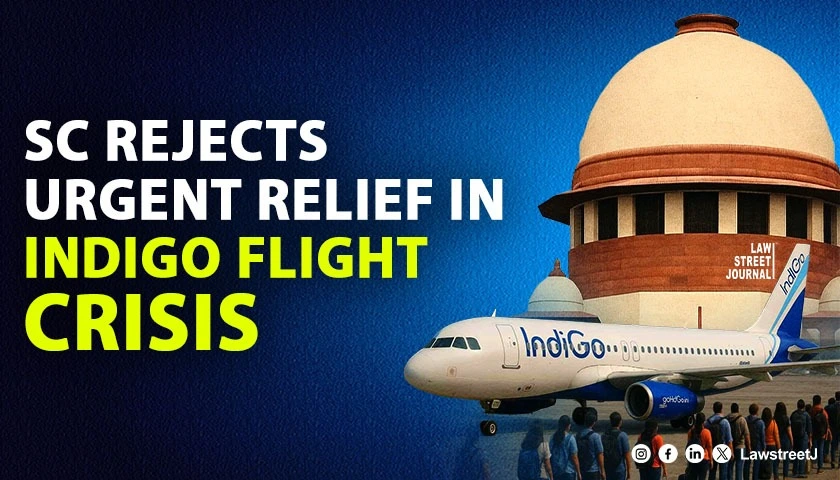
New Delhi: In a significant development amid nationwide disruption caused by large-scale flight cancellations by IndiGo Airlines, the Supreme Court of India, in a Bench led by Chief Justice of India Surya Kant along with Justice Joymalya Bagchi, declined to urgently list a petition seeking immediate judicial intervention in what was described as an unprecedented aviation crisis affecting air passengers across the country.
The Bench observed that although “lakhs of people are stranded at airports… people having urgent work, people in need of urgent health issues,” the Central Government and relevant aviation authorities have already taken cognisance of the situation and initiated remedial measures. The Court stated that at present “there is no urgency right now,” while keeping open the possibility of intervention should the situation worsen.
The matter arose from a public interest litigation filed by IndiGo All Passenger and Another, seeking suo motu intervention on behalf of passengers stranded due to abrupt cancellations and prolonged operational delays. The petition described the situation as a “humanitarian crisis,” alleging that the disruption amounted to a violation of passengers’ fundamental right to life under Article 21 of the Constitution. Submissions before the Court highlighted that travellers, including senior citizens, children, and persons with urgent medical needs, were left waiting for several hours without basic assistance. Counsel for the petitioners asserted that “this is a serious issue,” contending that cancellations were undertaken without sufficient prior notice.
The crisis has been widely linked to severe staffing shortages following the enforcement of the revised Flight Duty Time Limit regulations under the Civil Aviation Requirements (CAR) 2024 issued by the Directorate General of Civil Aviation. CAR 2024 introduced stricter duty-hour limitations and mandatory minimum rest periods for pilots and crew in the interest of flight safety and fatigue management. The new norms significantly reduced available operational manpower, causing a sharp decline in crew deployment capacity. Consequently, IndiGo experienced a collapse of scheduled operations, resulting in mass cancellations, overcrowding, and chaos at major airports.
CAR 2024 also strengthens passenger-protection obligations and mandates airlines to provide timely communication, meals and accommodation support, and compensation in cases of avoidable cancellations and extended delays. Passenger-rights advocates have argued that the present crisis demonstrates widespread non-compliance with these revised standards. The inability of airlines to provide required care during disruptions has prompted demands for a more stringent enforcement and penalty framework.
Although the Supreme Court declined extraordinary relief, it acknowledged the magnitude of distress faced by passengers and noted that the Union Government and DGCA have initiated intervention measures, including operational audits and directives to stabilise flight schedules. The order leaves open the possibility of further judicial scrutiny, with petitioners expressing their intent to return to Court should remedial steps prove inadequate. Potential future directions sought include compulsory status reports, monitored compliance with CAR 2024 obligations, and reforms to the compensation framework for mass cancellations.
The petitioners emphasised that continued oversight is necessary to prevent recurrence of such systemic collapse and to ensure robust passenger protection in the aviation sector.
Case Details:
Coram: Hon’ble the Chief Justice of India Surya Kant and Hon’ble Mr. Justice Joymalya Bagchi
Date of Order: 05 December 2025