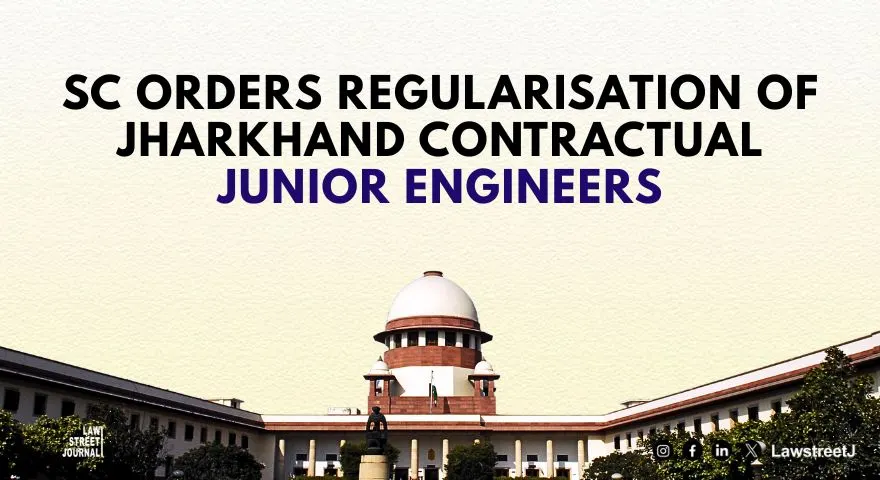
New Delhi: The Supreme Court has directed the State of Jharkhand to regularise the services of contractual Junior Engineers who had been working on sanctioned posts for more than ten years, holding that the State’s refusal to do so was arbitrary and violative of Article 14 of the Constitution.
A Bench comprising Justice Vikram Nath and Justice Sandeep Mehta set aside a series of judgments passed by the Jharkhand High Court which had declined relief to the employees on the ground that their appointments were purely contractual and governed by express terms barring regularisation.
The appeals were filed by three Junior Engineers, including Bhola Nath, who were appointed in 2012 pursuant to a public advertisement issued for 22 sanctioned posts of Junior Engineer (Agriculture) in the Soil Conservation Department of the State. Although the advertisement described the engagement as contractual and temporary, the appellants were selected through a prescribed recruitment process and continued in service through repeated extensions for over a decade.
During this period, the engineers were subjected to transfers, postings, and service conditions similar to those applicable to regular employees. Their performance was consistently found satisfactory, and recommendations for regularisation were also forwarded by departmental authorities. However, in 2023, the State declined to grant any further extension and refused to consider their claims for regularisation.
Aggrieved, the appellants approached the Jharkhand High Court seeking a writ of mandamus for regularisation. The writ petitions were dismissed by a Single Judge, and the dismissal was upheld by the Division Bench in intra-court appeals. The High Court held that the appellants had no enforceable right to seek regularisation in view of the contractual terms of appointment.
Reversing these findings, the Supreme Court held that the High Court had failed to examine the dispute in its proper constitutional context and had mechanically relied on contractual clauses without considering the State’s obligation to act as a model employer.
The Court observed that fundamental rights, including the guarantee of equality under Article 14, are incapable of waiver by contract. Merely because the appellants had accepted contractual terms barring regularisation, the State could not rely on such clauses to justify arbitrary action. The Court held that contractual stipulations cannot override constitutional guarantees or immunise the State from judicial scrutiny.
Placing reliance on precedents such as Central Inland Water Transport Corporation v. Brojo Nath Ganguly and Pani Ram v. Union of India, the Court emphasised the unequal bargaining power between the State and contractual employees. It noted that job seekers often have no meaningful choice but to accept onerous conditions imposed by the State in order to secure livelihood, and such contracts cannot be treated on par with agreements between equal parties.
The Court also examined the doctrine of legitimate expectation and held that continuous engagement for over a decade, coupled with repeated extensions and acknowledgment of satisfactory performance, gives rise to a reasonable expectation that the State would recognise long service. The abrupt discontinuation of engagement without cogent reasons was found to be arbitrary and unfair.
Distinguishing the Constitution Bench decision in State of Karnataka v. Umadevi, the Court clarified that the bar on regularisation does not apply in cases where appointments were made against sanctioned posts following a due process of selection. The appellants’ appointments were held to be, at best, irregular and not illegal, making them amenable to regularisation.
The Supreme Court strongly deprecated the practice of keeping employees on perpetual contractual arrangements despite their services being integral to the functioning of the department. It held that the State cannot exploit contractual nomenclature to continue ad hocism for years and then discard employees when they become inconvenient.
Holding that the action of the State was manifestly arbitrary and violative of Article 14, the Court directed the State of Jharkhand to forthwith regularise the services of all the appellants against the sanctioned posts to which they were initially appointed, with all consequential service benefits accruing from the date of the judgment.
Case Details
- Case Title: Bhola Nath v. State of Jharkhand and Others
- Court: Supreme Court of India
- Citation: 2026 INSC 99
- Bench: Justice Vikram Nath and Justice Sandeep Mehta
- Civil Appeals: Arising out of SLP (Civil) Nos. 30762 of 2024, 28352 of 2024 and 3430 of 2025
- Date of Judgment: 30 January 2026
Appearances:
For the Petitioners:
Mr. Kumar Shivam, AOR; Mr. Pradeep Kumar Tripathi, Advocate; Mr. K. Parameshwar, Senior Advocate; Mr. Saurabh Mishra, Senior Advocate; Mr. Gaurav Prakash Pathak, Advocate; Ms. Anushka, Advocate; Mr. Nishant Kumar, AOR
For the Respondents:
Ms. Ruchira Gupta, Advocate; Mr. Jayant Mohan, AOR; Mr. Karma Dorjee, Advocate; Ms. Adya Shree Dutta, Advocate; Ms. Pooja Tripathi, Advocate; Mr. Mohtisham Ali, Advocate; Mr. Dorjee Ongmu Lachunga, Advocate; Mr. Mangaljit Mukherjee, Advocate; Mr. Anil Kumar, Advocate; Mr. Manoneet Dwivedi, Advocate; Mr. Prakash Kumarmangalam, Advocate; Mr. Abhishek Kumar Gupta, Advocate; Mr. Shantanu Sagar, AOR