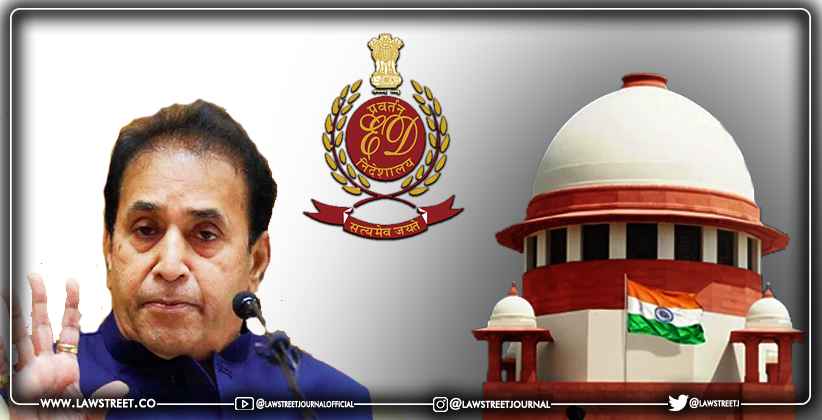
The Supreme Court of India, would set a hearing schedule and then rule on several questions pertaining to the Enforcement Directorate's authority to conduct investigations, issue summonses, arrest, investigate, and seize evidence.
Approximately 200 petitions regarding the interpretation of the Prevention of Money Laundering Act (PMLA) and the scope of the Enforcement Directorate's (ED) powers are outstanding.
Because the legal interpretation of the PMLA, Companies Act, and Customs Act is in doubt in such instances, all trials and investigations in a number of high-profile cases have been halted until, the court rules on these problems. Some of these petitions date back to 2014.
The outcome of this case will have ramifications for the ED, DRI, Customs, and all other agencies that aren't classified as police agencies.
NOTABLE CASES UP FOR REVIEW
Karti Chidambaram's INX media inquiry, corruption accusations involving former Akali minister Sarwan Phillaur and his son, the e-Tender scandal in Madhya Pradesh, money laundering charges against diamond dealer Ritesh Jain, and other businesses are among the cases before the Supreme Court.
The current controversy over extortion and money laundering accusations against former Maharashtra home minister Anil Deshmukh, who had challenged the ED's summons in the Supreme Court, is also included in the slew of cases.
The special bench comprising Justices AM Khanwilkar, Krishna Murari, and V Ramasubramaniam took notice of a number of concerns presented in these instances during a comprehensive hearing on July 26 (Monday).
On July 30(Friday), a special bench of the Supreme Court will hear various pleas seeking urgent decisions, including Anil Deshmukh's appeal against his ED summoning and Karti Chidambaram's request to release Rs 10 crore placed as security while travelling overseas.
14 KEY LEGAL ISSUES RAISED
From August 3, the main subject including legal concerns will be addressed. On July 26 (Monday), the bench also invited the attorneys involved in the case to meet and discuss the concerns that should be examined.
Multiple groups in the case are anticipated to be represented by a slew of top attorneys, including Solicitor General Kapil Sibal, Mahesh Jethmalani, Shyam Divan, Siddharth Lutra, AM Singhvi, and others.
Following Monday's (July 26) session, Solicitor General Tushar Mehta proposed 14 legal problems to be resolved under the PMLA, including the definition of crime, inquiry, evidence, arrests, and warrantless searches and seizuer.
Mehta additionally told the court that 82 of the cases included people facing charges under the PMLA, while 17 were under the Companies Act, 2013 and 27 were under the Customs Act, 2013.
Senior lawyers representing several petitioners have also proposed certain issues that may be discussed during the August 3 hearing on the topic.
The Solicitor General has concentrated on the legal aspects of the PMLA:
- Is the action under PMLA a cognizable or non-cognizable offence, especially in light of the 2019 explanation?
- Is it necessary to follow the procedure outlined in the sections of Chapter 12 of the Criminal Procedure Code 1973 while beginning and pursuing an investigation under the Prevention of Money Laundering Act, 2002?
- If section 45 of the PMLA, as modified, unconstitutional since it imposes two requirements for the issuance of bail? Is it true that the change eliminates the foundation of the 2018 ruling and reinstates the twin bail conditions?
- If the twin criteria are reinstated, is the 2018 ruling, which ruled that the twin conditions would apply to anticipatory bail, still the correct legal proposition?
- If the clauses of the PMLA governing the burden of proof infringe on the accused's basic rights?
- What does the crime under Section 3 of the PMLA entail? Is it allowed to broaden the definition of the crime under Section 3 by adding an explanation to Section 3 of the PMLA (introduced by amendment in 2019)?
- Is it necessary to file a chargesheet/complaint/FIR in the predicate offence before using the power of arrest under the PMLA? In the scope of section 3 read with section 2(u) of the PMLA, may money laundering not be considered a stand-alone offence?
- If court proceedings should rely on the statement recorded by employees of the Enforcement Directorate during the inquiry violates article 20(3) of the Constitution and is unacceptable under Section 25 of the Evidence Act?
- Whether PMLA's provisions addressing property attachment infringe the Article 300A's right to property.
- Is it possible to use the PMLA to prosecute conduct that happened before the crime was added to the Act's Schedule?
- Is it possible for a Writ Court to issue a blanket "no coercive actions" order without any factual basis being claimed or investigated just because the constitutional legitimacy of some sections has been questioned?
- If the search and seizure provisions of Sections 17 and 18 of the PMLA, as modified, are unconstitutional and void?
- Whether the arrested authority granted by Section 19 of the PMLA in violation of Articles 14 and 21 of the Constitution?
- Is it possible to continue the money laundering offence after the predicate offence has occurred? Is it possible to commit money laundering even though the predicate or planned offence was not planned at the time the planned crime took place?