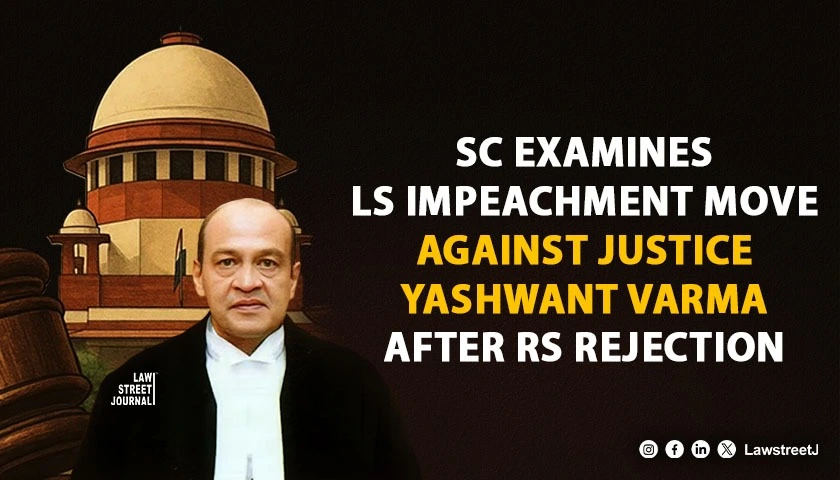
New Delhi: The Supreme Court of India has raised important constitutional and statutory questions on whether the Lok Sabha can continue with impeachment proceedings against Allahabad High Court judge Justice Yashwant Varma even if the Rajya Sabha has rejected a similar motion. The issue arose while the Court was hearing a challenge to the constitution of a three-member inquiry committee formed to probe allegations against Justice Varma.
The matter was heard by a Bench comprising Justice Dipankar Datta and Justice Satish Chandra Sharma. The proceedings stem from a writ petition filed by Justice Varma questioning the legality of the inquiry committee constituted by the Speaker of the Lok Sabha under the Judges (Inquiry) Act, 1968.
Justice Varma has assailed the constitution of the committee on the ground that impeachment motions were moved in both Houses of Parliament on the same day, and while the Lok Sabha Speaker proceeded to constitute the inquiry committee, the Rajya Sabha, through its Deputy Chairman, rejected the motion. According to the petitioner, once the Rajya Sabha declined to admit the motion, the Lok Sabha could not have proceeded further, and the constitution of the inquiry committee was therefore contrary to law.
Senior Advocate Mukul Rohatgi, appearing for Justice Varma, argued that the proviso to Section 3(2) of the Judges (Inquiry) Act mandates that an inquiry committee can be constituted only if the motion is admitted in both Houses. He submitted that rejection of the motion by one House defeats the proceedings in the other, and that the Speaker acted in excess of jurisdiction by constituting the committee despite the Rajya Sabha’s decision. It was further contended that the Deputy Chairman of the Rajya Sabha had no authority to reject a motion that was allegedly admitted by the Chairman.
The Supreme Court, however, expressed reservations about this interpretation. Justice Datta observed that the proviso appears to bar only the constitution of a joint committee unless both Houses admit the motion, but does not expressly prohibit one House from proceeding independently if the other rejects the motion. The Bench questioned whether rejection of a motion in one House automatically nullifies a motion admitted in the other, noting that the statute does not contain an explicit bar to such a course.
The Court also considered submissions by the Solicitor General, appearing for the Lok Sabha Secretariat, who maintained that the Rajya Sabha motion was never admitted and that the Deputy Chairman acted within his authority in rejecting it. It was submitted that the Lok Sabha Speaker was therefore competent to admit the motion placed before her and to constitute the inquiry committee in accordance with the statutory scheme.
During the hearing, the Bench indicated that there appeared to be some infirmity in the manner in which the inquiry committee was constituted, particularly in relation to the absence of coordination between the two presiding officers of Parliament. At the same time, the Court clarified that it was not examining the merits of the allegations against Justice Varma, but was confined to the legality of the procedure adopted under the Judges (Inquiry) Act and the constitutional framework governing the removal of judges.
The Supreme Court observed that the matter raises serious questions touching upon parliamentary procedure, judicial accountability, and the safeguards provided to members of the higher judiciary under the Constitution. The Court indicated that it would further examine whether the procedural irregularities, if any, were grave enough to warrant judicial interference with ongoing parliamentary proceedings.
The case has been adjourned for further hearing, with the Supreme Court set to continue its examination of whether the impeachment process initiated in the Lok Sabha can legally proceed in the absence of concurrence from the Rajya Sabha.
Case Details:
Case Title: Justice Yashwant Varma v. Office of the Speaker of the House of the People & Ors.
Court: Supreme Court of India
Bench: Justice Dipankar Datta and Justice Satish Chandra Sharma
Date of Hearing: 7 January 2026
Advocates Appearing:
For the Petitioner: Mukul Rohatgi, Senior Advocate
For the Respondents (Lok Sabha Secretariat / Union of India): Tushar Mehta, Solicitor General of India