38.6c New Delhi, India, Sunday, December 14, 2025
Top Stories Supreme Court
Political NEWS Legislative Corner Celebstreet International Videos
Subscribe Contact Us
close
Judiciary

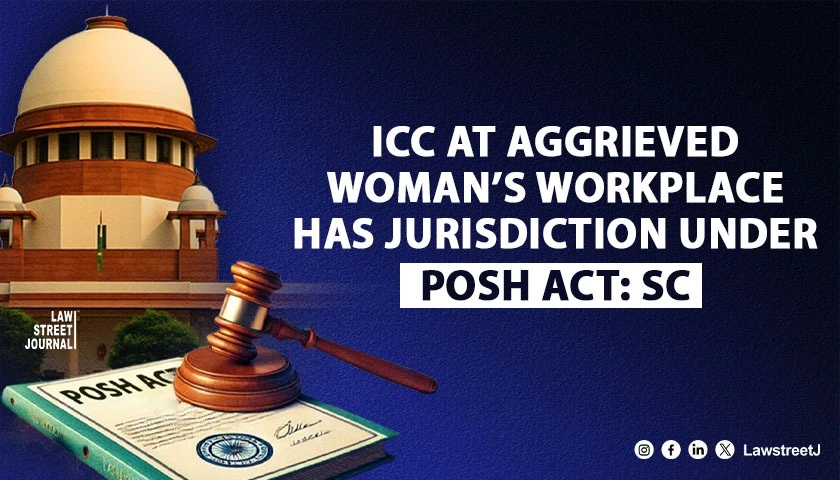
SC Expands Ambit of POSH Act: “Restrictive Interpretation Would Undermine Remedial Intent” [Read Judgment]

By Samriddhi Ojha      13 December, 2025 07:13 PM      0 Comments
SC Expands Ambit of POSH Act Restrictive Interpretation Would Undermine Remedial Intent

New Delhi: In a landmark ruling, the Supreme Court of India, on December 10, 2025, delivered a comprehensive judgment in Dr. Sohail Malik v. Union of India & Anr., definitively settling a crucial jurisdictional issue under the Sexual Harassment of Women at Workplace (Prevention, Prohibition and Redressal) Act, 2013 (POSH Act). The Court dismissed a civil appeal filed by Dr. Sohail Malik, an IRS officer, thereby affirming that the Internal Complaints Committee (ICC) constituted at the workplace of an aggrieved woman is competent to entertain and inquire into a sexual harassment complaint against a respondent who is an employee of a separate government department.

The jurisdictional challenge arose from a complaint filed by a 2004-batch Indian Administrative Service (IAS) officer, posted as Joint Secretary, Department of Food and Public Distribution, New Delhi. She alleged that Dr. Sohail Malik, a 2010-batch IRS officer posted as OSD (Investigation), Central Board of Direct Taxes, sexually harassed her at her workplace in Krishi Bhawan on May 15, 2023. The aggrieved woman lodged a complaint with the ICC of her own department. Dr. Malik contested this, arguing that only the ICC constituted by his employer—the Department of Revenue—had jurisdiction to proceed against him, primarily relying on his interpretation of Section 11 of the POSH Act.

The appellant’s contention was that the phrase “where the respondent is an employee” in Section 11(1) of the POSH Act mandates the inquiry to be conducted by the ICC at the respondent’s workplace. The Supreme Court, however, rejected this argument, stating that such a “restrictive interpretation of the POSH Act would run contrary to the scheme of the Act, specifically in light of the all-encompassing and wide definition given to the term ‘workplace’ in Section 2(o) of the POSH Act.” The Court emphasized that the POSH Act is a “social welfare legislation” intended to enforce a woman’s right to a safe environment free from sexual harassment under Article 21 of the Constitution.

Justice J.K. Maheshwari, authoring the judgment, clarified the meaning of the crucial word “where” in Section 11(1), holding that the word “is quite clearly used in the context of a situation rather than a place.” It was deemed a “procedural trigger, directing the ICC to apply the service rules applicable to the ‘respondent’; it is not a jurisdictional constraint limiting a particular ICC from hearing the complaint.” The Court further noted that the narrow interpretation advocated by Dr. Malik “would undermine the POSH Act’s remedial social welfare intent, as it would create significant practical hurdles for the aggrieved woman.”

The judgment also provided clarity on the procedural mechanism for inter-departmental complaints, particularly for Central Government employees. The Court recognised the two-stage inquiry process outlined in the Government of India’s Office Memorandum dated July 16, 2015. The ICC constituted at the aggrieved woman’s workplace is competent to conduct the first stage, which is the “preliminary/fact-finding inquiry.” Upon submission of the inquiry report and recommendations to the respondent’s employer, the employer—acting as the Disciplinary Authority—will decide whether disciplinary proceedings are warranted.

Addressing the initiation of disciplinary action, the Court observed:
“Upon receiving the findings and recommendations of the ICC constituted at the aggrieved woman’s workplace, the employer of the ‘respondent’, being the Disciplinary Authority, upon deciding that disciplinary proceedings are warranted, may issue a charge-sheet to the ‘respondent’ and initiate disciplinary proceedings against him.”
In the event of formal disciplinary proceedings, the Court explained that the ICC constituted at the respondent’s department would then act as the inquiring authority at the second stage, thereby harmonising the POSH Act with the Central Civil Services (Classification, Control and Appeal) Rules, 1965.

The judgment concluded by directing that the report of the ICC “shall be transmitted to the Department of the appellant forthwith, which shall take further action as necessary under the POSH Act, following the procedure prescribed in the relevant service rules.” The appeal was dismissed, and all pending applications were disposed of.

[Read Judgment]


Share this article:

About:

Samriddhi is a legal scholar currently pursuing her LL.M. in Constitutional Law at the National Law ...Read more


Leave a feedback about this
Related Posts
View All

Another CBI Officer Investigating Rakesh Asthana Moves SC Against Transfer, Makes Startling Revelations Another CBI Officer Investigating Rakesh Asthana Moves SC Against Transfer, Makes Startling Revelations

After A.K. Bassi, another CBI officer who was investigating corruption allegations against Special Director Rakesh Asthana moved the Supreme Court.

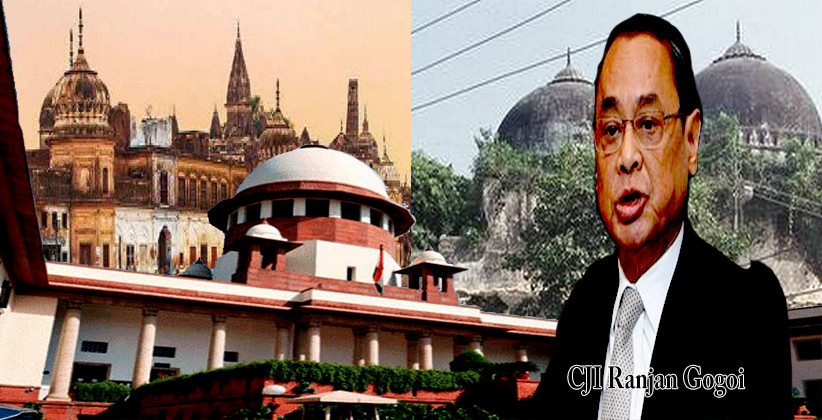
Ayodhya verdict: SC rules in favour of Ram Lalla, Sunni Waqf Board gets alternate land Ayodhya verdict: SC rules in favour of Ram Lalla, Sunni Waqf Board gets alternate land

SC bench led by CJI Ranjan Gogoi has allotted the dispute site to Ram Janmabhoomi Nyas, while directing the government to allot an alternate 5 acre land within Ayodhya to Sunni Waqf Board to build a mosque.

Supreme Court: Money Spent On Judiciary Less Than 1% In All States Except Delhi Supreme Court: Money Spent On Judiciary Less Than 1% In All States Except Delhi

The court guided all states to document their response to the commission's report within four weeks. If any of the states fail to file a response, it will be presumed that they have no objections to the recommendations made by the commission, the court said.

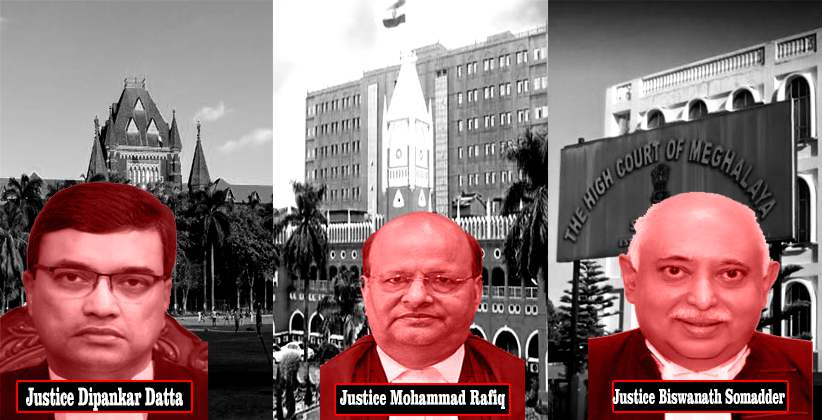
Supreme Court Top Panel Names Chief Justices for Bombay, Orissa and Meghalaya High Courts Supreme Court Top Panel Names Chief Justices for Bombay, Orissa and Meghalaya High Courts

On April 18, 2020, the Supreme Court Collegium recommended new Chief Justices for three High Courts. Justice Dipankar Datta was proposed as Chief Justice of the Bombay High Court, succeeding Justice B.P. Dharmadhikari. Justice Biswanath Somadder was nominated as Chief Justice of Meghalaya High Court, while Justice Mohammad Rafiq was recommended for transfer as Chief Justice of Orissa High Court.

TRENDING NEWS

sc-orders-aiims-to-form-secondary-medical-board-to-evaluate-passive-euthanasia-for-man-in-vegetative-state-for-13-years
Trending Judiciary
SC Orders AIIMS to Form Secondary Medical Board to Evaluate Passive Euthanasia for Man in Vegetative State for 13 Years [Read Order]

Supreme Court directs AIIMS to form a Secondary Medical Board to assess passive euthanasia for a man in a vegetative state for 13 years.

13 December, 2025 06:00 PM
endless-compassion-not-permissible-sc-bars-claims-for-higher-post-after-compassionate-appointment
Trending Judiciary
‘Endless Compassion Not Permissible’: SC Bars Claims for Higher Post After Compassionate Appointment [Read Judgment]

Supreme Court rules that employees cannot seek higher posts after accepting compassionate appointment, calling such claims “endless compassion.”

13 December, 2025 06:54 PM

TOP STORIES

sc-questions-precedent-on-contractual-bars-to-arbitration-claims-refers-bharat-drilling-to-larger-bench
Trending Judiciary
SC Questions Precedent on Contractual Bars to Arbitration Claims, Refers ‘Bharat Drilling’ to Larger Bench [Read Judgment]

Supreme Court refers the 2009 Bharat Drilling ruling to a larger bench, questioning its use in interpreting contractual bars on arbitration claims.

08 December, 2025 04:45 PM
j-and-k-high-court-upholds-dismissal-of-injunction-plea-in-agrarian-reforms-dispute
Trending Judiciary
J&K High Court Upholds Dismissal of Injunction Plea in Agrarian Reforms Dispute [Read Order]

J&K High Court upholds dismissal of injunction plea, ruling that agrarian disputes fall under Agrarian Reforms Act authorities, not civil courts.

08 December, 2025 05:21 PM
sc-declines-urgent-relief-in-indigo-flight-cancellation-crisis-says-centre-dgca-already-acting
Trending Judiciary
SC Declines Urgent Relief in IndiGo Flight Cancellation Crisis, Says Centre, DGCA Already Acting

Supreme Court declines urgent intervention in the IndiGo flight-cancellation crisis, noting Centre and DGCA actions under the CAR 2024 framework.

08 December, 2025 05:29 PM
sc-rules-temple-funds-belong-to-the-deity-cannot-be-diverted-to-rescue-cooperative-banks
Trending Judiciary
SC Rules Temple Funds “Belong to the Deity”, Cannot Be Diverted to Rescue Cooperative Banks

Supreme Court rules temple funds belong to the deity and cannot be used to rescue weak cooperative banks; directs return of deposits to Thirunelly Devaswom.

08 December, 2025 05:36 PM

ADVERTISEMENT


Join Group

Signup for Our Newsletter

Get Exclusive access to members only content by email