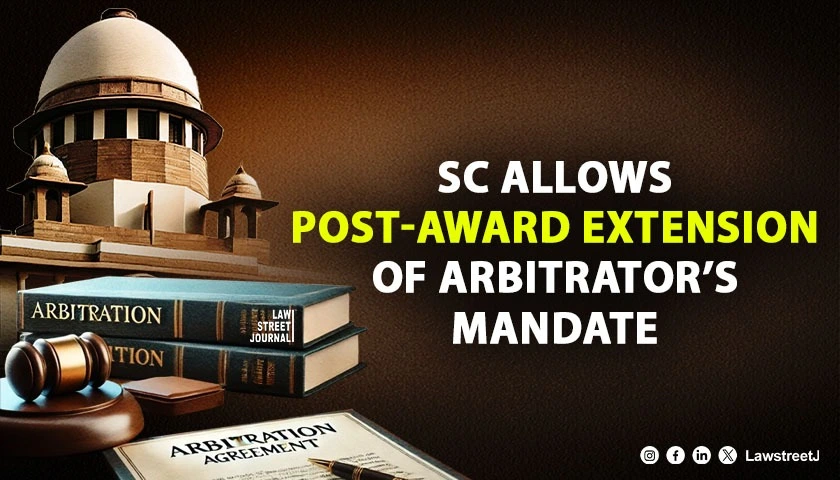
New Delhi: The Supreme Court of India has authoritatively settled a long-standing controversy surrounding timelines in arbitral proceedings by holding that courts are empowered to extend the mandate of an arbitrator under Section 29A of the Arbitration and Conciliation Act, 1996, even after an arbitral award has been rendered, provided the award was delivered after the expiry of the statutory time limit. The Court clarified that such an award is unenforceable, but the jurisdiction of the court to consider an application for extension is not extinguished by the arbitrator’s act of delivering a delayed award.
The ruling was delivered in an appeal arising from proceedings between C. Velusamy and K. Indhera, where the Madras High Court had taken the view that once an award is passed after the expiry of the arbitrator’s mandate, the award is a nullity and the court lacks the power to revive or extend the mandate. The Supreme Court overturned this view, restoring the application for extension of mandate and laying down detailed principles governing Section 29A.
The dispute arose out of three agreements to sell between the parties. After disputes emerged, a sole arbitrator was appointed by the High Court in April 2022. Pleadings were completed in August 2022, triggering the twelve-month statutory period for making the award under Section 29A(1). With the consent of the parties, the mandate was extended by six months under Section 29A(3), taking the outer limit to February 20, 2024. Although arguments were concluded and the matter was reserved, settlement talks continued intermittently. The arbitrator eventually passed the award on May 11, 2024, after the mandate had expired.
The respondent challenged the award under Section 34 on the ground that the arbitral mandate had already terminated. The appellant, on the other hand, filed an application under Section 29A(5) seeking extension of the arbitrator’s mandate. The Madras High Court dismissed the extension application as not maintainable and allowed the Section 34 challenge, holding that an award passed after the expiry of the mandate was void and incapable of being cured.
Allowing the appeal, the Supreme Court examined the legislative history of arbitration law in India, including the Arbitration Act of 1940, the Arbitration and Conciliation Act of 1996, and the amendments introducing Section 29A. The Court noted that Section 29A was introduced to curb delays in arbitration and ensure the timely completion of proceedings, not to abort arbitrations on technical grounds after substantial progress had been made.
The Bench explained that while Section 29A(4) provides that the mandate of the arbitrator terminates if the award is not made within the stipulated time, such termination is not absolute. The statute expressly empowers the court to extend the mandate either before or after the expiry of the prescribed period. The Court emphasised that the power of extension vests in the court and is independent of the arbitrator’s conduct.
Crucially, the Supreme Court held that an award rendered after the expiry of the mandate does not acquire the status of an enforceable decree under Section 36. However, such an award does not deprive the court of its jurisdiction to entertain an application for extension of the mandate. The arbitrator’s unilateral act of delivering a delayed award cannot defeat the statutory powers of the court.
The judgment also approved earlier observations in Rohan Builders, clarifying that termination of mandate under Section 29A is transitory and subject to judicial intervention. The Court rejected the view that Section 29A contains an implied bar against post-award extensions. It held that if Parliament intended such a bar, it would have been expressly stated.
The Court undertook an extensive comparative analysis, referring to international practices under English law and other jurisdictions, to highlight that courts often retain the power to retrospectively extend time limits to prevent arbitration from failing due to procedural delays. The judgment stressed that rigid adherence to timelines should not frustrate the objective of arbitration as an effective dispute resolution mechanism.
Summarising the legal position, the Supreme Court laid down that delay in the delivery of an arbitral award, by itself, is not a ground to set aside the award unless such delay demonstrably affects the merits. It further clarified that courts, while extending the mandate, may impose costs, reduce arbitrators’ fees, or even substitute arbitrators if circumstances warrant, thereby ensuring discipline and integrity in arbitral proceedings.
The ruling is significant for arbitration practice in India, as it strikes a balance between enforcing statutory timelines and preserving the substantive progress of arbitral proceedings. By affirming the supervisory role of courts under Section 29A, the Supreme Court has ensured that arbitration remains expeditious without becoming hostage to procedural technicalities.
Case Details:
- Case Name: C. Velusamy v. K. Indhera
- Citation: 2026 INSC 112
- Court: Supreme Court of India
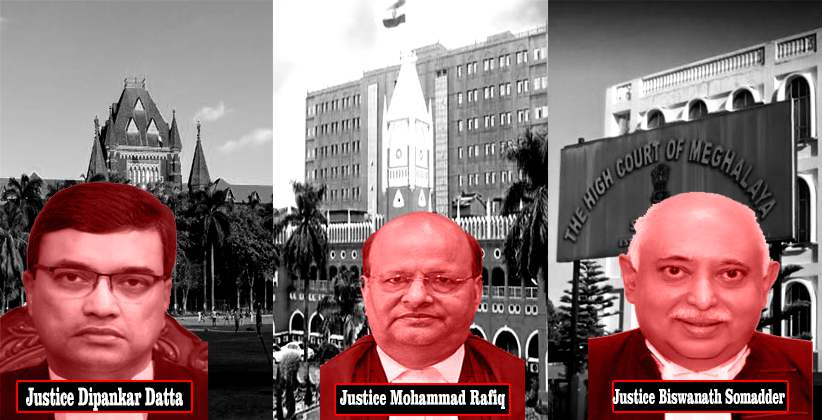
- Bench: Justice Pamidighantam Sri Narasimha and Justice Atul S. Chandurkar
- Date of Judgment: 3 February 2026