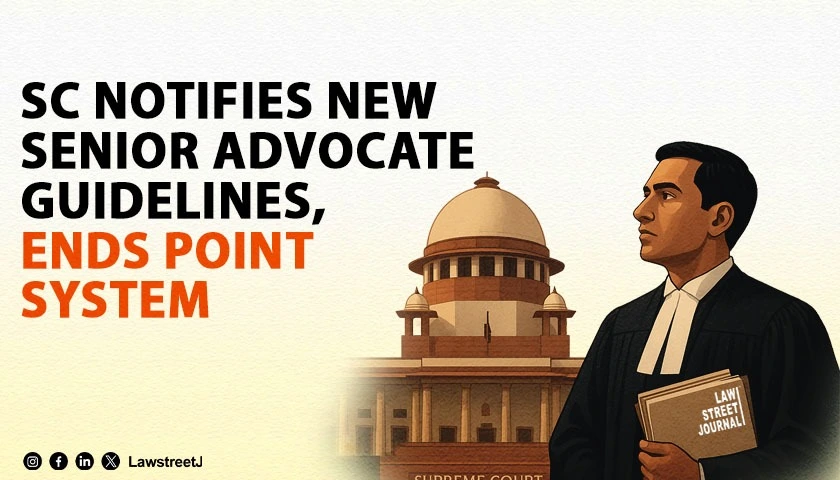
New Delhi: The Supreme Court has notified the Guidelines for Designation of Senior Advocates, 2026, replacing the 2023 framework and significantly overhauling the process for the conferment of the Senior Advocate designation. The new guidelines were approved in a Full Court meeting and issued pursuant to the Supreme Court’s judgment in Jitender @ Kalla v. State (Govt. of NCT of Delhi), wherein the Court had expressed reservations about the existing point-based assessment system.
The 2026 Guidelines do away with the earlier structured point system and the interview component that formed part of the designation process under the 2017 and 2023 regimes. Under the previous framework, candidates were evaluated on quantified criteria, including reported judgments, publications, teaching assignments, and personal interaction. The Court had observed that the numerical evaluation model had become unworkable and required reconsideration to ensure fairness, transparency, and institutional credibility.
Under the revised scheme, the process will be overseen by a Permanent Committee for the Designation of Senior Advocates, headed by the Chief Justice of India and comprising the two senior-most Judges of the Supreme Court. The Committee will scrutinise applications and place its recommendations before the Full Court for final consideration.
Eligibility under the new guidelines requires an advocate to have a minimum of ten years’ standing at the Bar. The advocate must ordinarily be at least 45 years of age, though the Full Court retains the discretion to relax this requirement in appropriate cases. The applicant should be mainly practising before the Supreme Court, though advocates with specialised practice before tribunals or other constitutional courts may also be considered.
Applications will be invited annually by the Secretariat, following which proposals will be published on the Supreme Court’s website to invite suggestions from stakeholders. The Committee will assess candidates based on broad qualitative criteria such as ability, standing at the Bar, special knowledge or expertise in law, integrity, and overall contribution to the legal profession.
The Guidelines also empower the Full Court to designate an advocate even without a formal application, subject to the advocate’s consent. Further, provision has been made for the recall of designation in cases where subsequent conduct warrants such action.
The designation of Senior Advocate under Section 16(2) of the Advocates Act, 1961, remains a recognition of exceptional legal ability, professional standing, and ethical standards. The 2026 framework signals a return to a more holistic and deliberative evaluation model in place of the earlier quantified scoring mechanism.
Key Highlights
- Guidelines Notified: February 11, 2026
- Framework Replaced: 2023 Guidelines
- Point System: Abolished
- Interview Process: Discontinued
- Oversight Body: Permanent Committee headed by the CJI and two senior-most Judges
- Minimum Standing: 10 years at the Bar
- Ordinary Age Requirement: 45 years (relaxable by Full Court)
- Practice Requirement: Primarily before the Supreme Court (with flexibility for specialised practitioners)
- Evaluation Criteria: Ability, standing at the Bar, expertise, integrity, and professional contribution
- Additional Power: Full Court may designate suo motu and may recall designation in appropriate cases