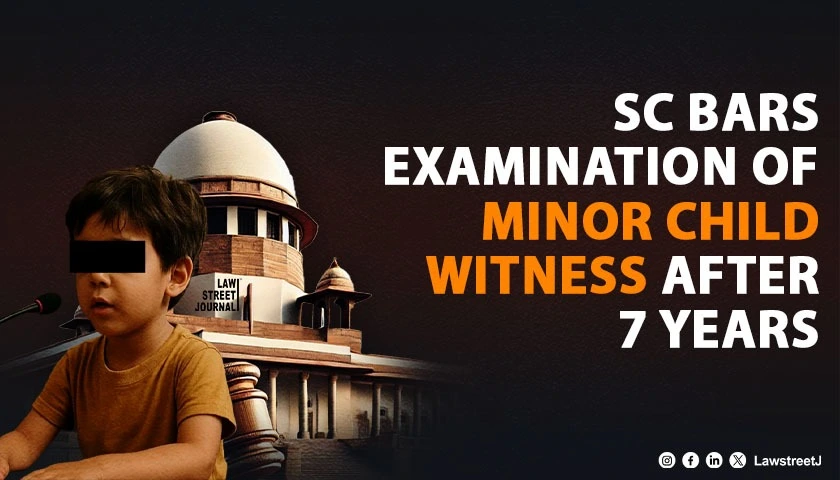
New Delhi: The Supreme Court of India, on December 19, 2025, allowed the appeals of Mayankkumar Natwarlal and another, setting aside a common judgment of the High Court of Gujarat that had permitted the prosecution to examine the minor daughter, Aashvi, as a witness in a 2018 Sessions Case. The Bench of Justice Vikram Nath and Justice Augustine George Masih restored the order of the Trial Court, which had earlier rejected the application under Section 311 of the Code of Criminal Procedure, 1973 (CrPC).
The case stems from an FIR registered in December 2017 following the suicide of the appellant’s wife on November 5, 2017. Charges were framed under Sections 498A, 306, 323, 504, 506(2), and 114 of the Indian Penal Code, and Sections 3 and 7 of the Dowry Prohibition Act. The deceased’s daughter, Aashvi, was approximately four years and nine months old at the time of the incident.
The controversy arose when, after the examination of 21 prosecution witnesses and at an advanced stage of the trial in September 2023, the respondents (complainant/father of the deceased) filed an application under Section 311 CrPC seeking to examine the minor child. The Trial Court rejected the plea, noting that neither the FIR nor the investigation statements had ever mentioned the child’s presence at the time of the incident. However, the High Court intervened, allowing the examination on the basis that the child “could be treated as a material witness, and possibly an eyewitness, having regard to Section 118 of the Indian Evidence Act, 1872.”
The Supreme Court, however, found the High Court’s interference unwarranted. In its judgment dated December 19, 2025, the Court stated: “The respondents have failed to establish that examination of the minor witness, at this belated stage, is essential for the just decision of the case.”
The Court outlined several reasons for setting aside the High Court’s judgment. First, it held that “there is no material on record to substantiate the claim that the minor child was present at the time of the incident. The FIR, statements recorded during investigation, and the testimony of the complainant do not disclose such presence.” The Court described the assumption that the child was an eyewitness as “speculative.”
Second, addressing the reliability of the proposed testimony, the Court observed that “the child was of a very tender age at the time of the incident. More than seven years have elapsed since then. Memory at such a young age is vulnerable to distortion and external influence.” Further, noting that the child had been residing with her maternal grandparents since the incident, the Court emphasized that this “raises a reasonable apprehension of tutoring, which significantly affects the reliability and evidentiary value of her proposed testimony.”
Finally, the Bench noted the timing of the application, observing that “the application under Section 311 CrPC was filed after the examination of 21 prosecution witnesses and at an advanced stage of the trial.” While acknowledging the wide power under Section 311, the Court reiterated that “it is to be exercised sparingly and only when the evidence sought is indispensable for arriving at the truth. The present case does not satisfy this requirement. Allowing the examination of the child witness would only protract the trial and cause prejudice to the accused.”
Concluding the matter, the Supreme Court held that the High Court had “committed an error in law in setting aside the order of the Trial Court and permitting the examination of the minor witness.” The appeals were allowed, and the order of the learned Sessions Judge dated March 30, 2024, in Sessions Case No. 22 of 2018 was restored, directing the Trial Court to proceed with the trial in accordance with law.
Case Details
Case Title: Mayankkumar Natwarlal Kankana Patel & Anr. v. State of Gujarat & Anr.
Citation: 2025 INSC 1475
Court: Supreme Court of India
Bench: Justice Vikram Nath and Justice Augustine George Masih
Date of Judgment: December 19, 2025
Appearing for Appellants: Mr. Mayank Kshirsagar, learned counsel
Appearing for Respondent No. 2 (Complainant): Mr. Pradhuman Gohil, learned counsel
Appearing for Respondent-State: Ms. Swati Ghildiyal, learned counsel