


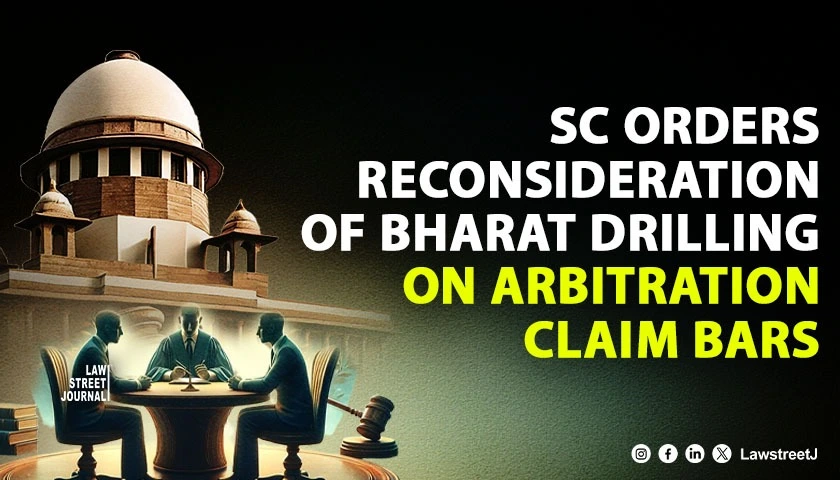
New Delhi: The Supreme Court of India has referred its 2009 decision in Bharat Drilling & Foundation Treatment Pvt. Ltd. v. State of Jharkhand and Ors to a larger bench for authoritative reconsideration, expressing serious concern over the frequent and incorrect application of that precedent while interpreting prohibitory claim clauses in Government contracts. The ruling, delivered on December 05, 2025, in The State of Jharkhand v. The Indian Builders Jamshedpur (Civil Appeal Nos. 8261–8262 of 2012), arises from a dispute concerning the scope of an Arbitral Tribunal’s power to award claims expressly barred under the contract.
The State of Jharkhand had appealed against a judgment of the High Court of Jharkhand, which allowed a Section 37 appeal under the Arbitration and Conciliation Act, 1996. The High Court had restored an arbitral award concerning Claims 3, 4, and 6, which had earlier been set aside by the Civil Court under Section 34. The Civil Court had held that these claims were specifically prohibited by the contractual agreement.
Mr. Rajiv Shankar Dwivedi, learned counsel for the Appellant–State of Jharkhand, argued that the High Court committed a serious error by relying solely on the Bharat Drilling precedent. He submitted that the decision is being “applied, regularly and wrongly, to interpret prohibitory claim clauses in all Government contracts.” According to the State, Claim 3 (underutilised overheads), Claim 4 (loss due to underutilised tools, plants, and machinery), and Claim 6 (loss of profit) were explicitly barred by Clauses 4.20.2 and 4.20.4 of the contract, which provide: “4.20.2: No claim for idle labour, idle machinery, etc. on any account will be entertained…” and “4.20.4: No claim shall be entertained for business loss or any such loss.”
The Supreme Court bench, comprising Justices Pamidighantam Sri Narasimha and Atul S. Chandurkar, agreed to examine the question of law due to the compelling need for clarity. The Court noted that the High Court had relied heavily on the 2009 judgment without independently evaluating the contractual clauses:
“When we peruse the judgment of the High Court under Section 37, we find that there is no discussion whatsoever as regards claim nos. 3, 4 and 6, except for reference and reliance on the order of this Court in Bharat Drilling (supra).”
The bench found it “quite evident” that the High Court had disposed of the appeal under the impression that the issue was conclusively covered by Bharat Drilling, without assessing the explicit contractual prohibitions.
The Court also observed that the central reasoning in Bharat Drilling—that a contractual bar applies only to the department and not to the Arbitral Tribunal—had relied on Board of Trustees for the Port of Calcutta v. Engineers-De-Space-Age, a case concerning interest pendente lite under Section 31(7) of the Act, which involves a distinct legal question.
Reinforcing the principle of party autonomy, the Court cited Central Organisation for Railway Electrification (CORE), noting:
“Party autonomy has been described by this Court as the ‘brooding and guiding spirit’ and ‘backbone’ of arbitrations.”
The bench emphasized that excepted or prohibitory clauses must be given effect based on the agreement between the parties, which is the primary guiding principle for an Arbitral Tribunal.
Clarifying the distinction between prohibited claims and the grant of interest, the Court held that the reasoning in Bharat Drilling, which relied on Port of Calcutta, is not appropriate for determining the enforceability of contractual bars. The Court further noted that the 2009 approach is inconsistent with more recent Supreme Court jurisprudence on arbitration law.
Concluding the analysis, the bench stated:
“In view of the above discussion and in order to ensure clarity and consistency, we are of the opinion that the ratio of Bharat Drilling requires to be reconsidered.”
The registry has been directed to place the matter before the Hon’ble Chief Justice for orders constituting a larger bench to settle the issue authoritatively.
Case Details
Case Title: The State of Jharkhand v. The Indian Builders Jamshedpur
Case Numbers: Civil Appeal Nos. 8261–8262 of 2012
Coram: Pamidighantam Sri Narasimha and Atul S. Chandurkar, JJ.
Date of Judgment: December 05, 2025
Advocates:
For Appellant (State of Jharkhand): Mr. Rajiv Shankar Dwivedi, learned counsel
For Respondent (The Indian Builders Jamshedpur): Mr. Manoj C. Mishra, learned counsel






Nasir Shah Dec 09, 2025
Nice explanation...https://legal4india.blogspot.com/?m=1