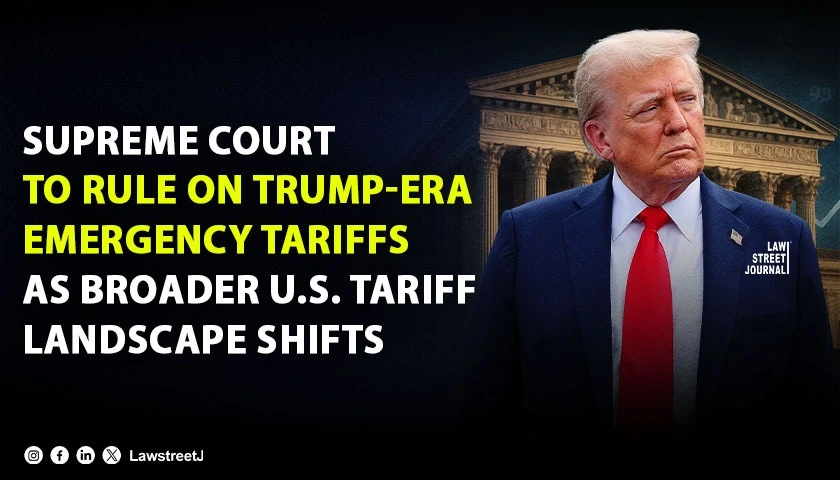
New Delhi: The Supreme Court of the United States has agreed to review a pivotal constitutional case testing the legality of tariffs imposed by the Trump administration under the International Emergency Economic Powers Act (IEEPA), a decision that could reshape U.S. trade policy at a time of sweeping tariff developments and shifting global trade relationships. The government’s petition for a writ of certiorari challenges a split en banc ruling by the U.S. Court of Appeals for the Federal Circuit, which determined that the administration exceeded its authority when it used IEEPA to impose broad and enduring tariffs on foreign imports.
The Supreme Court’s involvement comes amid a highly dynamic tariff environment in early 2026. According to international trade law advisers, the Trump administration’s use of IEEPA to levy “trafficking,” “reciprocal,” and country-specific tariffs targeting Canada, Mexico, China, India, and other nations has not only invited judicial scrutiny but also civil litigation by importers seeking duty refunds should the tariffs be invalidated. Nearly 2,000 protective refund cases have already been filed in the U.S. Court of International Trade, which has acknowledged jurisdiction to order refunds if the Supreme Court ultimately holds the IEEPA-based tariffs unlawful.
The immediate legal dispute before the Supreme Court concerns whether IEEPA authorises the President to impose such tariffs. The Federal Circuit majority held that while IEEPA allows the President to regulate importation during a declared emergency, it does not explicitly grant tariff-imposing authority and therefore cannot support broad fiscal measures without clear congressional authorisation. The court also applied the major questions doctrine, cautioning that allowing open-ended tariff authority would represent an improper delegation of core legislative power. This ruling has stayed the Federal Circuit’s mandate, leaving the controversial tariffs in force pending Supreme Court review.
In its petition, the government argues that IEEPA’s broad language was deliberately crafted to allow the President flexibility in responding to extraordinary threats from foreign actors, including through the regulation of imports via monetary instruments such as tariffs. It also warns that the lower court’s interpretation could hamper executive functions in foreign affairs and national security, traditionally areas in which courts grant substantial deference to the political branches.
The tariff case arrives in a context of intense trade policy activity. Beyond the IEEPA dispute, the Trump administration has deployed other statutory authorities to advance its tariff strategy. For instance, Section 232 of the Trade Expansion Act of 1962 continues to underpin tariffs on items such as advanced computing semiconductors at 25 percent, while Section 301 of the Trade Act of 1974 has been used to expand tariffs on Chinese goods over intellectual property concerns and to impose duties on Nicaraguan imports following a Section 301 investigation.
These non-IEEPA tariff strategies form part of a broader pattern of U.S. trade policy in early 2026. The United States and India, after a prolonged period of strained trade relations driven in part by punitive tariffs, have reached a trade agreement that reduces U.S. tariffs on Indian imports from 50 percent to 18 percent, in exchange for India ending its purchases of Russian oil and lowering barriers for U.S. goods.
Meanwhile, tensions with European nations have flickered, with threats of tariffs related to geopolitical disagreements, such as U.S. pressure in the Greenland crisis, highlighting the intersection of tariff policy and global diplomacy. At one point, threats targeted eight European countries with escalating tariffs unless they supported U.S. objectives, though some measures were later paused following negotiations.
The IEEPA case has also coincided with broader economic effects linked to tariff policy. Analysts reported that companies across the U.S. began raising prices at the start of 2026 in response to existing tariffs, a trend reinforced by Federal Reserve feedback showing increased business cost pressures. These price changes risk feeding into inflation dynamics, complicating the Federal Reserve’s goals of stabilising the economy.
At the same time, global trade trends reflect tariff-driven uncertainty. A recent global trade update noted that governments continued to increase tariffs in 2025, reshaping value chains and creating trade volatility that discourages investment and disrupts supply networks.
The Supreme Court’s decision in the IEEPA tariff case will therefore have ramifications far beyond the discrete question of statutory authority. If the Court upholds the Federal Circuit’s restrictions, a major tool in the administration’s trade arsenal could be curtailed, forcing greater reliance on more constrained executive trade authorities such as Sections 232 and 301. Such an outcome would also influence the ongoing litigation seeking refunds of duties already collected.
Given the Supreme Court’s docket and typical timing, a final decision is not expected until later in February or beyond, leaving observers to assess the broader implications for U.S. trade policy, international economic relations, and key industries affected by tariff fluctuations. In the meantime, trade lawyers and business stakeholders continue to monitor tariff developments and protective litigation strategies as enterprises adapt to an uncertain trade environment.
Case Details
- Case Name: Donald J. Trump, President of the United States & Ors. v. V.O.S. Selections, Inc. & Ors.
- Court: Supreme Court of the United States
- Nature of Proceedings: Petition for Writ of Certiorari
- Challenged Judgment: Decision of the U.S. Court of Appeals for the Federal Circuit (en banc)
- Statute Involved: International Emergency Economic Powers Act (IEEPA), 50 U.S.C. § 1701 et seq.
Key Issues:
- Whether IEEPA authorises the President to impose broad tariffs during a declared national emergency
- Whether such authority constitutes an unconstitutional delegation of legislative power
- Current Status: Supreme Court review pending; Federal Circuit’s mandate stayed pending decision