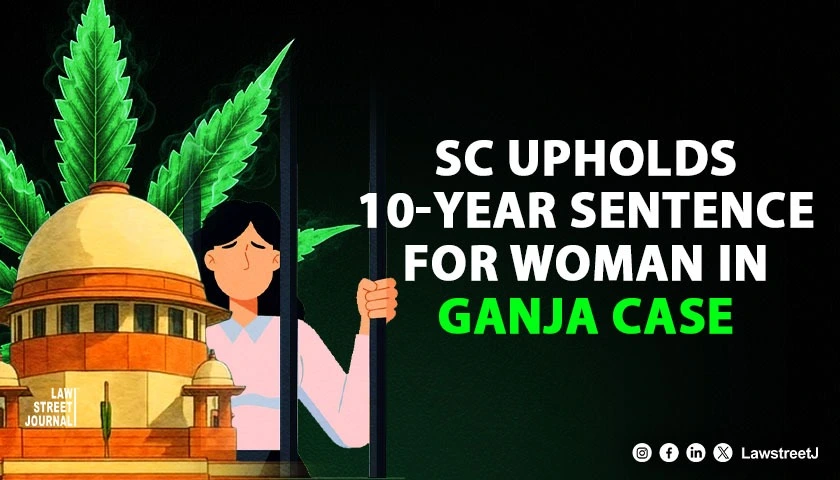
New Delhi: The Supreme Court of India, on December 11, 2025, dismissed the appeal filed by Jothi alias Nagajothi, upholding her conviction and the mandatory minimum sentence of 10 years’ rigorous imprisonment under the Narcotic Drugs and Psychotropic Substances Act, 1985 (NDPS Act). The appellant was convicted for the conscious possession of 23.500 kg of ganja, which constitutes a commercial quantity.
A Bench presided over by Justice Vipul M. Pancholi rejected the primary arguments raised by the appellant regarding alleged procedural infirmities, particularly the absence of independent witnesses and non-compliance with the mandatory sampling procedures under Section 52-A of the NDPS Act.
Regarding the absence of independent witnesses, the Court affirmed the High Court’s finding, stating that “the contention of the appellant with regard to the absence of independent witnesses has been examined in detail by the High Court, noting that PWs 1–3 consistently deposed that no persons were present in the vicinity at the time of seizure.” The judgment reiterated the settled position that “the non-examination of independent witnesses is not, by itself, fatal to the prosecution,” especially where the testimony of official witnesses is “consistent and coherent.” The Court found that their depositions “corroborate each other on all material particulars and no material has been brought out in cross-examination to cast doubt on their credibility.”
The appellant’s counsel further contended that the samples were drawn at the spot without the presence or certification of a Magistrate, thereby violating Section 52-A of the NDPS Act. The Supreme Court rejected this submission as “legally untenable,” relying on its authoritative clarification in Bharat Aambale v. State of Chhattisgarh. The Bench held that “mere non-compliance or delayed compliance with Section 52-A is not fatal unless the irregularity creates discrepancies affecting the integrity of the seized substance or renders the prosecution case doubtful.” The Court noted that the prosecution had established an unbroken chain of custody, observing that “the sample packets were duly sealed with signatures and seizure details,” and were produced before the Magistrate, who subsequently ordered the forwarding of sample ‘S-1’ for chemical analysis.
The judgment also dismissed the contention relating to minor discrepancies in sample weight, which reduced from “about 50g” to 40.6g. The Court accepted the explanation that the difference was “sufficiently explained by natural drying and loss of moisture,” a fact also recorded in the Analysis Report. Endorsing the High Court’s observation, the Bench held: “The minor discrepancy in the quantity does not have much relevance, more so when it is the specific case of the prosecution that about 50 grams was taken as sample and not exactly 50 grams.”
Finally, the Court addressed the appellant’s plea for reduction of sentence based on mitigating factors, including her youth, lack of prior criminal history, and responsibility towards her minor child. Emphasising the statutory framework of the NDPS Act, the Bench held that “the NDPS Act prescribes minimum mandatory sentences for possession of commercial quantity. The Court has no discretion to reduce the sentence below the statutory minimum under Section 20(b)(ii)(C) of the NDPS Act.” The Court concluded that “humanitarian considerations, though relevant for executive remission, cannot override the statutory minimum punishment mandated by the legislature. Thus, no interference with the sentence is permissible.”
Accordingly, the conviction and sentence imposed by the Trial Court and affirmed by the High Court were upheld. The appellant, however, was observed to be “at liberty to pursue any remedy available in law for statutory remission before the appropriate authority.”