38.6c New Delhi, India, Tuesday, January 20, 2026
Top Stories Supreme Court
Political NEWS Legislative Corner Celebstreet International Videos
Subscribe Contact Us
close
Judiciary

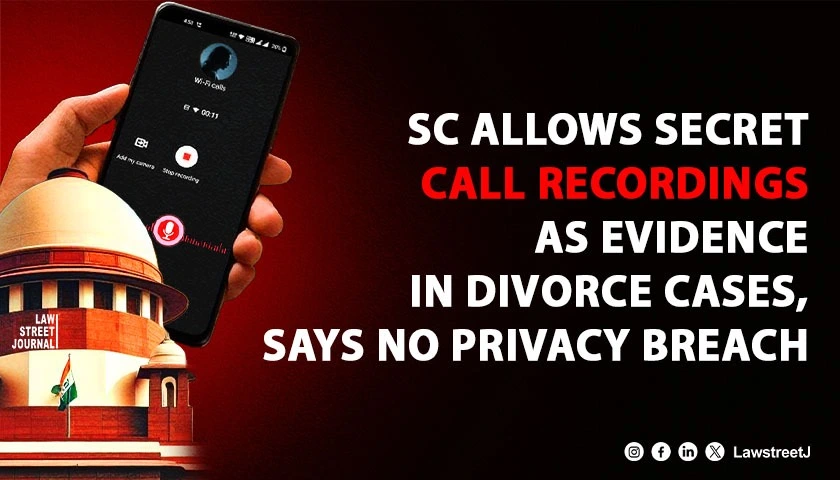
Using secret phone call recordings or snooping of wife as evidence can't violate privacy: SC [Read Judgment]

By Jhanak Sharma      15 July, 2025 11:54 AM      0 Comments
Using secret phone call recordings or snooping of wife as evidence cant violate privacy SC

NEW DELHI: The Supreme Court on Monday held using secret phone call recordings or snooping of his wife as evidence in divorce proceedings can't be termed as "any breach of privacy."

The apex court set aside the Punjab and Haryana High Court's decision which prohibited a man from using such evidence in divorce proceedings.

A bench of Justices B V Nagarathna and Justice Satish Chandra Sharma said, "We do not think there is any breach of privacy in this (either spouse's recording or snooping of one another) case. In fact, Section 122 of the Evidence Act does not recognise any such right. On the other hand, it carves out an exception to right to privacy between spouses and therefore cannot be applied horizontally at all."

The court ruled that the fact that the conversation was recorded without the consent and knowledge of the person speaking is not a prohibition on the admissibility of the evidence.

The court allowed an appeal by the husband against Punjab and Haryana High Court's judgment of November 12, 2021, which had held that recording a wife's telephonic conversations or snooping on her without her knowledge amounted to "clear breach of privacy" and thereby cannot be admitted as evidence before a Family Court.

"In today’s day and age, when the technological advancement has made it easier to record and recreate moments of past and present for reference in future, then to say that such better forms of evidence and material would not be admissible on the ground of they being in violation of the right to privacy would amount to defeating the very object of the Evidence Act," the bench said.

Reversing the High Court's judgement, the court said, "If the marriage has reached a stage where spouses are actively snooping on each other, that is in itself a symptom of a broken relationship and denotes a lack of trust between them."

The court said, the privacy of communication exists between spouses, but the said right of privacy cannot be absolute and has to be read also in light of the exception provided in Section 122 of the Evidence Act.

The exception has been carved out in the provision to state that such privilege between spousal communication does not extend to a case of litigation between the spouses themselves, the court added.

"In such a situation, the spouses would have the right to prove their respective cases and therefore can let in such evidence which is permitted under Section 122 of the Evidence Act, if one could use the expression “spill the beans”," the bench said.

The court emphasised before a court of law, a relevant piece of conversation available on an electronic device should not be allowed to be shut out when it is the best evidence available for deciding the dispute.

Amicus curiae Vrinda Grover contended that permitting such an evidence would jeopardise domestic harmony and matrimonial relationship and it would encourage snooping on the spouse, thereby fracturing the very objective of Section 122 of the Evidence Act.

"We do not think such an argument is tenable," the bench said.

The Family Court in Bathinda had allowed the husband to rely on certain recordings of phone calls against his wife to support claims of cruelty.

The High Court, however, accepted the wife's challenge that the recordings were made without her knowledge or consent and violated her fundamental right to privacy.

The apex court allowed the Family Court to proceed with the case after taking judicial note of the recorded conversations.

 

[Read Judgment]


Share this article:

About:

Jhanak is a lawyer by profession and legal journalist by passion. She graduated at the top of her cl...Read more

Follow:
FacebookTwitterLinkedinInstagram


Leave a feedback about this
Related Posts
View All

Another CBI Officer Investigating Rakesh Asthana Moves SC Against Transfer, Makes Startling Revelations Another CBI Officer Investigating Rakesh Asthana Moves SC Against Transfer, Makes Startling Revelations

After A.K. Bassi, another CBI officer who was investigating corruption allegations against Special Director Rakesh Asthana moved the Supreme Court.

Ayodhya verdict: SC rules in favour of Ram Lalla, Sunni Waqf Board gets alternate land Ayodhya verdict: SC rules in favour of Ram Lalla, Sunni Waqf Board gets alternate land

SC bench led by CJI Ranjan Gogoi has allotted the dispute site to Ram Janmabhoomi Nyas, while directing the government to allot an alternate 5 acre land within Ayodhya to Sunni Waqf Board to build a mosque.

Supreme Court: Money Spent On Judiciary Less Than 1% In All States Except Delhi Supreme Court: Money Spent On Judiciary Less Than 1% In All States Except Delhi

The court guided all states to document their response to the commission's report within four weeks. If any of the states fail to file a response, it will be presumed that they have no objections to the recommendations made by the commission, the court said.

Supreme Court Top Panel Names Chief Justices for Bombay, Orissa and Meghalaya High Courts Supreme Court Top Panel Names Chief Justices for Bombay, Orissa and Meghalaya High Courts

On April 18, 2020, the Supreme Court Collegium recommended new Chief Justices for three High Courts. Justice Dipankar Datta was proposed as Chief Justice of the Bombay High Court, succeeding Justice B.P. Dharmadhikari. Justice Biswanath Somadder was nominated as Chief Justice of Meghalaya High Court, while Justice Mohammad Rafiq was recommended for transfer as Chief Justice of Orissa High Court.

TRENDING NEWS

accused-need-not-appear-on-every-date-after-bail-in-appeals-sc
Trending Judiciary
Accused Need Not Appear on Every Date After Bail in Appeals: SC [Read Order]

Supreme Court rules accused on bail after suspension of sentence need not appear on every hearing date in appellate or revisional courts.

19 January, 2026 12:47 PM
delhi-hc-upholds-press-councils-rejection-of-editors-guilds-claim-in-15th-press-council-constitution
Trending Judiciary
Delhi HC Upholds Press Council’s Rejection of Editors Guild’s Claim in 15th Press Council Constitution [Read Judgment]

Delhi High Court upheld Press Council of India’s rejection of Editors Guild’s claim, citing delay and non-compliance, and declined to interfere in 15th Press Council constitution.

19 January, 2026 01:39 PM

TOP STORIES

madras-hc-seeks-larger-bench-to-reconsider-bar-on-enrolment-of-law-graduates-with-pending-criminal-cases
Trending Judiciary
Madras HC Seeks Larger Bench To Reconsider Bar On Enrolment Of Law Graduates With Pending Criminal Cases [Read Order]

Madras High Court refers to larger bench to reconsider bar on enrolment of law graduates with pending criminal cases under Advocates Act.

15 January, 2026 05:28 PM
madras-hc-state-organizes-jallikattu-at-avaniyapuram-private-committees-cannot-claim-independent-right
Trending Judiciary
Madras HC: State Organizes Jallikattu at Avaniyapuram; Private Committees Cannot Claim Independent Right [Read Order]

Madras High Court rules that only the State can organize Jallikattu at Avaniyapuram; private committees have no independent right to conduct the event.

15 January, 2026 05:52 PM
sc-delivers-split-verdict-on-section-17a-of-prevention-of-corruption-act-refers-matter-to-larger-bench
Trending Judiciary
SC Delivers Split Verdict on Section 17A of Prevention of Corruption Act, Refers Matter to Larger Bench [Read Judgment]

Supreme Court delivers a split verdict on Section 17A of the Prevention of Corruption Act, with judges differing on its validity and referring the issue to a larger bench.

15 January, 2026 08:04 PM
daughter-in-law-widowed-after-father-in-laws-death-entitled-to-maintenance-from-his-estate-sc
Trending Judiciary
Daughter-in-Law Widowed After Father-in-Law’s Death Entitled to Maintenance from His Estate: SC [Read Judgment]

Supreme Court rules that a daughter-in-law widowed after her father-in-law’s death can claim maintenance from his estate under Hindu law.

15 January, 2026 09:03 PM

ADVERTISEMENT


Join Group

Signup for Our Newsletter

Get Exclusive access to members only content by email