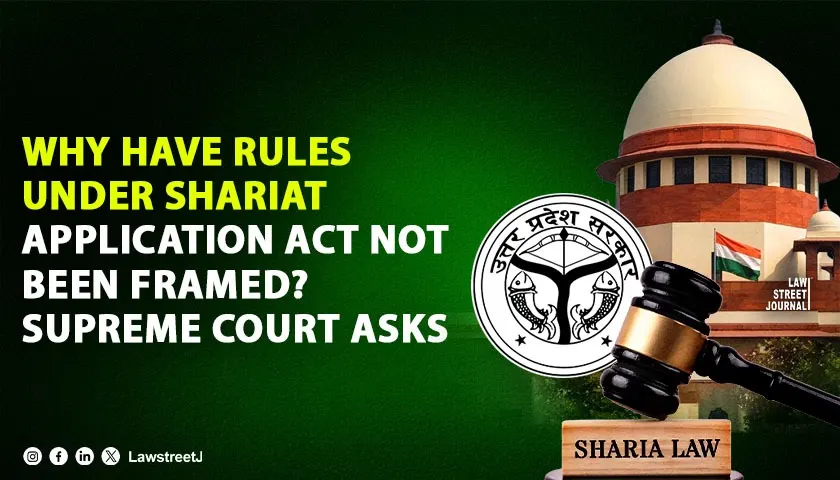
New Delhi: The Supreme Court has sought responses from the Union Government and the State of Uttar Pradesh on the apparent non-framing of rules under Section 4 of the Muslim Personal Law (Shariat) Application Act, 1937, raising concerns about a possible statutory vacuum affecting the application of Muslim personal law.
A Bench of Justice Sanjay Karol and Justice Augustine George Masih was hearing Civil Appeal No. 2637 of 2012 in Smt. Gohar Sultan v. Sheikh Anis Ahmad and Another when the issue arose during arguments.
During the hearing, the Court’s attention was invited to the provisions of the Muslim Personal Law (Shariat) Application Act, 1937. The Bench recorded that it had been brought to its notice that there had been no compliance thus far with Section 4 of the Act. In view of this submission, the Court expressed its inclination to implead the Union of India through the Secretary, Department of Legislation, as well as the State of Uttar Pradesh, as party respondents.
The Bench accordingly issued notice. Counsel for the State of Uttar Pradesh accepted notice, and the matter has been listed for further hearing on February 18, 2026. The newly added respondents have been directed to file affidavits indicating the latest status.
Section 3 of the 1937 Act provides that a Muslim may make a declaration before the prescribed authority that he or she wishes to be governed by Muslim personal law in matters such as marriage, dissolution of marriage, maintenance, inheritance, guardianship, and other enumerated subjects. Once such a declaration is made and accepted, the person and his or her descendants are to be governed by Shariat in those matters.
However, Section 4 mandates that the State Government shall make rules prescribing the authority before whom the declaration under Section 3 is to be made and the procedure to be followed. The issue flagged before the Supreme Court is that, in the absence of such rules, the statutory mechanism contemplated by Section 3 may be rendered ineffective in Uttar Pradesh.
The appeal before the Court arises out of a 2011 judgment of the Delhi High Court which invalidated a 1992 Will propounded by the appellant, Gohar Sultan, daughter of the deceased testatrix, Mst. Nawab Begum. The High Court had held that the Will was not proved in accordance with the requirements of the Indian Succession Act, 1925, particularly since the sole attesting witness turned hostile and the strict proof requirements were not satisfied.
The appellant’s case before the Supreme Court is that the testatrix was a Muslim and intended to be governed by Muslim personal law. However, she could not make a formal declaration under Section 3 of the Shariat Act because the procedural rules contemplated under Section 4 had not been framed by the State Government of Uttar Pradesh. It was argued that in the absence of prescribed rules, the statutory right under Section 3 becomes illusory.
The Supreme Court observed that unless rules under Section 4 prescribe the form of declaration, designate the competent authority, and lay down the procedure, a person cannot effectively avail the benefit of Section 3. The Bench’s order reflects concern that the absence of such rules may create uncertainty in the application of Muslim personal law in succession and testamentary matters.
The case also raises broader questions about the interface between personal law and the Indian Succession Act, 1925. The Delhi High Court had reasoned that since there was no formal declaration under Section 3 of the Shariat Act, the Will had to be tested under secular law, which requires proof by at least two attesting witnesses. The appellant contends that this interpretation overlooks the practical impossibility of making a declaration in the absence of rules under Section 4.
By impleading the Union of India and the State of Uttar Pradesh, the Supreme Court has signalled that the issue may have implications beyond the individual dispute and could require clarification on whether States have fulfilled their statutory obligations under the 1937 Act.
The matter is scheduled to be taken up on February 18, 2026, when the Court will consider the affidavits to be filed by the newly added respondents.
Case Details:
Case Title: Smt. Gohar Sultan v. Sheikh Anis Ahmad and Another
Case Number: Civil Appeal No. 2637 of 2012
Court: Supreme Court of India
Date of Order: February 4, 2026
Bench: Justice Sanjay Karol and Justice Augustine George Masih
For Appellant:
Mr. Rakesh Khanna, Senior Advocate;
Mr. M. Khairati, Advocate;
Mr. Irshad Ahmad, AOR;
Mr. Ashok Kumar, Advocate;
Mr. H.M. Ghouse, Advocate;
Mr. Junaid Ali Khan, Advocate;
Mr. Shoaib Khan, Advocate
For Respondents:
M/s Equity Lex Associates, AOR;
Mr. Salman Khurshid, Senior Advocate;
Mrs. Naghma Imtiaz, Advocate;
Mr. Zargham Ahmed, Advocate;
Mr. Saif Naseem, Advocate;
Mrs. Lubna Naaz, Advocate;
Ms. Mariya Mansuri, Advocate;
Ms. Sidra Khan, Advocate;
Ms. Azra Rehman, Advocate


.jpeg)