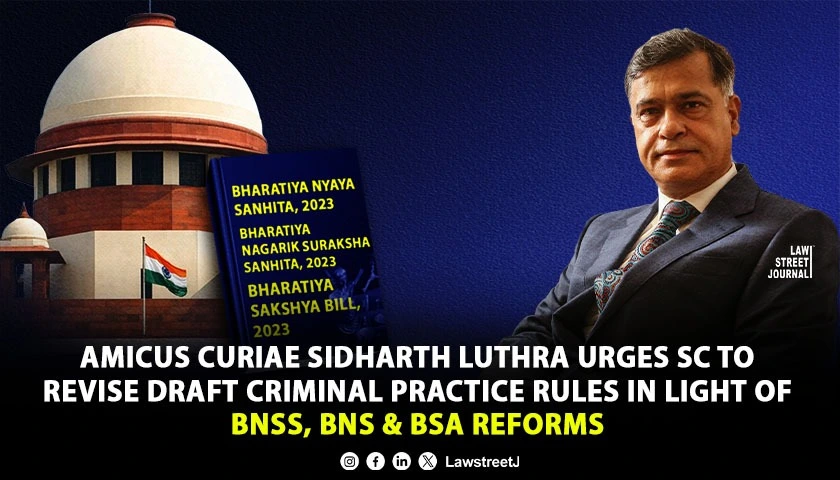
New Delhi: In the long-pending suo motu proceedings titled In Re: To Issue Certain Guidelines Regarding Inadequacies and Deficiencies in Criminal Trials, Senior Advocate and Amicus Curiae Sidharth Luthra has filed a comprehensive compilation before the Supreme Court, seeking the adoption of revised Draft Rules of Criminal Practice, 2026, in supersession of the 2021 framework.
The suo motu matter culminated in a landmark 2021 judgment, in which the Supreme Court framed uniform Draft Rules of Criminal Practice to address chronic deficiencies in criminal investigation and trial processes. The Court had directed States and High Courts to implement the Rules within six months and to amend police manuals and High Court rules accordingly.
However, with the enforcement of the new criminal codes — namely the Bharatiya Nagarika Suraksha Sanhita, 2023; the Bharatiya Nyaya Sanhita, 2023; and the Bharatiya Sakshya Adhiniyam, 2023 — the amicus has urged the Court to recalibrate the 2021 Rules to align them with the newly structured procedural and evidentiary regime.
The compilation argues that the BNSS and BSA introduce technology-driven mechanisms such as mandatory or enabling audio-visual recording, digital evidence authentication, and time-bound procedural safeguards, which require harmonised implementation through updated judicial practice rules. It is prayed that the revised Draft Rules of Criminal Practice, 2026, be treated as binding directions under Article 142 of the Constitution until formally adopted by High Courts.
A central feature of the proposed revisions concerns mandatory audio-video recording at various stages of criminal investigation and trial. The BNSS now expressly enables or mandates audio-visual documentation of the scene of crime, search and seizure operations, and the recording of statements. The amicus refers to the Standard Operating Procedure issued by the Ministry of Home Affairs prescribing hash value generation, dual certification under the BSA, chain of custody documentation, secure storage, and mirroring of digital evidence. Uniform adoption of encryption standards and tamper-proof storage mechanisms across States and Union Territories has been sought to prevent evidentiary challenges and ensure the integrity of electronic material.
The compilation highlights the shift introduced by Section 63(4) of the BSA, which requires dual certification for electronic records. Under the SOP framework, Part A certification is to be issued by the operator or officer in charge, while Part B must be provided by a designated expert. The amicus has pointed out that States must notify experts under Section 329 BNSS and Section 79A of the Information Technology Act to operationalise this requirement, failing which the evidentiary reforms may remain ineffective.
Time-bound framing of charges is another key reform. The BNSS mandates that charges be framed within 60 days from the first hearing on charge, including in Special Courts such as those under the Prevention of Corruption Act. The amicus contends that strict compliance is necessary to curb delays that have historically plagued criminal trials.
The revised draft also emphasises standardisation in evidence recording and judgment writing. Depositions are to be paragraph-numbered, exhibits witness-linked, and omnibus marking of entire Section 161 or 164 statements avoided. Judgments must clearly set out points for determination, findings, reasons, and structured appendices listing witnesses and exhibits. These measures echo the Supreme Court’s earlier directions aimed at improving clarity and facilitating appellate review.
On bail jurisprudence, the amicus has sought structured timelines for the disposal of bail applications in non-bailable offences within three to seven days. Particular emphasis has been laid on undertrials in custody beyond five years and cases where detention exceeds the likely sentence. Reliance has been placed on the Supreme Court’s decisions in Satender Kumar Antil v. Central Bureau of Investigation and Hussain v. Union of India, which underscored the constitutional mandate of a speedy trial under Article 21.
The compilation further flags uneven implementation of witness protection frameworks under Section 398 BNSS, which statutorily incorporates the witness protection regime earlier approved in Mahender Chawla v. Union of India. While several States and Union Territories have notified schemes, others are yet to do so, prompting the amicus to seek status reports and timelines.
In a push toward digital accessibility, the amicus has annexed the e-True Copy Rules, 2024, notified by the High Court of Delhi, proposing their adoption nationwide. The Rules allow electronic applications, authenticated digital copies, and regulated third-party access in compliance with the IT Act. Uniform digital copy access, it is argued, is essential in a system transitioning toward integrated e-courts.
At the Union level, the amicus has sought directions for a national roadmap from the Ministry of Law and Justice for integrated e-court services; reports from the Ministry of Home Affairs and the Ministry of Electronics and Information Technology on digital evidence standards; and structured data on video conferencing infrastructure in courts and prisons. Training modules for judges and prosecutors under the BNSS regime through the National Judicial Academy and State Judicial Academies have also been sought.
Additionally, invoking Sections 18 to 20 BNSS, the amicus has pressed for strict separation between investigation and prosecution through the operationalisation of Directorates of Prosecution, a reform repeatedly emphasised but unevenly implemented across States.
The compilation also reiterates that courts must record reasons when probation is denied under Section 401 BNSS or the Probation of Offenders Act, reinforcing the principle of individualized sentencing.
The Supreme Court is expected to consider the compilation in continuation of the suo motu proceedings. If adopted, the revised Draft Rules of Criminal Practice, 2026, could become a binding nationwide framework governing criminal trials in the post-BNSS era, potentially marking the most significant procedural overhaul since the transition from the Code of Criminal Procedure, 1973.
Case Details:
- Case Title: In Re: To Issue Certain Guidelines Regarding Inadequacies and Deficiencies in Criminal Trials
- Nature of Matter: Suo motu proceedings concerning systemic deficiencies in criminal trials
- Current Development: Compilation filed by Amicus Curiae seeking adoption of revised Draft Rules of Criminal Practice, 2026
- Amicus Curiae: Sidharth Luthra, Senior Advocate
- Statutes Involved: Bharatiya Nagarika Suraksha Sanhita, 2023; Bharatiya Nyaya Sanhita, 2023; Bharatiya Sakshya Adhiniyam, 2023; Information Technology Act; Probation of Offenders Act
- Key Precedents Relied Upon: Satender Kumar Antil v. CBI; Hussain v. Union of India; Mahender Chawla v. Union of India
- Relief Sought: Adoption of revised Rules under Article 142; uniform SOP for AV recording; bail timelines; witness protection compliance; digital evidence standardisation; separation of prosecution and investigation

![Supreme Court Frees Death Row Convicts Due to Flawed Investigation in 2013 Kidnap Murder Case [Read Judgment]](/secure/uploads/2023/09/lj_8975_1adddeb4-b0a7-46df-a9cc-4af7ecac44ec.jpg)
![Accused not to be forced to make self incriminating statement on threat to withdraw protection from arrest: SC [Read Order]](/secure/uploads/2024/03/lj_9274_Self-Incrimination.webp)