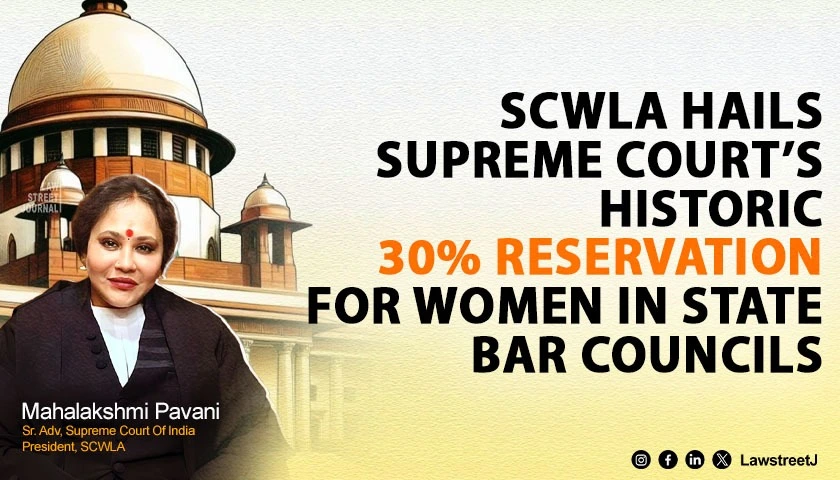
New Delhi: In a watershed moment for India’s legal fraternity, the Supreme Court Women Lawyers Association (SCWLA) has welcomed the Supreme Court of India’s landmark judgment mandating 30% reservation for women advocates in State Bar Councils where elections have not yet been notified. The judgment, delivered on December 8, 2025, is being heralded as one of the most progressive steps toward achieving substantive gender parity within the governing bodies of the legal profession.
The ruling came from a Bench led by Chief Justice of India Mr. Justice Surya Kant and Justice Joymalya Bagchi, who directed that the relevant Rules under the Advocates Act, 1961 shall be deemed amended to operationalise women’s reservation without delay. SCWLA described the decision as a “monumental declaration reflecting the judiciary’s commitment to constitutional gender equality.”
A Structural Reform Long Overdue
In its press statement, SCWLA commended the Bench for addressing the “stark underrepresentation of women” in Bar Council elections, noting that systemic and social barriers often prevent competent women advocates from securing elected positions.
For the current election cycle, the Court has devised a pragmatic formula:
- 20% seats to be filled through elections
- 10% seats through a co-option mechanism
SCWLA emphasized that the co-option provision is a lifeline for women who may be deserving yet unable to marshal resources to contest traditional elections. By guaranteeing space for talent, the Court has ensured that “women will secure their rightful place in decision-making processes and the posts of office-bearers.”
In its press release, SCWLA President and Senior Advocate Mahalakshmi Pavani said that the Association believes this verdict marks a pivotal moment for the legal profession—one where women will increasingly “lead and shape the legal fraternity,” occupying vital roles in governance, policy-making, leadership, and institutional reform.
A Defining Constitutional Moment
The judgment stems from petitions filed in Yogamaya M.G. v. Union of India (W.P. (C) No. 581/2024) and Shehla Chaudhary v. Union of India (W.P. (C) No. 1060/2025). The Court reaffirmed the spirit of Article 15(3) of the Constitution, which permits affirmative measures for women, noting that the legal system must reflect “the growing capability and participation of women in the legal fraternity.”
SCWLA, in its press release, states that it believes that with this verdict, the legal profession stands at a pivotal point where women will increasingly “lead and shape the legal fraternity”—occupying roles in governance, policy-making, leadership, and institutional reform.
The Association expressed deep gratitude to Senior Advocate Shobha Gupta, Dr. Charu Mathur, AOR and their entire team for championing the cause with “relentless and concerted efforts.”
Implementation Now Lies with the Bar Council of India
Looking forward, SCWLA expressed confidence that the Bar Council of India (BCI), under the leadership of Chairman Manan Kumar Mishra, will implement the judgment in its true letter and spirit. The Association described the moment as the beginning of an era where Bar governance bodies finally reflect equitable representation.
As the legal fraternity prepares for the forthcoming State Bar Council elections under this new framework, the judgment is expected to serve as a catalyst for broader conversations on gender reform, institutional inclusivity, and fair governance across legal institutions nationwide.
Disclaimer: This content is produced and published by LawStreet Journal Media for informational purposes only and does not constitute legal advice. The views expressed are independent of any legal practice of the individuals involved.