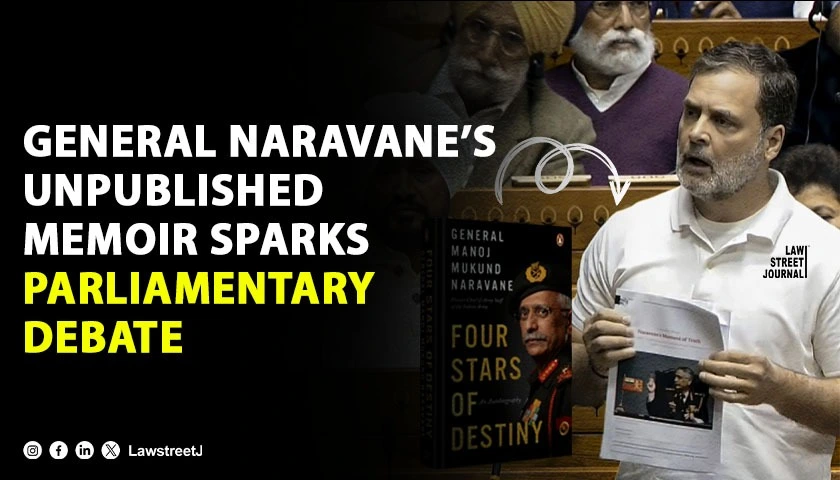
New Delhi: On February 02, 2026, the Lok Sabha was repeatedly adjourned after Rahul Gandhi quoted excerpts from General M.M. Naravane’s unpublished memoir, Four Stars of Destiny. The government objected, citing parliamentary rules and national security concerns, while the opposition maintained that the passages highlighted India’s border challenges, particularly the Galwan Valley clash.
General Naravane’s Career and Memoir:
General (Dr.) Manoj Mukund Naravane (Retd.) served as the 28th Chief of Army Staff (COAS) from December 31, 2019, to April 30, 2022, succeeding General Bipin Rawat. Commissioned into the 7th Battalion of the Sikh Light Infantry in 1980, Naravane’s career spanned over four decades and included key roles such as Vice Chief of Army Staff and General Officer Commanding-in-Chief of Eastern Command.
His tenure coincided with critical events, including the 2020 Galwan Valley clash and the prolonged standoff along the Line of Actual Control (LAC). Naravane’s memoir, Four Stars of Destiny, was scheduled for release in 2024 but remains unpublished pending clearance from the Ministry of Defence (MoD). Excerpts carried by The Caravan magazine later became the basis of Rahul Gandhi’s remarks in Parliament.
Galwan Valley Clash and Naravane’s Role:
On June 15, 2020, Indian and Chinese troops clashed in the Galwan Valley, resulting in the deaths of 20 Indian soldiers. China later acknowledged casualties but did not disclose full figures. As Army Chief at the time, General Naravane directed India’s military response and oversaw disengagement negotiations. He has publicly stated that India did not lose territory in Galwan and described the confrontation as a “major jolt for China since 1979.”
Reported excerpts from the memoir describe how, on August 31, 2020, Naravane sought clear orders from India’s political leadership in response to Chinese tanks moving towards Rechin La in eastern Ladakh. These passages have since become politically sensitive, with opposition leaders using them to question the government’s handling of border security.
Exact Points Reported from Four Stars of Destiny
According to verified excerpts carried in The Caravan and quoted in Parliament:
- Chinese Tanks in Doklam (2017): Naravane reportedly describes Chinese armoured movements during the Doklam standoff, noting how Indian troops blocked road construction and held firm against escalation.
- Rechin La Incident (August 31, 2020): The memoir recounts how Naravane sought explicit political direction when Chinese tanks advanced towards Rechin La in eastern Ladakh, underscoring the urgency of high-level decision-making during the crisis.
- Galwan Valley Clash (June 15, 2020): Naravane details the violent confrontation in which 20 Indian soldiers were killed, reiterating that India did not lose territory and characterising the clash as a “major jolt for China since 1979.”
- Strategic Lessons: The memoir reportedly highlights India’s military preparedness, the importance of political–military coordination, and the challenges of managing border tensions with China.
Though officially unpublished, these passages have become politically contentious and were central to the parliamentary debate.
Parliamentary Proceedings and Legal Dimensions:
During the Budget Session on February 2, 2026, Rahul Gandhi quoted from a The Caravan article containing excerpts from Naravane’s memoir while replying to the Motion of Thanks to the President’s Address. He displayed printouts of the magazine and referred to mentions of “Chinese tanks in Doklam.”
Defence Minister Rajnath Singh and Home Minister Amit Shah immediately objected, questioning whether Gandhi was quoting from a book that had been officially published. Speaker Om Birla reminded members that parliamentary rules prohibit citing material not in the public domain. The confrontation led to multiple adjournments of the Lok Sabha.
Legal experts note that while parliamentary privilege allows members to cite publicly available material, quoting from unpublished manuscripts raises concerns of propriety and national security. Under Indian law, retired military officers are required to obtain MoD clearance before publishing works that may contain classified or sensitive information.
General Naravane’s unpublished memoir has thus become the centre of a parliamentary flashpoint, intertwining questions of national security, parliamentary privilege, and political accountability. Given his direct role in the Galwan Valley clash, his perspectives carry considerable weight in public discourse. As the Ministry of Defence continues its review of Four Stars of Destiny, the episode highlights how military memoirs can significantly influence legislative proceedings and political debate at the highest level.

![Lakshadweep MP Mohammed Faizal Disqualified from Lok Sabha After Conviction Suspension Plea Rejected by Kerala High Court [Read Notice]](/secure/uploads/2023/10/lj_9640_87b5fd97-0e05-4ff8-9a99-3be1e4446192.jpg)