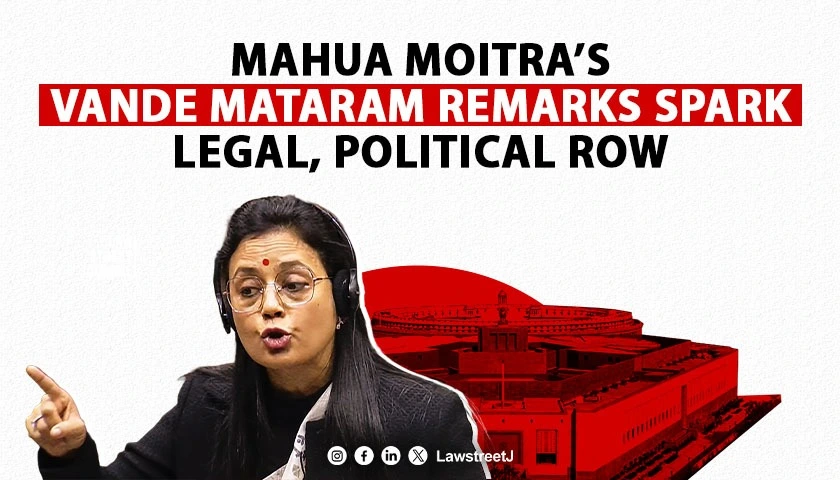
New Delhi: Trinamool Congress MP Mahua Moitra’s remarks during the ongoing Winter Session of Parliament have reignited a complex debate over the national song “Vande Mataram,” raising constitutional questions and historical scrutiny. Her statements, delivered during a commemorative discussion marking 150 years of the hymn, challenged the Bharatiya Janata Party (BJP) and Rashtriya Swayamsevak Sangh (RSS) on their claims to patriotic legacy while invoking legal precedents and freedom-fighter history.
Historical Origins and Legal Status of Vande Mataram
“Vande Mataram,” composed by Bankim Chandra Chattopadhyay in 1875 and later included in his novel Anandamath (1882), became a rallying cry during India’s freedom movement. The song was adopted by revolutionaries such as Ram Prasad Bismil and Ashfaqulla Khan, whose names Moitra referenced in her speech. While the hymn holds deep cultural and historical significance, its legal status remains distinct from that of the national anthem “Jana Gana Mana.” The Constituent Assembly, in 1950, declared “Vande Mataram” the national song, but it was never accorded the same legal standing as the national anthem, and there is no statutory mandate requiring its recital.
In 2004, the Supreme Court of India ruled that singing “Vande Mataram” cannot be enforced upon any citizen, citing Articles 19(1)(a) and 25 of the Constitution, which guarantee freedom of expression and religion respectively. The judgment reaffirmed that national symbols must be respected voluntarily, not through compulsion.
The Ministry of Home Affairs has issued multiple circulars reiterating this position, emphasizing that while the song is emblematic of India’s unity, its recital must remain a matter of personal choice. The National Integration Council has also advised against coercive nationalism, advocating for inclusive civic engagement. On December 8, 2025, Moitra addressed the Lok Sabha during a special debate commemorating the 150th anniversary of “Vande Mataram.” She alleged that BJP leaders had attempted to “make Muslims sing” the hymn while some of them “couldn’t sing it themselves,” calling the situation a “badly scripted comedy.” Her remarks drew immediate attention across party lines.
Moitra further questioned the BJP and RSS’s historical connection to the freedom struggle, stating that “Vande Mataram” predates both organisations—the RSS was founded in 1925 and the BJP in 1980. She invoked the legacy of Ram Prasad Bismil and Ashfaqulla Khan, asking, “Who in the BJP or RSS has even a tenuous link to the freedom struggle to lecture others on its meaning?” Prime Minister Narendra Modi opened the debate earlier that day, emphasizing the song’s role in uniting the country during colonial rule. Union Home Minister Amit Shah echoed this sentiment in the Rajya Sabha, stating that “Vande Mataram” represents the soul of India and should be respected by all citizens.
Opposition leaders, including AIMIM chief Asaduddin Owaisi, responded by affirming their patriotism while defending the constitutional right not to be compelled to sing any hymn. Owaisi stated, “Being Muslim does not reduce my love for India,” referencing the Supreme Court’s 1986 ruling in Bijoe Emmanuel v. State of Kerala, which protected three Jehovah’s Witness students from disciplinary action for refusing to sing the national anthem on religious grounds.
Legal Implications and Electoral Undercurrents
The controversy arrives ahead of the 2026 West Bengal Assembly elections, where communal narratives have historically influenced political discourse. Moitra accused the BJP of using the issue to polarize voters rather than addressing substantive concerns such as unemployment, inflation, and governance. Legal experts have noted that any attempt to mandate the singing of “Vande Mataram” would likely be struck down by courts as unconstitutional. The Supreme Court’s jurisprudence consistently upholds individual rights over symbolic nationalism. Article 25 guarantees freedom of conscience and the right to freely profess, practise, and propagate religion, while Article 19(1)(a) protects freedom of speech and expression.
Senior advocate Indira Jaising stated in a recent interview, “The Constitution does not permit forced patriotism. Symbols of national pride must be embraced voluntarily, not imposed.” Constitutional scholar Faizan Mustafa added that “Vande Mataram’s status as a national song does not override fundamental rights.” The Law Commission, in its 2018 advisory, recommended against legislating mandatory patriotic acts, citing risks to pluralism and civil liberties. No legislative proposal has been introduced in the current session to alter the legal status of “Vande Mataram.”
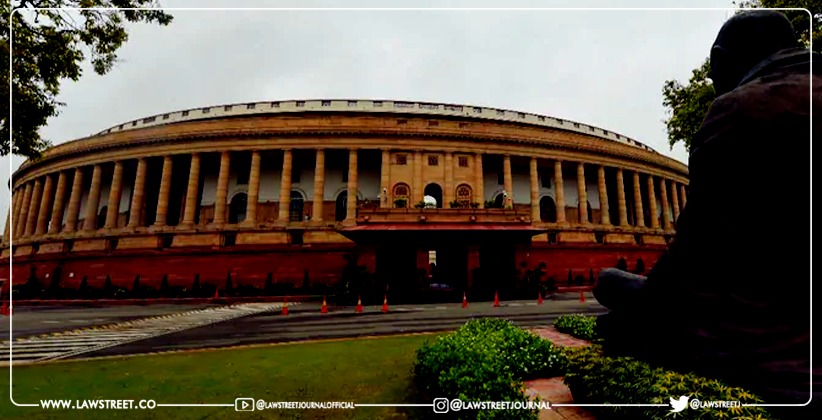
As Parliament continues its year-long celebration of the hymn’s 150th anniversary, the debate reflects broader questions about identity, patriotism, and the role of historical symbols in contemporary governance. The government has announced cultural programs and educational initiatives to commemorate the milestone, but legal and political tensions remain under scrutiny.

![Number of Constitution bench matters reduced drastically over decades, Lok Sabha informed [Read Statement]](/secure/uploads/2023/08/lj_1613_Constitution_bench_cases_sc.jpg)
![Amicus curiae supports plea for permanent disqualification of convicted lawmakers [Read Report]](/secure/uploads/2023/09/lj_2142_39a30518-7616-4c47-8f64-5f81898860ae.jpg)