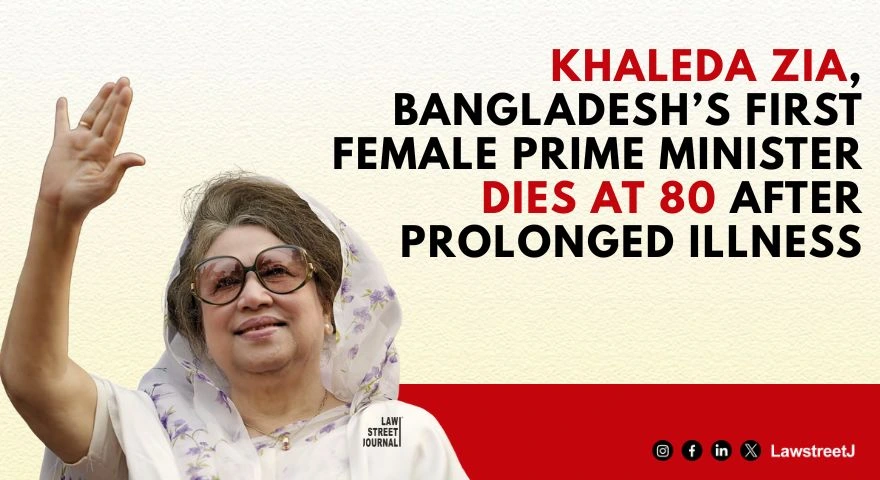
New Delhi: Former Prime Minister Khaleda Zia passed away on December 30, 2025, in Dhaka at the age of 80, following a long battle with multiple health complications. Her death marks the end of a pivotal chapter in Bangladesh’s political history.
Political Legacy and Tenure:
Begum Khaleda Zia served as the Prime Minister of Bangladesh for two non-consecutive terms—first from 1991 to 1996, and again from 2001 to 2006. She was the first woman to hold the office in the country and led the Bangladesh Nationalist Party (BNP), which she chaired from 1984 until her death.
Her political career began after the assassination of her husband, former President Ziaur Rahman, in 1981. She assumed leadership of the BNP in 1984 and quickly became a dominant figure in national politics. Under her leadership, the BNP won the 1991 general elections, marking the restoration of parliamentary democracy after years of military rule. Her administration introduced economic liberalisation policies and oversaw infrastructure development, though it faced criticism over governance and human rights issues.
In 2001, she returned to power with a landslide victory, securing 193 out of 300 parliamentary seats. Her second term was marked by political unrest, allegations of corruption, and increasing tensions with the opposition Awami League, led by Sheikh Hasina.
Zia’s rivalry with Hasina defined Bangladeshi politics for decades. The two leaders alternated in power and were frequently at odds over electoral processes, governance, and constitutional reforms. Their political feud led to repeated street protests, strikes, and confrontations between party supporters, contributing to a volatile political climate.
Legal Proceedings and Imprisonment:
Khaleda Zia’s later years were overshadowed by legal battles and imprisonment. In February 2018, she was convicted by a Dhaka court in the Zia Orphanage Trust corruption case and sentenced to five years in prison under the Penal Code and the Prevention of Corruption Act, 1947. The verdict was upheld by the High Court, which extended her sentence to ten years. She was also convicted in a second case involving the Zia Charitable Trust, receiving an additional seven-year sentence.
Her legal team consistently denied the charges, alleging political motivation behind the prosecutions. The BNP claimed the cases were part of a broader campaign to sideline opposition leaders ahead of the 2018 general elections. Zia’s incarceration led to widespread protests and international concern over the fairness of the judicial process. Human rights organisations, including Amnesty International and Human Rights Watch, called for her release on humanitarian grounds.
In March 2020, the government granted her conditional release under Section 401 of the Code of Criminal Procedure, citing her deteriorating health. She was released from prison and placed under house arrest, with restrictions on travel and political activity. Her health continued to decline, and she was admitted to Evercare Hospital in Dhaka multiple times over the next five years.
Illness, Death, and National Response:
Khaleda Zia died at 6:00 a.m. local time on December 30, 2025, at Evercare Hospital in Dhaka. According to medical reports released by her physicians, she had been suffering from advanced liver cirrhosis, diabetes, arthritis, and cardiac complications. Her condition had worsened significantly in recent months, prompting renewed appeals from her party and family for medical treatment abroad, which were denied by the government citing legal constraints.
The Bangladesh Nationalist Party confirmed her death in an official statement, describing her as a “national leader” and announcing a seven-day mourning period. Her funeral is scheduled to be held at the Baitul Mukarram National Mosque, followed by burial at the family graveyard in Dhaka. The government has declared a one-day state mourning, with flags flown at half-mast across public institutions.
International reactions have begun to emerge, with leaders from South Asia expressing condolences. The United Nations and the European Union acknowledged her contributions to Bangladesh’s democratic transition and called for continued political reconciliation in the country.
Legal and Political Implications:
Khaleda Zia’s death raises significant questions about the future of the BNP and opposition politics in Bangladesh. Her son, Tarique Rahman—currently residing in London and facing multiple criminal charges in absentia—is expected to assume greater leadership responsibilities. Legal experts note that her passing may influence pending appeals and proceedings related to her convictions, though formal closure will depend on judicial review.
The BNP’s participation in the upcoming 2026 general elections remains uncertain, with internal divisions and leadership challenges ahead. Analysts suggest that Zia’s absence may reshape the political landscape, potentially opening avenues for reform and dialogue between rival factions.
Her death also underscores the intersection of health, law, and politics in Bangladesh, highlighting the need for transparent legal processes and humane treatment of political detainees. As the nation reflects on her legacy, Khaleda Zia remains a symbol of resilience and controversy in equal measure.