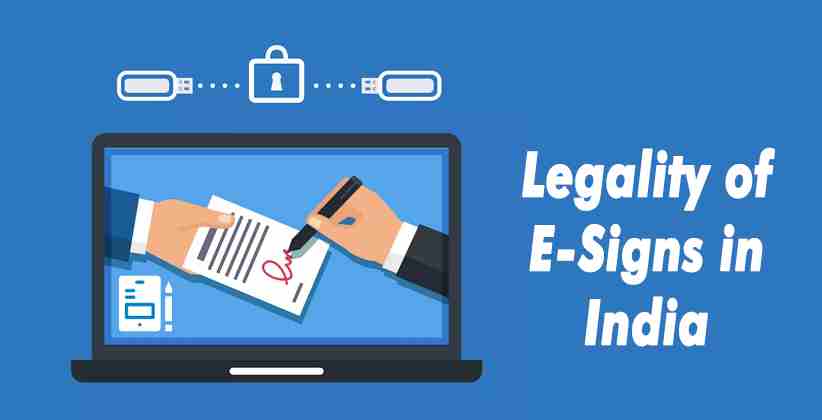
Electronic signatures arent a recent phenomenon. We can found traces of e-signs around since the American Civil War, during which contracts were signed through Morse. In a modern time, an e-Sign refers to a unique, digitized, encrypted personal identifier. We can understand e-sign in short terms that it is different from the wet signatures created by hand. The basic meaning of e-sign is to complete transactions, loops, and agreements electronically. In our country it is already accepted that electronic signatures as legally valid since 2000, with the introduction of the Information Technology Act 2000.
Validity of e-signs
In India, the e-Sign has been granted legal status by amendments to various laws, namely the Information Technology Act, the Indian Evidence Act, and the Negotiable Instruments Act. In the financial sector, people have already started using e-Sign to get customers to sign loan and card applications, and loan agreements.
Licensed Certifying Authorities issue Digital Signature Certificates under the Ministry of Information Technology which secures the use of Digital Signature Certificates authentic and valid, just as any type of signature which is on the paper. Electronic signatures can also use as proof of signature and presumption to electronic agreements under the Indian Evidence (Amendment) Act, 1882. Digital Signature Certificates can be generated for Aadhaar based e-sign as well, and it can be viewed by individual by just clicking on the e-Sign button on the browser. At the present time, it is safe to state; there has been a significant increase in the uses of electronic signatures all over India.
The invalidity of e-sign
No doubts that e-signs are valid in India but there are some documents that could not be present through digitally signatures. There are many reasons behind it and the central government also not support promoting those documents with electronic signatures. So The Central Government has stipulated that electronic signatures cannot be used on every type of documents.
Any electronic signature used on any of the type documents which are listed below will not make such a signature or the document itself valid.
Under Section 1(4) of the Information Technology Act, 2000, electronic signatures or the statute IT Act itself will not be applicable to,
- Any type of documents as prescribed by the Central Government by way of a notification published in Its Official Gazette from time to time for any kind of rules and regulations.
- Any sale of immovable property within the territory of India or any type of contract, interest, or conveyance in such immovable property.
- Any sort of Power of Attorney as given under Section 1A of the Powers of Attorney Act, 1882.
- A will and testament are provided under Section 2(h) of the Indian Succession Act, 1925.
- A negotiable instrument was given under Section 13 of the Negotiable Instruments Act, 1881.
- Any type of trust as given under Section 3 of the Indian Trusts Act, 1882.
Causes that make e-signatures valid in India
There are 5 bold factors given under the IT Act which are responsible for the validity of e-signatures across India.
- It is most important that E-signatures must be uniquely linked to the person who is signing the document. We can face often such types of conditions often by issuing a digital-certificate-based digital ID.
- At the time of signing, the person or authority who is signing the certificate must have full control over the data used to generate the e-signature. In a lot of cases, online e-signature service providers grant the person who is electronically signing the certificates to directly affix their e-signature to the document in order to meet this requirement.
- Any sort of variation to the affixed e-signature to any document must be traceable. This phenomenon can be done by encrypting the document with a tamper-evident seal.
- There should be an audit trail that can record such steps taken during the signing process.
- The electronic signature certificate must be issued by a licensed and well-known Certifying Authority and is recognized by the Controller of such Certifying Authorities appointed as per the provision given under the IT Act.