


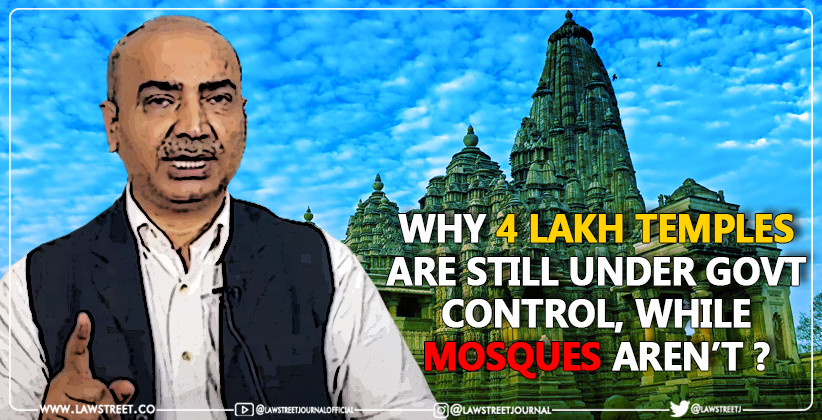
A PIL was recently filed by Lawyer and BJP spokesperson, Ashwini Upadhyay, in the Apex court demanding equal treatment of all religious institutions by the government. It requested the apex court to direct the Centre to form a Common Charter for Religious and Charitable Institutions and Uniform Code for Religious-Charitable Endowments.
The Plea further called for action against the inequal treatment of Hindu, Sikh, Jain, and Buddhist worship places by state governments.
State governments own and control the management of Temples and Gurdwaras, control and operate their assets, take their money, and even have major say in events like Puja and other rituals. At the same time, Mosques and Churches, in India, are owned and operated by the respective religious organizations. The governments do not charge them anything, instead they provide them monetary support and other benefits as well.
In 2002, from 2 lakh temples in Karnataka, the government collected Rs. 72 crores but returned merely Rs. 10 crores for repair and maintenance. On the Other hand, it granted Rs. 50 crores for the Madrasas and Rs. 10 crores for the churches
Notably, India still follows age old laws which were made by Britishers. One such Act is the Hindu Religious & Charitable Endowments Act which was created in 19th century to control and regulate Hindu temples.
Even after Independence, politicians concocted this anti-secular law to Provincialize the administration of Hindu Religious Institutions.
Under it, the state governments have taken over thousands of temples. This has in effect allowed loot of temple wealth and resources of temples by state governments over decades.
States not only collect taxes, manage assets, impose State control in temples, but they also often appoint non-Hindus, or even anti-Hindu, bureaucrats, or politicians over Hindu temples. This has led to deterioration of many ancient temples.
A UNESCO report in 2017 cautioned that Tamil Nadu government, which manages around 30 thousand temples, neither has the capacity nor qualified experts to carry out conservation, leading to massacre of ancient temples. (Source: TOI)

Not only are these laws hurt religious sentiments of Hindus, Sikhs, Jains, and Buddhists, but they also violate Article 14, 15, and 26 and go against the basic structure of the Constitution of India. Article 26 gives a natural right to all communities to manage their institutions, but Hindus, Jains, Sikhs, and Buddhists have been denied this privilege.
We need to ask ourselves, what kind of a democracy we live in? More importantly we must ask the government, why does it wear the secularism cloak when asking for votes and then discriminate between communities.
Hindus, Jains, Buddhists, and Sikhs have similar rights to own, acquire, administer movable-immovable properties of their religious places like Muslims and Christians and State cannot abridge it. Ashwini Upadhyay states in the PIL.
As the plea states, it is thus necessary that the Centre drafts a Common Charter for Religious and Charitable Institutions and Uniform Code for Religious-Charitable Endowments to ensure that all religious institutions are treated equally, and that they are regulated properly so that the culture and history of this great land can be preserved.
A plea has been filed in Madras High Court challenging the Hindu Religious and Charitable Endowment (HR&CE) Act, 1959. The Counsel of the petitioner, R Giriraj, said that there is no such Act for any religion other than Hinduism. Contending that the Act is against the fundamental rights provided under the Constitution of India and mentioning several earlier judgements of the Supreme Court, he stated that the government should not be running the temple administration. Admitting the petition, the court has asked the state of Tamil Nadu to file a counter affidavit.
These Religious Endowment Acts are based on pre-independence statute imposed by the Britishers.





Rangabalan Feb 10, 2024
Ashwini Upadhyaya Mahodaya. Why can't we start with the states ruled by BJP, and set precedence. Also we should develop a fool-proof MODEL for Management of a Temple Trust. I volunteer to help in this matter. I am Indian settled in Sydney Australia.
Sanatan Jun 16, 2022
This is the actual question whcih we need to hear about, Why only Hindu Temples are governed, Rules and Regulation should be same for all Community