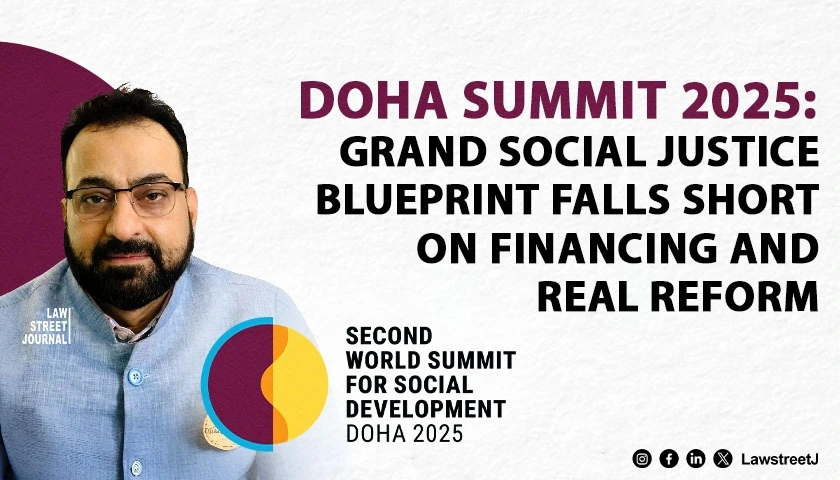
New Delhi: The Second World Summit for Social Development, concluded in Doha last month, produced a Political Declaration that can only be described as a magnificent blueprint laid out on the shifting sands of global finance. While world leaders celebrated the renewal of decades-old social justice commitments, the inescapable reality is that the Declaration offers refined rhetoric without revolutionary remedy. Doha, in essence, is a threshold, not a transformation.
This Summit was tasked with converting aspirational goals into binding obligations, facing the grim arithmetic of a world where 673 million went hungry in 2024, and structural asymmetry sees Africa bearing 90% of disaster impacts despite contributing less than 4% of global emissions. The vulnerability of millions displaced, food-insecure, and toiling in precarity highlights the existence of a profound canyon between rhetoric and the desperate need for tangible resource transfers.
The Social Compass
Analytically, the Doha Declaration achieved vital progress by framing poverty eradication, decent work, and social inclusion not as siloed challenges, but as interconnected priorities. This holistic approach acknowledges that strong social foundations are prerequisite for sustainable economic transformation.
On universal social protection, the text moved beyond mere aspiration, establishing a measurable commitment: developed countries must support developing nations in expanding coverage by at least 2% points per year. India's surge in social protection coverage, from 22% in 2016 to 64% in 2025, is implicitly cited as the global standard for this effort. Furthermore, the Declaration robustly addresses the looming structural crisis of youth unemployment. With 1.2 billion young people expected to enter the labour force by 2035 versus only 420 million projected jobs, the commitment to macroeconomic policies promoting job creation, living wages, and the formalisation of informal economies is crucial. It establishes a fundamental legal floor by reinforcing International Labour Organization conventions and committing to eliminate forced labour, trafficking, and child labour.
Likewise, commitments to universal health coverage, including equitable access to medicines and mental health services, and mandates for universal, equitable, and affordable quality education are welcome reaffirmations of foundational rights. The declaration weaves the nexus between poverty, inequality, climate chaos, and conflict into its core text, explicitly stating that "social development and social justice are indispensable for the achievement and maintenance of peace and security". Recognition of this systemic entanglement is significant; it anchors human dignity at the centre of global governance.
Yet, if the social commitments form the magnificent blueprint, the financing segment is the glaring omission; the foundation built on thin air. Here lies Doha's most significant weakness, a fatal ambiguity for least-developed countries. The pre-summit advocacy demanded the operationalisation of the polluter-pays principle and the conversion of adaptation finance into non-repayable grants. Doha did neither. The Declaration merely "calls for timely and effective implementation" of existing, often inadequate, frameworks like the Addis Ababa Action Agenda and the Sevilla Commitment.
The adaptation-finance gap; a staggering USD 258–313 billion annually remains completely unbudgeted. Instead, developing countries are urged toward "innovative financing" and "public-private partnerships". These phrases are little more than euphemisms for instruments that either privatise public goods or saddle vulnerable nations with crippling debt. For nations where climate adaptation loans consume the fiscal space needed for essential services like schools and clinics, this failure to establish binding resource transfers represents a profound moral and operational deficit. On sovereign debt, the language commits only to "fair and timely solutions" a suggestion of negotiation rather than systemic transformation. While a Global Fund for Social Protection was proposed to address these gaps, the Declaration simply "notes" ongoing work, leaving this critical mechanism perpetually aspirational.
In the realm of climate justice, the Declaration restated the essential principle of "common but differentiated responsibilities". Ten years after the Paris Agreement, however, this principle remains a rhetorical shield rather than an operational mandate. Developing nations spoke passionately about their rising vulnerability and shrinking fiscal space, yet the Declaration provides no mechanism to convert these pleas into binding obligations on major emitters. The failure to establish debt-for-climate-adaptation swaps further cements the reality that while principles are affirmed, practice remains unchanged.
This paralysis extends to the multilateral system itself. The Declaration admits that global governance must be "just, democratic, equitable and representative," yet structural reform is wholly absent. The UN Security Council veto persists, and the governance structures of crucial financial institutions like the IMF and World Bank remain dominated by wealthy nations. The proposed 5-year follow-up process, while a step toward accountability with specified benchmarks, risks becoming a ceremonial assessment of unmet commitments because it lacks enforcement capacity and decision-making reform.
Managed Incrementalism on the Precipice
What Doha delivered was managed incrementalism. It successfully renewed commitments and offered incremental progress on specific indicators, such as measurable expansion of social protection coverage. But the "juridical ambition establishing rights, obligations and accountability" sought by advocates remains missing.
The burden of translation from the elevated text of the Declaration into resource transfers and enforceable mechanisms falls primarily on developing nations already constrained by fiscal limitations and conditional austerity imposed by international financial institutions. The critical challenge is converting the Doha consensus from a high-water mark of recognition into an operational reality that prioritises justice over unrestrained growth. The future hinges on what transpires between this moment and 2030. If the global community fails to install the steel girders of non-repayable finance and mandatory institutional reform into this blueprint, the social fault lines identified so clearly in Doha risk fracturing irreparably.
About Author:
Dr. Arvind kumar, President, Founder of India Water Foundation is a strategist and key-influencer in the development sector with more than 30+ years of experience. He is an author, columnist, Water and Human Rights Pro-activist, and specializes in ecosystem-based adaptation, water-energy-food nexus, with specific emphasis on Transversality approach of inter-linkages between water, environment and SDGs. He is a Climate Policy Expert of Article 6.4 mechanism roster of experts of UNFCCC. He has published over 500+ research articles and is a Ph.D. in Defense Studies. He edited a publication with SAC Dhaka titled “SAARC Outlook on Water-Energy-Food Nexus in SAARC Region”. He is author of the publications ‘United Nations: 75 and beyond’ to commemorate 75 years of service of the UN, 'Ecosystem Based Adaptation' published by Elsevier London and 'India @75 and Beyond' to commemorate the 75 years of India's independence.
Disclaimer: The opinions expressed in this article are solely those of the author and do not necessarily reflect the views of LawStreet Journal.