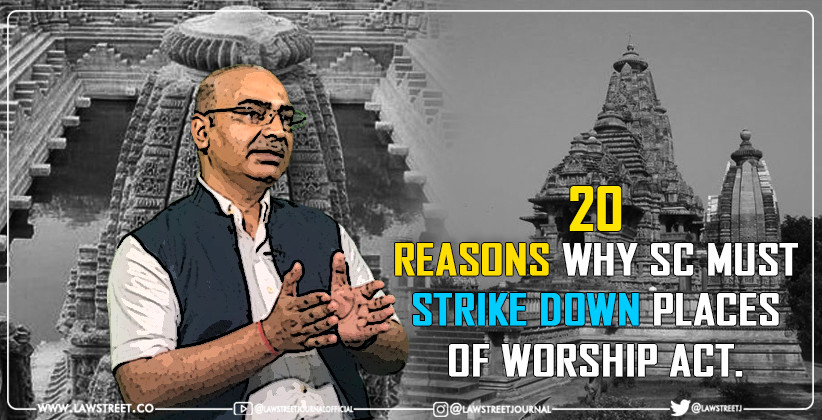
Places of Worship Act is illegal and unconstitutional because:
1. It has been enacted in the garb of Public order, which is a State subject [Entry-1, List-II, Schedule-7]. Likewise, Pilgrimage, other than pilgrimages to places outside India is also State subject [Entry-7, List-II, Schedule-7]. Therefore, Centre has no legislative competence to enact the impugned Act.
2. Article 13(2) prohibits the State to make laws to take away the rights conferred under Part-III but the Act takes away the rights of Hindus Jains Buddhist Sikhs to restore their places of worship and pilgrimages, destroyed by barbaric invaders.
3. It excludes the birthplace of Lord Rama but includes birthplace of Lord Krishna, though both are the incarnation of Lord Vishnu, the Creator and equally worshiped all over the world, hence arbitrary, irrational and offends Articles 14-15.
4. Right to justice, right to judicial remedy, right to dignity are integral part of Article 21 but impugned Act brazenly offends them.
5. Rights to pray, profess, practice and propagate religion of Hindus Jains Buddhists Sikhs, guaranteed under Article 25, have been deliberately and brazenly offended by the Act.
6. The impugned Act blatantly offends the rights of Hindus Jains Buddhists Sikhs to restore, manage, maintain and administer the places of worship and pilgrimage, guaranteed under Article 26.
7. Right to restore and preserve the script and culture of the Hindus Jains Buddhists Sikhs, guaranteed under Article 29 of the Constitution has been brazenly offended by the impugned Act.
8. Directive principles are nevertheless fundamental in the governance of the Country and Article 49 directs the State to protect the places of national importance from disfigurement and destruction.
9. State is obligated to respect the ideals and institutions and value and preserve the rich heritage of Indian culture.
10. Only those places can be protected, which were erected or constructed in accordance with personal laws of the person who erected/constructed them, but places erected/constructed in derogation of the personal law, cannot be termed as a place of worship.
11. The retrospective cutoff-date i.e. 15.8.1947 was fixed to legalize the illegal acts of barbaric invaders and foreign rulers.
12. The Hindu Law was the Law in force at the commencement of the Constitution by virtue of the Article 372(1).
13. Hindus Jains Buddhists Sikhs have right to profess, practice propagate religion as provided in their religious scriptures and Article 13 prohibits from making law which takes away their rights.
14. The status of mosques can be given only to such structures which have been constructed according to tenets of Islam and all the mosques constructed against the provisions contained in Islamic law cannot be termed as mosque. Thus, Muslims cannot assert any right with respect to any piece of land claiming to be mosques unless the same has been constructed according to Islamic law. Moreover, the property vested in the Deity continues to be the Deitys property irrespective of the fact that any person has taken illegal possession.
15. Section 4(1) violates the concept that Temple property is never lost even if is enjoyed by strangers for hundreds of years; even the king cannot deprive temples of their properties. The Idol/deity which is embodiment of supreme God and is a juristic person, represents the Infinite- the timeless cannot be confined by the shackles of time.
16. On the touch stone of the principle of secularism, read with Articles 14-15, it is very clear that State cannot show its inclination/hostile attitude towards any religion, may be majority or minority. Thus, the impugned act violates the principle of secularism as it curbs the right of Hindus Jains Buddhists Sikhs for restoration of their places of worship destroyed before 15.8.1947 even through Court.
17. The impugned act, without resolution of dispute through process of law, has abated the suit and proceedings, which is unconstitutional and beyond the law making power of the Centre. The impugned provisions cannot be implemented with retrospective effect and the remedy of disputes pending, arisen or arising cannot be barred. Centre neither can close the doors for aggrieved persons nor can take away the power of Courts of first instance, Appellate Court and Constitutional Courts, conferred under Article 226 or 32. The maxim ubi jus ibi remedium hasbeen frustrated by the impugned Act as pending suits/proceeding in respect of which cause of action has arisen and continues wrong, the remedy of the aggrieved person for resolution of disputes through Court have been abolished, which violate the very concept of justice and Rule of law.
18. The mosque constructed at temple land cannot be a mosque, not only for the reason that such construction is against Islamic law, but also on grounds that the property once vested in the deity continues to be deitys property and right of deity and devotees are never lost, howsoever long illegal encroachment continues on such property. Right to restore back religious property is unfettered and continuing wrong and injury may be cured by judicial remedy.
19. Barbaric invaders destroyed a number of places of worship and pilgrimage to make Hindus Jains Buddhists Sikhs to realize that they have been conquered and have to follow the dictum of the Ruler. Hindus Jains Buddhists Sikhs had suffered from 1192 to 1947. Question is as to whether even after the independence; they cannot seek judicial remedy to undo the barbarian acts through process of court to establish that law is mightier than the sword.
20. There are many International Conventions on the cultural and religious heritage and India is signatory of them. Therefore Centre is obligated to act in accordance with the conventions viz. (i) Fourth Geneva Convention 1949 reinforced the protection of Places of worship which constitute cultural - spiritual heritage of people (ii) Statutes of United Nations and UNESCO (iii) Hague Convention for the Protection of Cultural Property in the event of Armed conflict 1954 (iv) World Heritage Convention 1972 (v) Convention for the Protection of Architectural Heritage of Europe 1985 (vi) European Convention on Protection of Archaeological Heritage 1969 (vii) European Landscape Convention 2000 and (viii) The European Convention on Protection and Promotion of Diversity of Cultural Expressions 2005.