“If it takes a village to raise a child, it also takes a village to raise a rapist”
~Jackson Katz
When gender violence educator Jackson Katz famously used these words, he wasn't speaking about a physical village. He was speaking about the "village" of our institutions—the systems of power, the silence of peers and the failures of the law that collectively enable a predator. The Kuldeep Singh Sengar case stands testament to it wherein a village has been meticulously documented: from the local police who initially refused to lodge an FIR, to the political machinery that vehemently shielded him, to the tragic custodial death of the victim’s father after being assaulted by the MLA’s brother or the fact that the victim and her family were the scapegoat of a meticulously planned “accident” resulting in the untimely demise of her two aunts and her lawyer. So much so that the Hon’ble Supreme Court of India was compelled to take suo moto cognizance of the matter in 2019. Yet, on December 23, 2025, the Delhi High Court added a new, baffling layer to this institutional protection of a predator. By suspending Sengar’s life sentence on a semantic technicality, ruling that a sitting MLA is not a "public servant" under the IPC, the court has effectively chosen a dictionary definition over the spirit of justice. In doing so, the law has moved from being the survivor’s shield to becoming a part of the very "village" that enables the powerful. The victim’s fault? The fact that she chose to voice the injustice perpetrated against her and her family by a political bigot, a criminal; and the price she paid was beyond anything which the Hon’ble Courts could ever quantify.
This verdict is a rude shock, a clarion call that makes one realize that it is only the certain socially and economically privileged that have the opportunity of protecting one’s own child in this country — a privilege that, in the face of political impunity, the common citizen simply does not have. The ardous plight of a young teenage girl from a Tier 2 city seems to have been made into an example as to how political positions of authority have the power to determine the unfortunate destiny of a young teenage girl, despite having mutilated her bodily integrity, her dignity and prestige. The young victim she was made to face a macabre fate where she was traded, passed around among various barbarians as a commodity to gratify their carnal desires, and then as if all of that were not enough, Sengar also tried to obliterate her very existence. The girl’s fault one might ask? She was an ordinary citizen of the country without any access to personnels of authority. Perhaps, the recent judgement of the Delhi High Court is a standing testimony as to how the vulnerable sections of our society would continue to be disposable and dispensable to politically connected goons. What I mean is this: why is the judicial system treating her in this manner? Is it because she is a poor and powerless woman? In my view, this judgment does not merely passively endorse rape culture, it actively reinforces it.
Our judicial system exists to make sure that the fundamental rights of the citizens of this country are protected, but law loses its moral authority when it prioritizes legal acrobatics over human life. The verdict does more than just grant temporary liberty to a convict; it strikes a devastating blow to the very foundation of public trust in the Indian judiciary. When the law retreats into the safety of semantic technicalities, debating the dictionary definition of a "public servant" while ignoring a decade of documented terrors of human trafficking, sex slavery, custodial death and highway bloodshed—it sends a chilling message to every citizen: that the rules are flexible for the powerful but the cage is absolute for the weak.
There is a bitter irony in the court’s focus on whether an MLA fits the narrow definition of a 'public servant' under the IPC. In every other sphere of Indian life, a lawmaker is the ultimate public figure—vested with the trust of thousands, paid by the state exchequer and granted the power to shape the very laws that govern us. To suggest that this power suddenly vanishes, or becomes 'private,' the moment it is used to exploit a child is a legal fiction that no common citizen can swallow. If the law recognizes an MLA as a public servant when they take a bribe, but refuses to see them as such when they commit a heinous crime, it has effectively created a hierarchy where money is more sacred than the dignity of a human being.
For a victim who was raped, sold and nearly killed, the court as the protector of rights and custodian of justice, was supposed to be the final sanctuary where might does not equal right. Instead, by allowing a convicted perpetrator to walk free on a linguistic nuance, the system has signaled that institutional memory is short and political impunity is long. This is not just a legal blunder; it is a profound betrayal of the social contract and constitutional responsibility entrusted upon the Higher Judiciary in India. Every time a "technicality" trumps the safety of a survivor, the common man’s faith in the scales of justice tips further toward cynicism, reinforcing their defeatism, leaving behind a country where justice feels less like a right and more like a high-priced commodity that only the rich and powerful can afford to purchase for themselves.
In a move of startling gaslighting, the Court argued that keeping Sengar in custody out of 'apprehension' would 'undermine the laudable work' of our police and paramilitary forces. This is a hollow defense. To suggest that the survivor’s fear is an insult to the uniform is to ignore the blood-stained history of this very case. It was the local police who initially refused to register the rape; it was the police who stood by as the survivor’s father was brutally assaulted; and it was in police custody that he ultimately died. Respect for an institution is earned through the protection of the weak, not by using its reputation as a pretext to release the powerful. By framing the survivor’s legitimate fears as a lack of faith in the police/paramilitary forces, the court has weaponized 'institutional respect' to silence a victim’s lived experience. It is not an 'insult' to the forces to acknowledge that a powerful man’s reach can bypass even the strongest security—it is a documented fact of her life.
It is a staggering contradiction: the state admits she is in mortal danger by stationing armed guards at her door, yet the court simultaneously rules that the man she needs protection from is safe enough to be sent back into society. By this ruling, the court is effectively telling her that while the state will provide a shield, it will also sharpen the sword of her oppressor.
The survivor was just 17 when she became a victim of this horrendous crime, losing not only her childhood at the hands of powerful men, but also enduring the murders of her family members by the perpetrators. And now, she is a married woman with young children who is once again left helpless right in front of the evil predator who destroyed her life—this time, by the judiciary.
Back then, she was a helpless teenage girl whom nobody could protect—a girl who could not see the same future for herself that any other girl her age would have. Just when she had finally begun to live more peacefully, got married, had children and probably even felt that the world may not be that cruel after all, the court has now made her a helpless mother who is begging for help, because she fears that the same fate awaits her young children now.
The High Court’s so called “technical” decision is a human disaster that has created a full circle of tragedy, moving the survivor from the innocent, young and vulnerable girl who couldn’t be protected by her parents or the system, to the helpless mother who now cannot protect her own children.
The raison d'être behind the enactment of the Protection of Children from Sexual Offences (POCSO) Act, 2012 so that the legal machinery is an uncompromising and unblemished shield for the minor, especially when the perpetrator occupies a position of authority. The legislature intended for POCSO to override the technical loopholes of the IPC to ensure that 'aggravated' crimes, those committed by individuals in positions of public trust, were met with the harshest possible reckoning. By reducing a lawmaker’s status to a semantic debate over the definition of a 'public servant,' the High Court has effectively defanged this landmark legislation. It has sent a message that the status of an MLA is a cloak of protection rather than a burden of responsibility. This ruling does not just erode a sentence, it also erodes the promise the state made to every child in this country: that their dignity is more valuable than any political title or linguistic nuance.
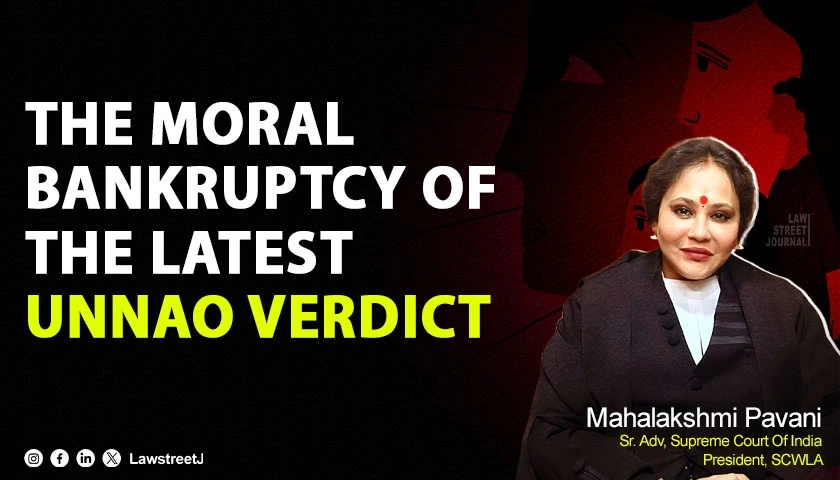
In the end, all I would like to say is that that the Delhi High Court has committed a grave judicial sin; unforgivable, grave and equally depraved of the constitutional rights endowed on a citizen of this country. By prioritizing a narrow, semantic interpretation over the safety of a survivor, it has forgotten that our laws are meant to be a shield for the vulnerable, not a sanctuary for the powerful. I can only hope that the Hon’ble Supreme Court of India moves swiftly to undo this monumental blunder. It must also send a clear, unshakeable message: that justice in this country is defined by the substance of human rights, not the shadows of linguistic technicalities.
Author:
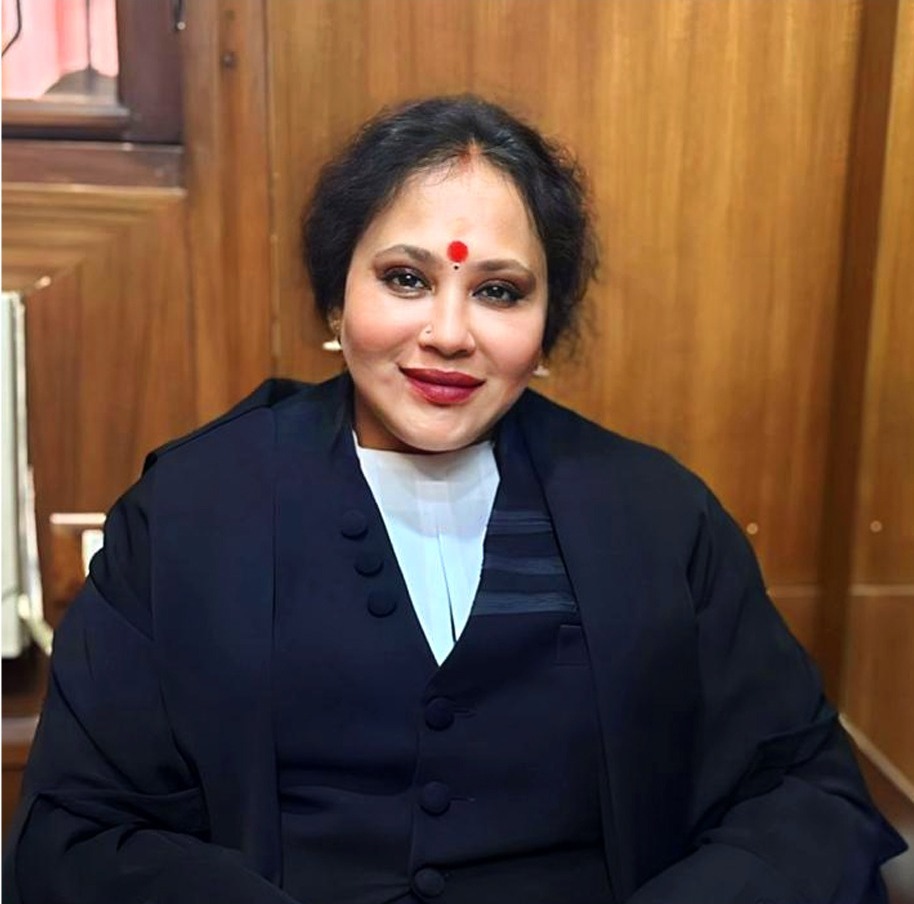
Mahalakshmi Pavani, Senior Advocate, Supreme Court.
Views expressed are Personal.
Author acknowledges the assistance of Ms.Prabisha Pradeep, Advocate.