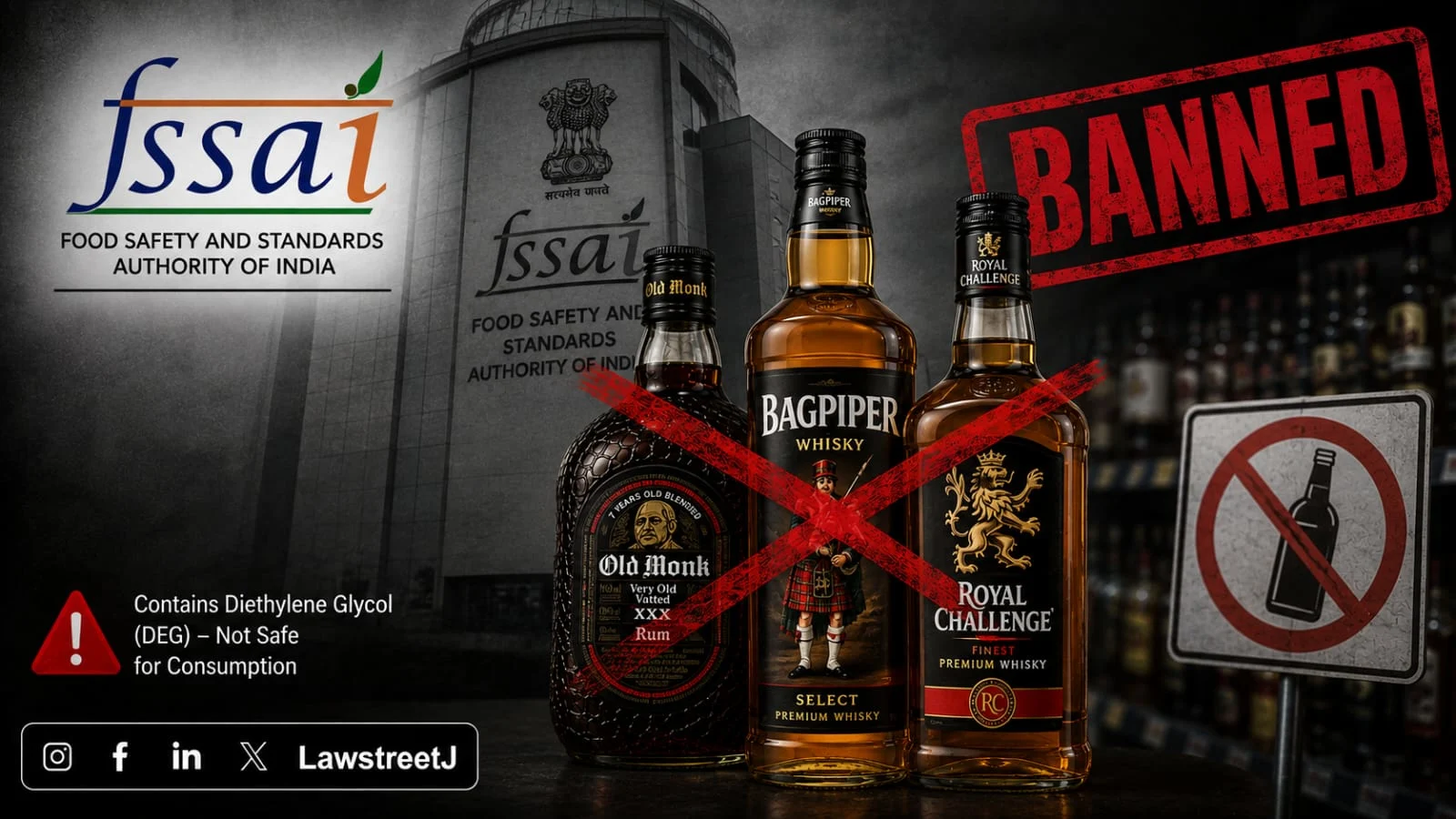

New Delhi: The Food Safety and Standards Authority of India has ordered a halt to the sale of ten specific alcoholic beverage variants from some of India's most recognisable spirits brands, following factory inspections and laboratory tests that found the use of artificial flavouring agents to mimic the natural taste of rum and whisky, and false age claims on product labels. The action, confirmed by FSSAI and the Ministry of Health and Family Welfare on August 3, 2026, targets products from three major manufacturers, Diageo India's United Spirits, Inbrew Beverages, and Mohan Rocky Springwater and has sent one of India's most commercially significant domestic liquor segments into regulatory uncertainty.
The Ministry of Health and Family Welfare said investigations found that some manufacturers were producing alcoholic beverages mainly from spirit or extra-neutral alcohol and later adding flavours to recreate the sensory characteristics of products such as rum and whisky.
The government has clarified that this is a standards and labelling compliance issue, not a case of counterfeit or spurious liquor.
The Full List of Affected Products and Facilities

The prohibition-of-sale orders are facility-specific, meaning they apply to products manufactured at particular plants not to every bottle of a given brand sold across India.
Following non-conforming laboratory reports, FSSAI prohibited the sale of products manufactured at the following specific facilities: Mohan Rocky Springwater, Khopoli (Maharashtra): Old Monk The Legend, Gold Reserve, and XXX Matured Rum. United Spirits, Baramati (Maharashtra): McDowell's No. 1 Rum. United Spirits, Madhya Pradesh: Antiquity Blue Whisky and Royal Challenge Whisky. INBREW Beverages, Madhya Pradesh: Bagpiper Deluxe Whisky and Old Cask Deluxe XXX Rum. Associated Alcohol & Breweries, Madhya Pradesh: Central Province Whisky and McDowell's No. 1 Celebration Matured XXX Rum.
Separately, inspections and product sampling were carried out at the Goa premises of Mandexi Distilleries and Breweries. The ministry said notices have also been issued to six other manufacturers in Maharashtra, with further regulatory action expected based on the outcome of the investigation.
FSSAI underscored that this enforcement does not represent the entire alcoholic beverage industry, acknowledging that many manufacturers continue to produce compliant products.
What the Regulations Say and What Was Violated

The legal foundation for the action rests primarily on the Food Safety and Standards (Alcoholic Beverages) Regulations, 2018, which govern how spirits must be manufactured, labelled, and marketed in India.
Under the Food Safety and Standards (Alcoholic Beverages) Regulations, 2018, adding artificial or nature-identical flavourings that imitate a spirit's natural taste is prohibited. FSSAI says that general additives like vanilla or coffee flavours are allowed, but adding the profile of the exact alcohol drink lacks justification since a neutral alcohol base is already used. If it is added, it must be declared as a flavoured spirit rather than standard liquor.
The regulator's position on this point was stated with unusual directness. FSSAI said in a statement: "There is no internationally recognised manufacturing practice whereby rum flavour is added to rum or whisky flavour is added to whisky."
Investigations revealed that several manufacturers were producing beverages using neutral or extra-neutral alcohol, which lacks inherent flavour, and spiking them with external flavourings to fake the expected sensory profile. Laboratory reports concluded that "the addition of artificial flavours is masking its natural flavour and making the product substandard." The failure to label such products as flavoured or premix variants could mislead consumers.
Tests conducted by the authority at Diageo and Inbrew factories found that flavour corresponding to the drink's category was added. As flavouring can be used to mask neutral spirits, the regulator said this might lead companies to skip proper maturation. This also eliminates the need for companies to use ingredients traditionally involved in making spirits, such as molasses, malt, and grapes.
The second category of violation, misleading age claims is equally significant and is governed directly by Section 24 of the Food Safety and Standards Act, 2006, which prohibits false or misleading claims on food labels.
The ministry flagged the "7 Years Old Blended" claim on an Old Monk XXX Rum variant as misleading. According to the investigation, the product's primary ingredient was neutral, unmatured spirit, while matured rum spirit accounted for less than 5 per cent of the blend. The ministry said this violated the Food Safety and Standards (Alcoholic Beverages) Regulations, 2018, which require age claims to be based on the youngest spirit in the blend.
Put plainly: a product cannot carry a claim of being "7 years old blended" if the overwhelming majority of the liquid in the bottle is unmatured neutral spirit. The law requires the age claim to reflect the youngest ingredient in the blend, meaning a bottle that is 95 per cent fresh neutral spirit cannot legally claim to be a seven-year-old product.
The Brands, Their Standing, and What This Means

The commercial significance of the FSSAI action can be understood through the individual standing of the brands affected.
Old Monk, produced by Mohan Rocky Springwater, has been in production since 1965 and carries near-iconic status in Indian rum culture, particularly in North India, where it has a deeply loyal consumer base across generations. The fact that three of its variants, Old Monk The Legend, Gold Reserve, and XXX Matured Rum are included in the ban makes this the most commercially visible part of the regulatory action.
McDowell's No. 1 is among India's largest-selling spirit brands, with a consumer reach that spans economic segments and geographies. The ban on its rum variant produced at the Baramati facility in Maharashtra carries significant market implications for United Spirits, which also produces Antiquity Blue Whisky and Royal Challenge Whisky, both now barred from sale from their Madhya Pradesh facility.
Antiquity Blue positions itself as a premium blended whisky. Bagpiper is positioned as an affordable whisky and is widely consumed across South and West India. Royal Challenge is a mid-range whisky brand with significant market presence.
With India's rising preference for imported alcohol, the crackdown on domestic brands might further decrease Indian-Made Foreign Liquor sales. The IMFL segment, which covers spirits produced in India regardless of the style they are marketed in, has already been under pressure from cheaper imports and evolving consumer tastes. The FSSAI action adds a regulatory layer of uncertainty at a difficult time for the domestic industry.
Scope of Further Action
The enforcement action is part of FSSAI's efforts to ensure compliance with labelling and quality standards for alcoholic beverages and prevent consumers from being misled by product descriptions and age claims. The ministry's reference to notices issued to six additional manufacturers in Maharashtra, and to inspections under way at premises in Goa, indicates that the current set of bans may represent only the first stage of a broader enforcement exercise.
The action is based on the Food Safety and Standards (Alcoholic Beverages) Regulations, 2018. The MoHFW further alleged that some manufacturers produced beverages primarily from spirit or extra-neutral alcohol and used flavours to recreate sensory characteristics, thereby misrepresenting the products to consumers. The ministry claimed consumers were not adequately informed about the true nature of these products on the front of the packaging.
No response from the affected manufacturers, Diageo India's United Spirits, Inbrew Beverages, or Mohan Rocky Springwater has been officially recorded in the ministry's public communication as of the time of publication. Consumers who currently hold bottles of the affected variants from facilities other than those named in the prohibition orders are not directly affected by the ban, as the orders are facility-specific and not brand-wide.