

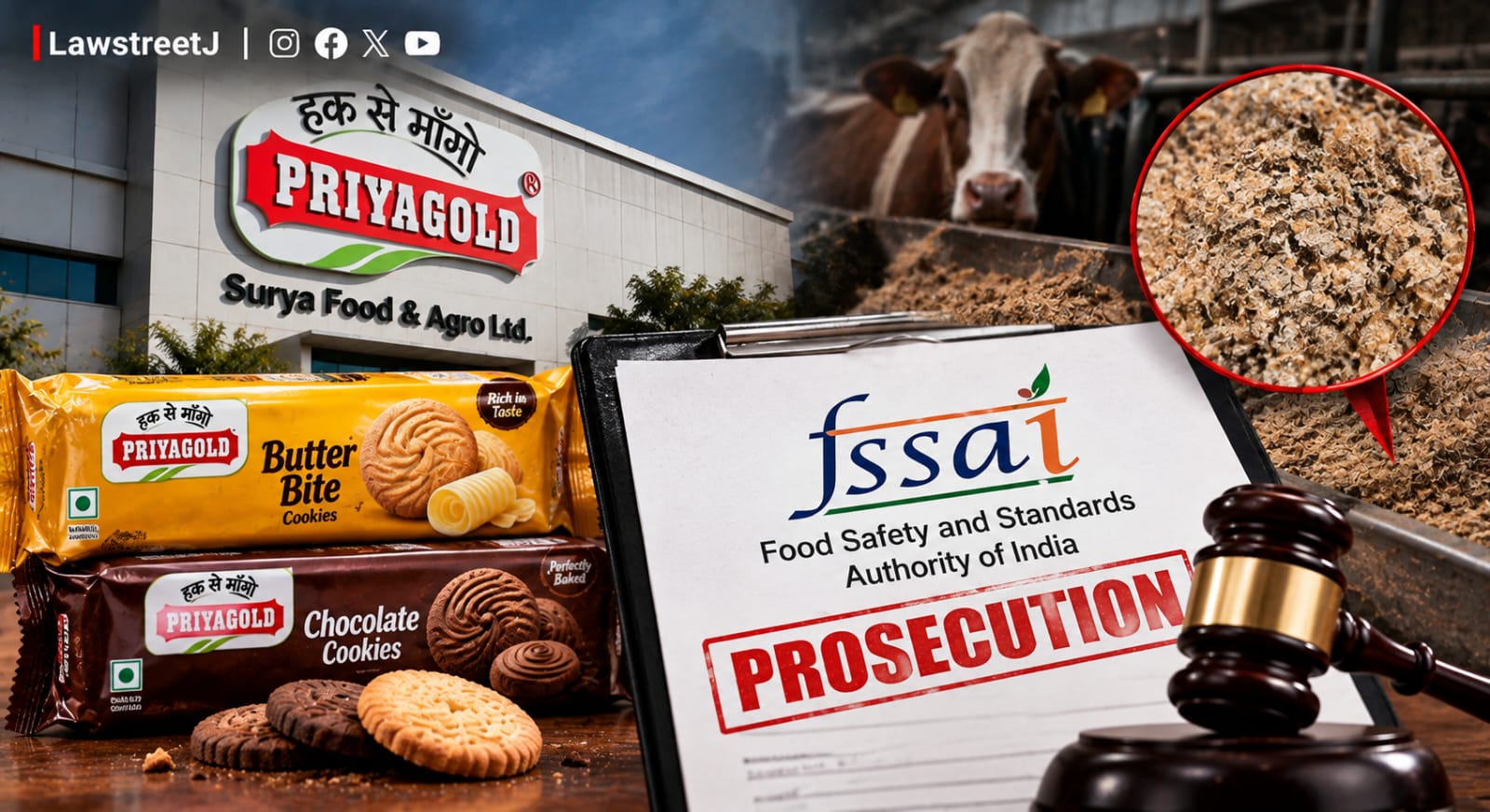
New Delhi — India's food safety regulator, the Food Safety and Standards Authority of India (FSSAI), has initiated legal proceedings for prosecution against Surya Food & Agro, the manufacturer of Priyagold biscuits, after inspectors found that bran meant for cattle feed was being used as a raw material in biscuit manufacturing. In the same enforcement action, announced via a social media post on Saturday, the regulator also initiated prosecution proceedings against Dodla Dairy over a substandard and unsafe milk sample, and against UEIR Organic Foods over pesticide residues detected in yellow raisins.
FSSAI conducted an inspection of Surya Food & Agro's facility following a consumer complaint, during which officials observed serious food safety and hygiene deficiencies. The regulator stated that "bran meant for cattle feed and not intended for human consumption was found being used as a raw material in Priyagold biscuit manufacturing as a source of fibre." Based on these findings, FSSAI has initiated legal proceedings for prosecution against the company for what it described as serious food safety violations.
The Findings Against Dodla Dairy
In the case of Dodla Dairy, a sample of the company's full cream milk was found to be substandard. Upon an appeal filed by the company contesting the initial finding, the sample was referred to the Referral Food Laboratory for further analysis. The Referral Food Laboratory confirmed that the sample was unsafe due to the presence of detergent or caustic soda, and separately substandard due to milk fat content falling below the minimum prescribed limit.
Based on this confirmed finding, authorities have directed further prosecution proceedings in respect of both the unsafe and substandard classifications of the product.
In the case of UEIR Organic Foods, FSSAI's testing found pesticide residues present in a sample of yellow raisins sold by the company, in excess of permissible limits under applicable food safety standards. This finding has similarly resulted in the initiation of prosecution proceedings against the company.
Legal Framework
FSSAI's enforcement actions proceed under the Food Safety and Standards Act, 2006, India's principal legislation governing food safety regulation, which establishes distinct statutory categories and corresponding penalties for different types of food safety violations. Under Section 3(1)(zz) of the Act, "unsafe food" is defined as an article of food whose nature, substance or quality is so affected as to render it injurious to health, through contamination, the presence of extraneous matter, or other specified conditions, including the addition of a substance directly or indirectly rendering it injurious to health.
Under Section 59 of the Act, the manufacture, sale, storage or distribution of unsafe food is punishable with imprisonment that may extend to six months and a fine of up to one lakh rupees where the unsafe food does not result in injury, with substantially higher penalties, including life imprisonment, prescribed where unsafe food causes death.
"Substandard food," a distinct statutory category defined under Section 3(1)(zx) of the Act, refers to an article of food that does not meet the specified standards prescribed under the Act's regulations, though not necessarily to a degree rendering it injurious to health. Section 51 of the Act prescribes a penalty for manufacturing, selling or distributing substandard food of up to five lakh rupees. The use of an ingredient, such as cattle feed bran, not intended or permitted for human consumption in a food product intended for human consumption may engage provisions relating to both adulteration and substandard or unsafe classification, depending on the specific findings of the testing laboratory and the applicable food safety standards for the product category concerned, here, biscuits.
Section 46 of the Act governs the procedure for food analysis, including the right of a food business operator to challenge an initial laboratory finding by requesting that a sample be sent to a Referral Food Laboratory for further analysis, as occurred in the Dodla Dairy matter, where the Referral Food Laboratory's confirmation of the original finding of unsafe and substandard classification cleared the way for prosecution to proceed. Food Safety Officers are empowered under Section 38 of the Act to inspect any place where food business is conducted, collect samples, and initiate the process leading to prosecution where violations of the Act or its regulations are found.