


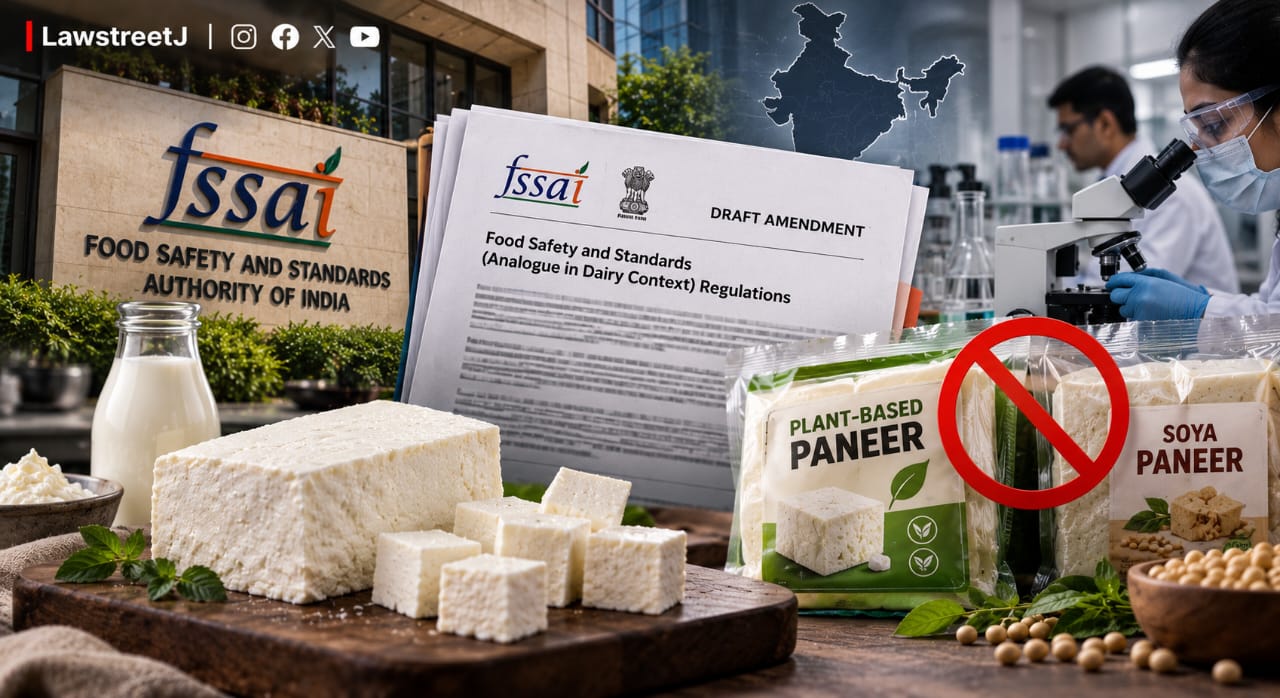
New Delhi — India's apex food safety regulator has moved to restrict the use of the term "paneer" for products manufactured from non-milk ingredients, in a draft regulatory amendment that could reshape labelling practices across the country's dairy and dairy-alternative food sector. The proposal follows more than a year of enforcement action by several state governments against so-called "analogue paneer," products designed to resemble conventional paneer but made using vegetable oils, fats, or proteins instead of milk.
The Draft Regulation
On September 22, 2026, the Food Safety and Standards Authority of India (FSSAI) published the draft Food Safety and Standards (Prohibition and Restrictions on Sales) Amendment Regulations, 2026, in the Gazette of India. The draft was issued under Section 92 of the Food Safety and Standards Act, 2006, which empowers the Central Government, on the recommendation of the Food Authority, to make regulations consistent with the Act and its provisions.
The proposed amendment seeks to insert a new clause into Regulation 2.1.1 of the existing Food Safety and Standards (Prohibition and Restrictions on Sales) Regulations, 2011. The new clause would specifically prohibit the sale of "paneer made of constituents not derived from milk." Under FSSAI's current standards, paneer is defined as a product prepared exclusively from milk or milk solids by coagulation and separation of curd from whey. The draft amendment is intended to ensure that only products meeting this definition may be represented, labelled, or marketed using the term "paneer."
Under the proposal, products that are already licensed or registered under the "Analogue in Dairy Context" category, and which are made from constituents not derived from milk, would be required to discontinue use of the word "paneer" in their nomenclature, labelling, and marketing materials. FSSAI has stated that the objective of the amendment is to ensure that the nomenclature and presentation of food products accurately reflect their nature and composition, allowing consumers to make informed purchasing decisions.
Notably, the draft does not propose an outright prohibition on the sale of non-dairy paneer-like products themselves. Rather, it restricts the specific use of the term "paneer" in connection with such products. This distinction means that, if the amendment is finalised in its current form, manufacturers may continue to produce and sell compliant analogue products, provided they are marketed under names that clearly distinguish them from conventional dairy paneer.
As with all draft regulations issued under the Food Safety and Standards Act, 2006, the proposed amendment is subject to a mandatory public consultation period. FSSAI has invited objections and suggestions from stakeholders and members of the public for 60 days from the date the Gazette notification was made available, placing the consultation deadline in late November 2026.
Submissions may be addressed to the Chief Executive Officer, FSSAI, at FDA Bhawan, Kotla Road, New Delhi. Under the standard regulatory process, the draft will be examined in light of the objections and suggestions received before any final notification is issued. The current publication therefore does not constitute a final or enforceable nationwide ban; it remains a proposal open to revision.
Regulatory Background: What Are Dairy Analogues
Dairy analogues are food products manufactured to imitate the taste, texture, or appearance of conventional dairy items without using milk-derived ingredients as their primary component. In the case of analogue paneer, manufacturers typically substitute milk fat or milk protein with vegetable oils, vegetable fats, or vegetable proteins to replicate the appearance and texture of traditional paneer at a lower production cost. Because such products are visually similar to conventional paneer, regulators have raised concerns that consumers may be unable to distinguish between the two at the point of sale, particularly in food service settings such as restaurants, hotels, and cloud kitchens where the ingredient composition is not always disclosed.
FSSAI's West Region had earlier addressed a related concern in April 2026, when it directed food businesses not to sell cheese analogue products as "paneer" and instructed establishments using such substitutes to disclose this on menus or display boards. The regulator characterised the practice of presenting analogue products as conventional dairy items without disclosure as a serious violation of food safety and labelling norms.
The national draft regulation follows enforcement action already undertaken by individual state governments, which have used their existing statutory powers to address analogue paneer within their jurisdictions ahead of any central rule change.
Chhattisgarh became the first state to impose restrictions specifically targeting analogue paneer. Maharashtra followed as the second state, issuing a state-wide prohibition through its Food and Drug Administration (FDA). The Maharashtra order, issued by Food Safety Commissioner Tukaram Mundhe, invoked Section 30(2)(a) of the Food Safety and Standards Act, 2006, a provision that allows the Commissioner of Food Safety to prohibit, in the interest of public health, the manufacture, storage, distribution, or sale of any article of food, either in the whole state or a specified area, for a period not exceeding one year. The order, published in the Official Gazette on July 30, 2026, took immediate effect and prohibited the manufacture, processing, preparation, packing, storage, distribution, transport, and both wholesale and retail sale of analogue or non-dairy paneer across Maharashtra for a period of one year.
According to the Maharashtra FDA, the decision followed a year-long statewide surveillance and sampling exercise conducted between April 1, 2025, and March 31, 2026, during which 308 paneer samples were tested. Of these, 109 samples, or 35.4 percent, failed to conform to prescribed quality standards. Within this group, 79 samples were classified as sub-standard and 30 were classified as unsafe for consumption. Officials stated that routine inspections, sampling exercises, and public awareness campaigns conducted prior to the ban had not adequately curbed the sale of non-compliant analogue paneer, prompting the decision to invoke the one-year prohibitory order.
The Maharashtra ban was accompanied by a state-wide enforcement drive involving Food Safety Officers and Assistant Commissioners, who were directed to inspect manufacturing units, warehouses, transport networks, wholesale markets, retail outlets, and food service establishments. As part of this enforcement effort, officials reported conducting inspections that led to the seizure of approximately 1,400 kilograms of adulterated paneer and around 718 litres of palm oil, an ingredient commonly used as a substitute for dairy fat, from a warehouse in Manjari Khurd, Pune. Across the broader inspection drive, authorities reported conducting 30 raids, arresting 28 individuals, inspecting 98 food establishments, and suspending 14 food licenses.
Maharashtra FDA officials clarified that the one-year duration of the ban was a statutory limit under Section 30(2)(a) of the Food Safety and Standards Act, 2006, which does not permit a permanent prohibition to be imposed through this specific provision. Officials also noted that, in the absence of a centrally notified quality standard specifically applicable to analogue paneer, state authorities had limited regulatory tools available beyond the temporary prohibitory order. The FDA further stated that serving analogue paneer to consumers as though it were conventional dairy paneer, without disclosure, would amount to an unfair trade practice under the Food Safety and Standards Act and would attract penal action under the Act's provisions.
Beyond Maharashtra and Chhattisgarh, several other states, including Gujarat and Karnataka, have introduced their own restrictions targeting analogue paneer, reflecting a broader pattern of state-level regulatory action preceding the central government's proposed amendment.
Legal Basis and Regulatory Framework
The proposed central amendment and the preceding state actions draw on distinct but related provisions of the Food Safety and Standards Act, 2006. State-level prohibitory orders, such as the one issued in Maharashtra, rely on Section 30(2)(a), which grants Commissioners of Food Safety the power to impose temporary, localised or state-wide prohibitions on specific food articles in the interest of public health, subject to a maximum duration of one year.
By contrast, the FSSAI's national draft amendment is being pursued through Section 92 of the Act, which allows for the creation of binding regulations of general application following a mandatory public consultation process. Regulations made under Section 92, once finalised, would not be subject to the one-year limitation that applies to state-level prohibitory orders, and would apply uniformly across India rather than on a state-by-state basis.
The Act separately addresses the mislabelling of food products under its provisions concerning misbranded food, which cover food items whose labelling is false or misleading regarding their true character, nature, or composition. Enforcement actions concerning the sale of analogue products as conventional paneer without disclosure have been framed by regulators with reference to these consumer-protection provisions of the Act.
As of the date of this report, the Food Safety and Standards (Prohibition and Restrictions on Sales) Amendment Regulations, 2026, remain in draft form. The 60-day public consultation window remains open, and no final notification incorporating the proposed restriction on the term "paneer" has yet been issued. The regulation will be considered for finalisation after the expiry of the consultation period, taking into account objections and suggestions received from stakeholders, manufacturers, and the public.




.jpeg)

