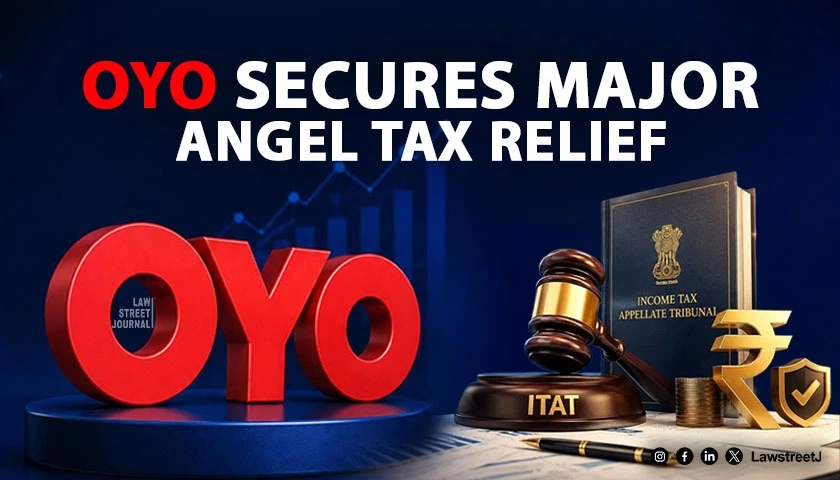
The Income Tax Appellate Tribunal (ITAT), Delhi Bench has deleted a massive addition of Rs 3,885.51 crore made against OYO Hotels and Homes Private Limited (OHHPL) under Section 56(2)(viib) of the Income Tax Act, 1961, holding that the said provision, being an anti-abuse measure targeted at curbing the circulation of unaccounted money, cannot be invoked in respect of share premium received by a subsidiary company from its holding company on issuance of Compulsory Convertible Preference Shares (CCPS).
A bench comprising Shri Vimal Kumar (Judicial Member) and Shri S. Rifaur Rahman (Accountant Member) pronounced the order on June 4, 2026, in OYO Hotels and Homes Private Limited v. DCIT, Circle 19(1), New Delhi [ITA Nos. 5718 & 7237/Del/2025, Assessment Year 2021-22]. The Tribunal partly allowed the assessee’s appeal while dismissing the Revenue’s cross-appeal in its entirety.
Background
OYO Hotels and Homes Private Limited (OHHPL) is primarily engaged in the business of marketing, managing and operating hotels, long-term and short-term stay homes, guest houses and other accommodation, providing technical know-how and training in hotel operations, and marketing and managing boarding and lodging services.
During the Assessment Year 2021-22, the company had issued Compulsory Convertible Preference Shares (CCPS) to its parent company, Oravel Stays Limited (OSL), in two tranches: 9,90,540 shares in April 2020 at a premium of Rs 2,316 per share (aggregate consideration of approximately Rs 230 crore), and 1,63,91,430 shares in November 2020 at a premium of Rs 2,140.50 per share (aggregate consideration of approximately Rs 3,672 crore). The total consideration received was approximately Rs 3,902 crore, with a share premium component of approximately Rs 3,737 crore.
To justify the share valuation, OHHPL had obtained valuation certificates from two independent experts using the Discounted Cash Flow (DCF) method, a Category I SEBI-registered merchant banker for the April 2020 issuance, and a registered valuer (Chartered Accountant) for the November 2020 issuance.
Assessment And CIT(A) Order
The Assessing Officer (AO) found multiple discrepancies in the valuation reports and rejected the DCF-based valuation on grounds including: use of unaudited balance sheets; failure to account for the COVID-19 pandemic’s devastating impact on the hospitality sector (despite the share subscription agreement being signed in April 2020, well after the pandemic’s onset); excessively aggressive growth projections (41% to 80% per annum) unsupported by the company’s actual financial performance; and significant deviation between projected and actual revenue figures.
The AO additionally invoked Section 56(2)(viib) on the conversion of 1,63,91,430 CCPS issued in earlier years into equity shares during the year under consideration, taxing a further amount of Rs 147.52 crore as excess share premium. The total addition under Section 56(2)(viib) was Rs 3,885.51 crore. Penalty proceedings were also initiated under Section 270A for alleged misreporting.
The National Faceless Appeal Centre (NFAC), Delhi confirmed the AO’s additions in its order dated September 10, 2025, finding the AO’s technical analysis of the valuation process to be “full of merit and extremely convincing.”
Assessee’s Submissions Before ITAT
Senior Advocate Shri Ajay Vohra, appearing for OYO, advanced submissions on two principal limbs. First, that Section 56(2)(viib), being an anti-abuse provision introduced to arrest the circulation of unaccounted money, cannot be extended to transactions involving share issuance by a subsidiary to its own holding company, since no infusion of unaccounted funds was involved or alleged. In this regard, reliance was placed on the Delhi High Court’s decision in FIS Payment Solutions and Services India Private Limited v. Union of India [W.P.(C) 10289/2024], as also coordinate bench decisions of ITAT Delhi including ITO v. K V Global Pvt. Ltd. [2024], which had upheld non-applicability of Section 56(2)(viib) even in cases where the holding company held 51% (not necessarily 100%) of the shares.
Second, and without prejudice, that once the assessee had lawfully opted for the DCF method under Rule 11UA(2) of the Income-tax Rules, the AO had no authority to substitute the Net Asset Value (NAV) method. Reliance was placed on the Delhi High Court’s judgment in PCIT v. Cinestaan Entertainment (P.) Ltd. (2021) and the Bombay High Court’s judgment in Vodafone M-Pesa Ltd. v. Pr. CIT (2018), both of which had settled that the method of valuation is the option of the assessee and the AO cannot change it.
It was also submitted that the issuance was a downstream investment by a foreign-owned and controlled company (FOCC), made in compliance with FEMA regulations and Foreign Exchange Management (Non-Debt Instruments) Rules, 2019, thereby placing the transaction completely outside the scope of the anti-abuse provision.
ITAT’s Findings And Reasoning
On Section 56(2)(viib)- The Core Issue
The Tribunal held that the shares were subscribed by the existing shareholders and the parent holding company, pursuant to a court-approved scheme of demerger sanctioned by the NCLT, Gujarat Bench. The marginal dilution of OSL’s shareholding from 100% to 99.6% post-demerger was merely on account of the proportionate allotment of shares to the existing shareholders of OSL as per the demerger scheme, and not on account of any fresh external investment. The Tribunal observed:
"The shares were issued to the existing shareholders and the shares issued to them adopting the price valued on the basis of fresh valuation, specifically for this purpose, cannot be treated as meant to issue shares to obtain or introduce unaccounted money into the system."
Relying on the coordinate bench decision in K V Global Pvt. Ltd. and the legislative intent behind Section 56(2)(viib), the Tribunal held that the provision was brought in to curb the circulation of unaccounted money and that, in the present facts, there was no basis to invoke it. The bench noted:
"After careful reading of section 56(2)(viib) of the Act and intention of the legislature, the provision was brought in to curb the circulation of unaccounted money and in the case on hand, the shares were issued to the existing shareholders and also it is fact on record that the company was running in consistent losses and only way to address such financial situation and bring the existing company out of debt is to introduce fresh and additional capital."
The Tribunal further held that the downstream investment was made by a FOCC after due compliance with FEMA regulations, and that foreign investment routed through proper legal channels cannot be characterised as unaccounted money. It also held that the AO and CIT(A) had exceeded their jurisdiction in substituting the DCF valuation with the NAV method, particularly since valuation under Rule 11UA had been carried out by a SEBI-registered Category I merchant banker and a registered valuer, and the tax authorities did not possess the requisite expertise for such technical re-evaluation.
On the Conversion Of CCPS Into Equity Shares
The Tribunal additionally held that the AO could not invoke Section 56(2)(viib) in respect of the conversion of CCPS issued in earlier assessment years into equity shares during the year under consideration, observing that the provision had no relevance to the impugned assessment year on this aspect. Both additions under Section 56(2)(viib), aggregating Rs 3,885.51 crore, were accordingly deleted.
On Management Fees-Rs 9.21 Crore
On the addition of Rs 9.21 crore on account of an accounting reversal entry in March 2021 relating to management fees, the Tribunal noted that the assessee had not provided sufficient documentary evidence to explain the year-end reversal, and remanded the issue to the AO for fresh adjudication after giving the assessee a proper opportunity of hearing. This ground was allowed for statistical purposes.
On Revenue’s Appeal- MTH Payments
On the Revenue’s appeal challenging the CIT(A)’s deletion of the disallowance on account of payments made to M/s Mypreferred Transformation & Hospitality Pvt. Ltd. (MTH), a joint venture between OSL and Softbank, the Tribunal upheld the CIT(A)’s finding that the payments were revenue in nature. The Tribunal observed that MTH had incurred capital expenditure on renovation and refurbishment of third-party hotel properties, and that OYO had not acquired any capital asset or enduring benefit in the capital field from such expenditure. The payments were in the nature of service charges for transformation services and could not be treated either as capital expenditure or as interest for the purposes of Section 40A(2)(b). Revenue’s appeal was dismissed.
Significance
The ruling provides significant clarity on two contested fronts in Indian tax law. First, it reinforces the settled principle that Section 56(2)(viib), a deeming provision creating a legal fiction to tax capital receipts as income, must be read in light of its anti-abuse legislative intent and cannot be mechanically applied to intra-group capital infusions between holding and subsidiary companies, particularly where NCLT-sanctioned corporate restructuring and FEMA compliance are involved. Second, it reaffirms the settled legal position that once an assessee has lawfully opted for the DCF method of valuation under Rule 11UA, the AO cannot substitute his own valuation or adopt a different method, and may only scrutinize the valuation within the four corners of the DCF methodology itself.
Case Details
Case Title: OYO Hotels and Homes Private Limited v. DCIT, Circle 19(1), New Delhi (and Cross-Appeal)
Case Numbers: ITA No. 5718/Del/2025 (Assessee’s Appeal) and ITA No. 7237/Del/2025 (Revenue’s Appeal), SA No. 222/Del/2026
Assessment Year: 2021-22
Court: Income Tax Appellate Tribunal, Delhi Bench ‘G’
Bench: Shri Vimal Kumar (Judicial Member) and Shri S. Rifaur Rahman (Accountant Member)
Date of Order: June 4, 2026
Assessee’s Counsel: Shri Ajay Vohra (Senior Advocate), Shri Manuj Sabharwal, Shri Devvrat Tiwari, Shri Manish Kumar (Advocates)
Revenue’s Counsel: Shri Mahesh Kumar (CIT DR)
Result: Assessee’s appeal partly allowed; Revenue’s appeal dismissed

![ITAT Mumbai Upholds Deletion of ₹35.87 Crore Addition on Cash Withdrawals Made for Construction Business [Read Order]](/secure/uploads/2026/02/lj_7820_ITAT_Mumbai_Upholds.webp)
![ITAT Cuts BBC Global News India PE Profit Attribution From 15% To 12% Of Ad Revenue [Read Order]](/secure/uploads/2026/08/lj_9489_ITAT_Cuts_BBC_Global_News.webp)