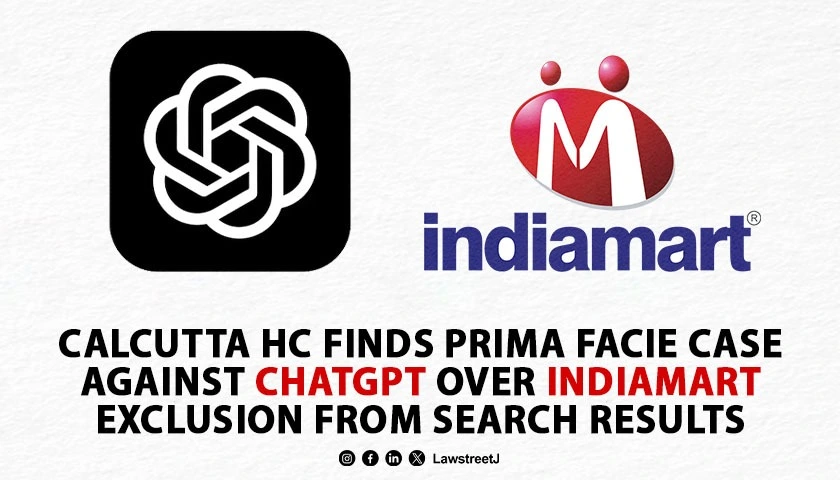
Kolkata: The Calcutta High Court has observed that a prima facie case has been made out in favour of IndiaMART InterMesh Limited against OpenAI Inc. for the alleged selective exclusion of IndiaMART from ChatGPT search results based on a report of the United States Trade Representative (USTR), while other similarly listed entities continue to remain accessible on the AI platform.
Justice Ravi Krishan Kapur heard the matter on December 24, 2025, and directed the petitioner to effect fresh service on the respondents. The matter has been listed for further hearing on January 13, 2026.
IndiaMART InterMesh Limited is engaged in business-to-business (B2B) integrated electronic commerce and operates an internet-based platform providing free and paid listings for a wide range of industrial products and services, particularly catering to small and medium enterprises. The petitioner operates through its web portal, www.indiamart.com, and a mobile application, enabling companies and individuals to advertise products and connect with prospective buyers. The company claims to have operations in approximately 40 countries, employs around 3,000 people, and enjoys substantial accessibility and turnover. The mark “IndiaMART” has been recognised as a well-known mark under the Trade Marks Act, 1999.
The petitioner has filed the suit seeking, inter alia, a declaration that USTR reviews containing adverse findings against it are not binding on the respondents and cannot be relied upon to exclude the petitioner, its marked websites, or its listings from search results generated on AI engines, including ChatGPT, along with other consequential reliefs.
The grievance of the petitioner centres on alleged selective discrimination by the respondents. IndiaMART alleges trade libel through implied disparagement, dilution of its mark, injurious falsehood, and unlawful interference with business resulting in unfair competition. OpenAI Inc. (respondent no. 1) is stated to be an intermediary under the Information Technology Act and a not-for-profit organisation incorporated under Delaware law, with its primary object being the development of artificial intelligence. Respondent no. 2 is the entity responsible for the commercial operations of ChatGPT, the flagship consumer AI interface.
The petitioner has alleged that the respondents specifically and consciously excluded IndiaMART from appearing in ChatGPT search results, while listings of other platforms and e-commerce marketplaces continue to be displayed. It is contended that such exclusion was based solely on a USTR report in which the petitioner was named, without providing any prior notice or opportunity of hearing to IndiaMART.
IndiaMART argued that blind reliance on the USTR report is arbitrary, capricious, and devoid of any rational basis. It was submitted that there is no foundation for the USTR’s findings, that the petitioner was never afforded an opportunity to defend itself, and that it has been selectively discriminated against without any logic. The petitioner further pointed out that other entities named in the same USTR report for alleged counterfeiting and piracy—such as DHgate, Pinduoduo, Shopee, and Taobao—continue to remain accessible on ChatGPT, demonstrating inconsistent application of the respondents’ standards.
The petitioner also relied upon a press release issued by the Ministry of Consumer Affairs, Food and Public Distribution, which clarifies that USTR reports and their findings are not binding on India and that India is under no obligation to take action based on such reports. It was contended that this position was neither considered nor addressed by the respondents.
Justice Kapur observed that, prima facie, it appears that the petitioner has been selectively discriminated against and unjustifiably excluded without any logical basis, resulting in loss of goodwill, reputation, and commercial injury.
However, the Court noted that granting the reliefs sought at this stage would virtually amount to granting a final decree. Accordingly, without affording the respondents an opportunity of hearing, there was no scope for passing any ad-interim order. The Court also noted that despite service, the respondents remained unrepresented.
The Court held that notwithstanding the existence of a strong prima facie case in favour of the petitioner, principles of natural justice require that the respondents be granted an opportunity before any interim relief is considered. In view of the ensuing court vacation, the matter has been listed for further hearing on January 13, 2026.
The Court further directed the petitioner to effect fresh service on the respondents by courier and email, and by any other permissible mode, informing them of the passing of the order and the institution of the suit.
Case Title: IndiaMART InterMesh Limited v. OpenAI Inc. & Ors.



![Calcutta High Court conducts late-evening hearing, orders release of lawyer arrested inside court [Read Order]](/secure/uploads/2023/12/lj_4146_Court_lawyers_arrest.jpg)
![Indian Courts this Week: Law Street Journal's Weekly Round-Up of SC & HCs [Jan 1 - Jan 6]](/secure/uploads/2024/01/lj_9050_WhatsApp_Image_2024-01-06_at_12.07.10_PM.jpeg)