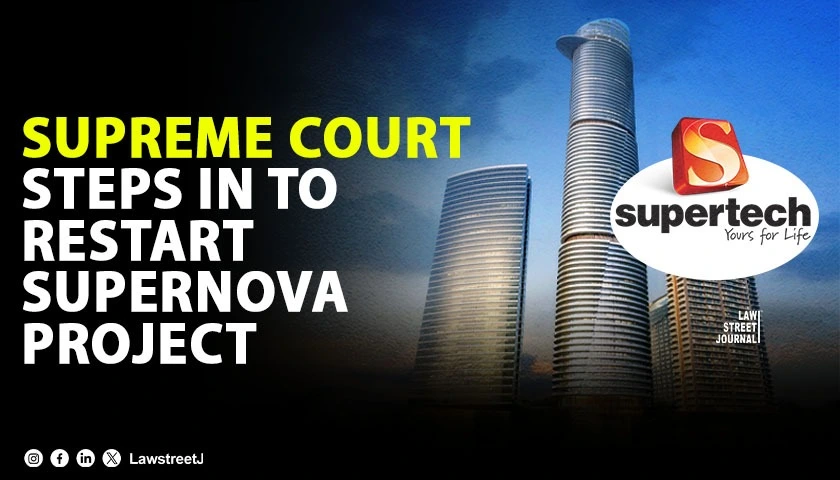
New Delhi: The Supreme Court has invoked its extraordinary powers under Article 142 of the Constitution to ensure completion of the stalled Supernova real estate project in Noida, constituting a three-member court-appointed committee to oversee the resolution process and replacing the Interim Resolution Professional and the Committee of Creditors.
Chief Justice of India Surya Kant and Justice Joymalya Bagchi were hearing Civil Appeal No. 11052 of 2025, filed by Ram Kishore Arora, a suspended director of Supertech Realtors Pvt. Ltd., challenging the NCLAT judgment dated August 13, 2025, which had upheld the admission of the corporate debtor into the Corporate Insolvency Resolution Process under Section 7 of the Insolvency and Bankruptcy Code, 2016.
The Supernova project, a mixed-use real estate development comprising residential units, commercial and office spaces, studio apartments, service apartments, and shopping centres situated in Sector 94, Noida, involves “a mosaic of competing claims and interests involving multiple stakeholders, including the Interim Resolution Professional, the Supernova Apartment Owners Association, various financial institutions, several home buyers, NOIDA, and the suspended Director.”
Recognising the complexity of the issues and the need to balance divergent interests, the Court had earlier appointed Advocate Rajiv Jain as amicus curiae on August 29, 2025. The amicus submitted an Opinion-cum-Report dated September 12, 2025, followed by a Revised Report-cum-Recommendations dated November 12, 2025, after consulting various stakeholders.
The Court noted:
“Upon a careful consideration of such suggestions and responses, as also the report of the learned amicus curiae, it appears that while each stakeholder asserts primacy of its respective rights, there is a broad and consistent expression of confidence in a court-monitored resolution.”
The amicus curiae recommended “the constitution of a Court-appointed Committee to ensure continuity of the resolution process, with appropriate judicial oversight and strict adherence to the objectives of the IBC, so as to secure equity among stakeholders and safeguard the rights of home buyers.”
In a significant observation criticising financial creditors, the Court held:
“The material on record indicates that, despite long-standing exposure to the Corporate Debtor, the lenders failed to intervene or undertake timely restructuring even when early signs of financial distress were apparent.”
The Court further stated:
“Such inaction has substantially contributed to the present state of insolvency, and in this backdrop, the claim of primacy now asserted by the financial creditors over the interests of home buyers appears considerably weakened.”
Finding this “a fit case for the exercise of this Court’s powers under Article 142 of the Constitution of India to do complete justice,” the Court discharged the Interim Resolution Professional, the Committee of Creditors, and the suspended Board of Directors, replacing them with a court-appointed committee.
The three-member committee will comprise Justice M.M. Kumar (former Chief Justice of the Jammu & Kashmir High Court, former President of the NCLT, and former Member of the NHRC) as Chairperson, Dr. Anoop Kumar Mittal (expert in construction, civil engineering, and project management), and Mr. Rajeev Mehrotra (expert in financial management).
The committee will “discharge the functions of the Board of Directors,” with the Chairperson having the “discretion to appoint further member(s) to the Committee and reconstitute its strength, if he deems fit.” The role of the appellant and his associates is “limited to providing technical cooperation to the Committee.”
Critically, the committee must “appoint a new developer after inviting proposals and due vetting, keeping in mind time-bound execution, track record, experience, and financial viability.” The Court clarified that “any developer associated with or related to the Corporate Debtor or the erstwhile management shall not be allowed to participate in the process.”
In a significant relief for home buyers, the Court declared a “zero period,” stating:
“No payments shall be made to these entities until completion of the project and handing over of the dwelling units to the home buyers.”
During this period, “the NOIDA Authority and the financial lenders shall not initiate or continue any coercive action against home buyers who have paid the consideration for their respective dwelling units.”
The Court directed that “upon completion of the project, any surplus generated shall be utilised towards the satisfaction of the dues of the financial lenders and the NOIDA Authority.”
NOIDA and other development authorities were directed “to process all approvals and licences expeditiously without demanding the previous dues to be cleared,” including registration of sub-lease deeds for the remaining 497 apartments out of 582, provided full payments have been made.
The Court also directed the committee to “appoint a reputed and experienced entity to conduct a forensic audit of the accounts of the Corporate Debtor and its parent company.”
All receivables, unsold inventory, and fresh collections must be “deposited in an escrow account and shall be used for construction purposes only.”
While the committee must “act in consultation with various stakeholders, namely, the Consortium of Banks, other financial creditors, home buyers, and authorities such as NOIDA,” the Court clarified that “the decision of the Committee shall be final and binding on all parties.”
Regarding compensation, the Chairperson will receive an honorarium of ₹10 lakh per month plus expenses, with the honorarium of other members to be decided by the Chairperson. A Member Secretary-cum-Nodal Officer may also be appointed, entitled to ₹2 lakh per month plus expenses.
The committee’s seat will be New Delhi, with the corporate debtor providing “requisite office space, personnel, and infrastructural support,” and bearing all honorarium and expenses.
The matter has been posted for further consideration on January 20, 2026.
Case Title: Ram Kishore Arora v. Bank of Maharashtra & Ors.