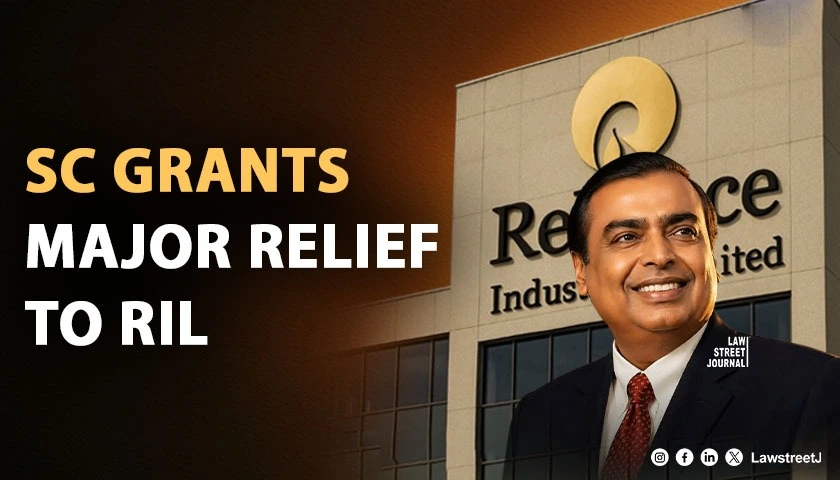
New Delhi: The Supreme Court on May 29, 2026, granted partial relief to Reliance Industries Limited (RIL) by setting aside a direction issued by the Securities and Exchange Board of India (SEBI) requiring the company to disgorge ₹447.27 crore in connection with trades in the shares and futures contracts of Reliance Petroleum Limited (RPL) in November 2007 [Reliance Industries Limited v. SEBI].
A Bench comprising Justice J.B. Pardiwala and Justice R. Mahadevan also set aside SEBI’s findings of fraud against the company. The Court further directed SEBI to refund ₹250 crore that RIL had already deposited. However, the Court upheld a separate ₹25 crore penalty imposed on RIL by SEBI’s adjudicating officer.
At the relevant time, RPL was a listed subsidiary of RIL, which held approximately 75 per cent of its shares. RIL decided to sell around 5 per cent of its shareholding in RPL, amounting to nearly 22.5 crore shares.
SEBI subsequently investigated trades in the RPL scrip between November 1 and November 29, 2007. It found that RIL had appointed 12 entities to take short positions in the November 2007 RPL futures contract, while RIL itself sold RPL shares in the cash segment. SEBI alleged that RIL used these entities to build large short positions in the futures and options segment in excess of prescribed position limits and that RIL sold a large number of RPL shares in the last few minutes of trading on November 29, 2007. According to SEBI, this depressed the settlement price of the November 2007 RPL futures contract and allowed RIL to make unlawful gains.
In March 2017, SEBI’s Whole Time Member held that RIL had adopted a fraudulent and manipulative strategy. RIL was directed to disgorge ₹447.27 crore along with interest at 12 per cent per annum, and RIL, along with the 12 entities, was barred from dealing in equity derivatives in the futures and options segment for one year.
RIL challenged the SEBI order before the Securities Appellate Tribunal (SAT). In November 2020, SAT dismissed RIL’s appeal by a majority of 2:1 and upheld the disgorgement direction. RIL thereafter challenged the SAT ruling before the Supreme Court.
Separately, SEBI’s adjudicating officer initiated penalty proceedings on the same broad allegations. In January 2021, the adjudicating officer imposed penalties of ₹25 crore on RIL, ₹15 crore on Mukesh Ambani, ₹20 crore on Navi Mumbai SEZ Private Limited, and ₹10 crore on Mumbai SEZ Limited.
In December 2023, SAT upheld the ₹25 crore penalty against RIL, holding that the company’s case was governed by the earlier 2020 SAT ruling. However, SAT quashed the penalty against Mukesh Ambani, holding that Section 27 of the SEBI Act, as it stood in 2007, applied only to “offences” by companies and not to civil penalty proceedings, and that the 2019 amendment extending the provision to “contraventions” was substantive and prospective in effect. SAT also quashed the penalties against Navi Mumbai SEZ and Mumbai SEZ, finding that SEBI had failed to establish their involvement in the alleged manipulative trades.
The Supreme Court set aside SEBI’s fraud findings against RIL and the consequential direction to disgorge ₹447.27 crore with interest. It further directed SEBI to refund the ₹250 crore that RIL had deposited during the pendency of the proceedings.
The Court, however, upheld the ₹25 crore penalty imposed on RIL by SEBI’s adjudicating officer.
Case Details
Case Title: Reliance Industries Limited v. SEBI
Court: Supreme Court of India
Bench: Justice J.B. Pardiwala and Justice R. Mahadevan
Date of Order: May 29, 2026
Appearances:
For RIL: Senior Advocates Harish Salve and Ritin Rai; Advocates K.R. Sasiprabhu, Amey Nabar, Aditya Swarup, Swati N. Jain, Vishnu Sharma, Ritika Sinha, Yasharth Misra, Ribhav Pande, Namrata Saraogi, and Madhav Agarwal.
For SEBI: Senior Advocates Arvind Datar and Pratap Venugopal; Advocate Abhishek Singh.