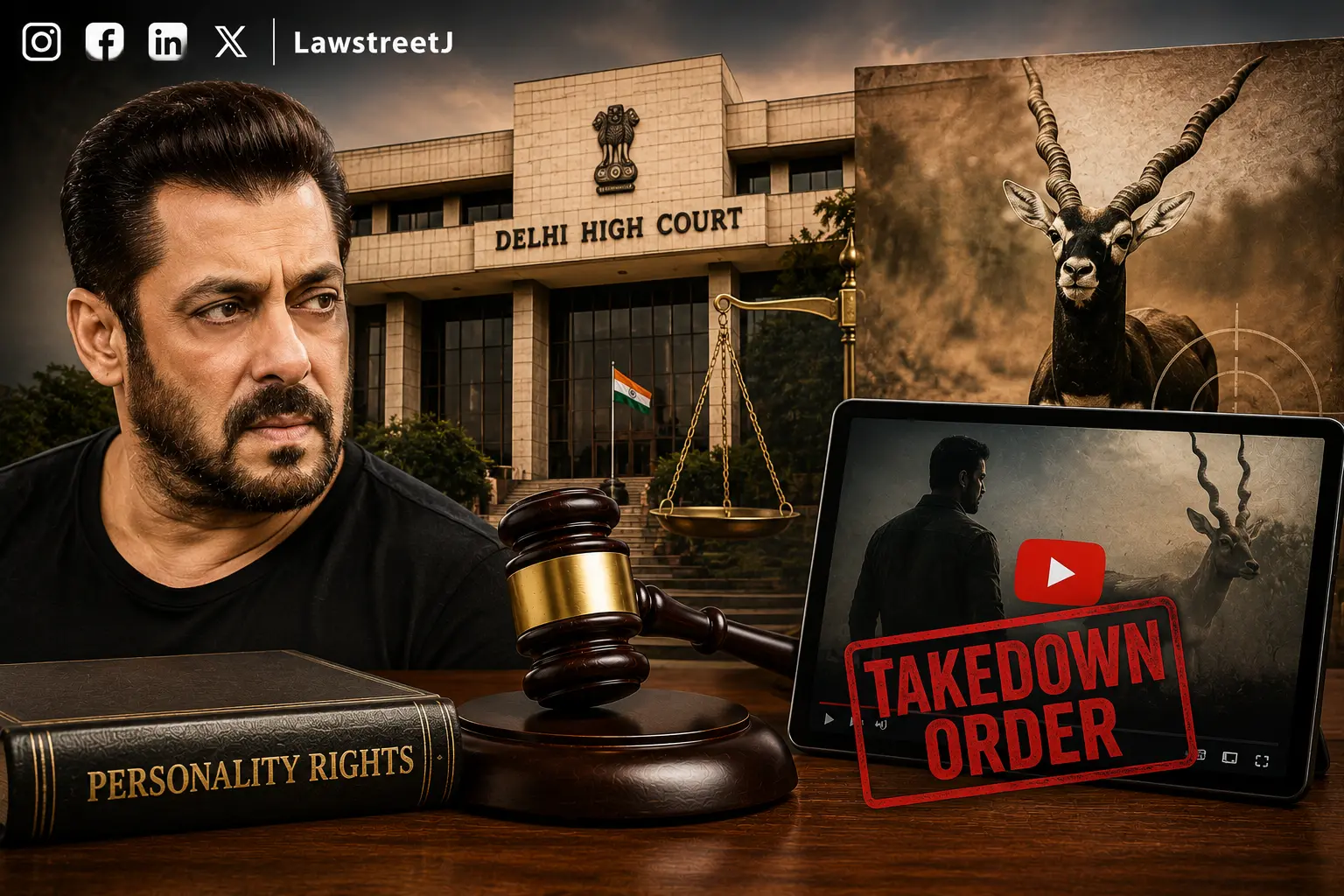
Justice Jyoti Singh directs removal of links to the teaser and producer Amit Jani's interviews, remarking "reputation once lost is lost," as Salman Khan's suit accuses the makers of misusing his personality rights and misrepresenting his acquittal under the Arms Act.
Court Orders Takedown, Signals a Stronger Order to Follow
The Delhi High Court on Monday directed the takedown of various links carrying the teaser of the proposed film "Kala Hiran: The Battle for Legacy," which is stated to be inspired by actor Salman Khan's 1998 blackbuck poaching case. Justice Jyoti Singh, hearing an application filed in Khan's suit seeking protection of his personality rights, said she would also order removal of interviews given by the film's producer, Amit Jani. Disagreeing with the producer's stand, the Court orally indicated it would pass an order with strong observations, remarking, "this must stop," and adding, "reputation once lost is lost."
What Khan's Application Alleges
Khan's application contends that the proposed film unlawfully exploits his personality rights and falsely portrays events associated with him, despite the makers' denial that the project is based on his life. The plea alleges that promotional material carries unmistakable references to the actor, including a lookalike shown wearing a blue bracelet that has become closely associated with Khan in the public imagination. It further alleges that one of the posters depicts the lookalike holding a rifle or gun, a portrayal the plea says is misleading given Khan's acquittal in the related Arms Act proceedings arising out of the same case, and capable of leaving the public with a false impression of what actually happened. Senior Advocate Ravi Prakash, with a team of advocates, appeared for the actor before the Court.
The Legal Basis for Personality Rights in India
India has no standalone statute protecting personality rights, so the doctrine has developed almost entirely through case law, drawing on the tort of passing off, copyright principles, and the right to privacy under Article 21 of the Constitution. In ICC Development (International) Ltd. v. Arvee Enterprises, 2003 (26) PTC 245 (Del), the Delhi High Court first articulated the right of publicity in Indian law, holding that it inheres in an individual by virtue of association with an event, sport or film, and cannot be commercially exploited without consent. This was extended in D.M. Entertainment Pvt. Ltd. v. Baby Gift House, CS(OS) No. 893/2002 (Del), where the unauthorised use of singer Daler Mehndi's voice and likeness in dolls was restrained as a misappropriation of his goodwill and identity.
The doctrine was consolidated in Titan Industries Ltd. v. Ramkumar Jewellers, 2012 (50) PTC 486 (Del), where the Court held that a celebrity need only be identifiable from the unauthorised use for liability to arise, without any separate proof of confusion or deception, in a dispute over hoardings that reproduced Amitabh Bachchan and Jaya Bachchan's endorsement of Tanishq jewellery for a rival brand. More recently, in Anil Kapoor v. Simply Life India & Ors., CS(COMM) 652/2023 (Del HC, decided September 20, 2023), Justice Pratibha M. Singh granted an omnibus injunction protecting actor Anil Kapoor's name, voice, likeness and even a signature dialogue against unauthorised commercial use, including through AI-generated content, holding that the ease of misuse enabled by technology heightened, rather than diminished, the need for protection.
Where the Balance Tips the Other Way: Free Speech and Artistic License
Personality rights in India have never been treated as absolute, particularly where they collide with the right to free expression under Article 19(1)(a) and the latitude traditionally given to creative works based on real events or public figures. The clearest illustration is Krishna Kishore Singh v. Sarla A. Saraogi, 2021 SCC OnLine Del 3146, where the father of actor Sushant Singh Rajput sought to restrain a film styled as a tribute to his son. The Delhi High Court declined a pre-release injunction, holding that a disclaimer clarifying the film was not a biopic addressed the plaintiff's core concern, and that restraining a film before release causes irreparable harm to the defendant that outweighs a plaintiff's ability to seek relief, including damages, after the fact if the final product does turn out to be objectionable. When the underlying suit was ultimately decided in 2023 SCC OnLine Del 3997, the Court went further, holding that publicity and privacy rights are personal to the individual and do not survive, or descend to heirs, after death.
Read together, this body of law suggests that Indian courts distinguish sharply between the commercial appropriation of a living celebrity's identifiable name, voice or image, which is restrained relatively readily, and a work of fiction or dramatisation inspired by a real person's life or a public controversy, which courts are more reluctant to enjoin before release, especially where a disclaimer can address the risk of the public mistaking the work for fact. The producers of "Kala Hiran" are likely to lean on this latter line of cases, arguing that a film styled around a well-publicised legal saga, rather than an unauthorised commercial endorsement, sits closer to protected creative expression.
Why the Court Appears Unpersuaded at This Stage
The oral remarks recorded on Monday suggest the Court views the present facts differently from a case like Krishna Kishore Singh, where the objection was to a fictionalised tribute rather than to specific, identifiable markers being used to trade on a living celebrity's persona. Khan's plea does not rest on the mere existence of a film inspired by a real controversy; it points to specific, alleged identity markers, the blue bracelet and the lookalike's resemblance, and to a specific factual misrepresentation, the depiction of a firearm despite an acquittal on the Arms Act charge, that goes beyond dramatisation into what the plea characterises as a misleading account of judicially settled facts. That combination, of identifiable persona plus an allegedly false portrayal of an outcome a court has already recorded, is closer to the fact pattern in Titan Industries and Anil Kapoor than to the disclaimer-cured dramatisation in Krishna Kishore Singh, which may explain the Court's evident inclination toward interim relief at this stage, notwithstanding that the matter remains to be finally argued.
Case Details
- Case Title: Salman Khan v. John Doe & Others
- Court and Bench: Delhi High Court, Justice Jyoti Singh
- Petitioner's Counsel: Senior Advocate Ravi Prakash, with Advocates Nizam Pasha, Parag Khandhar, Chandrima Mitra, Krishnan Kumar, Tapan Radkar, Astu Khandelwal and Zara Dhanboora