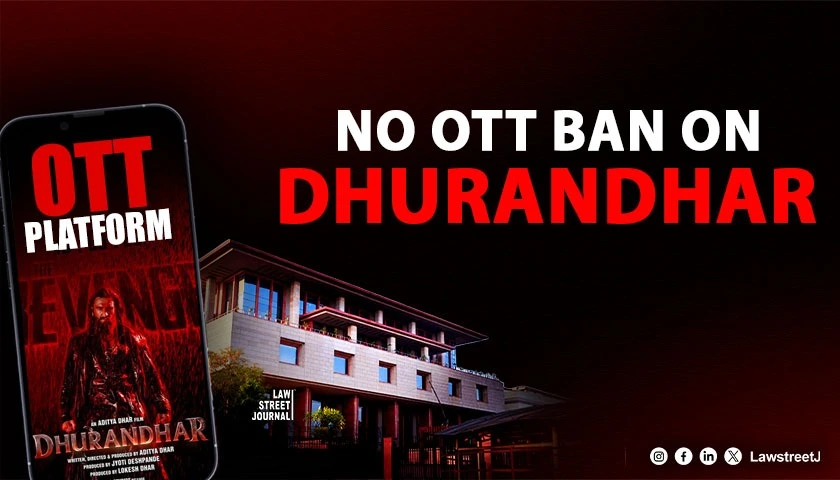
New Delhi: The Delhi High Court on May 14, 2026, declined to grant an interim injunction restraining the OTT release of the cinematograph film Dhurandhar: The Revenge in a copyright infringement suit filed by Trimurti Films Private Limited over the use of the iconic song ‘Tirchi Topiwale’ from the 1989 film Tridev. The matter was heard in Trimurti Films Private Limited v. B62 Studios Private Limited & Ors. While refusing the relief sought, Justice Tushar Rao Gedela directed defendant no. 3, Super Cassettes Industries Private Limited (T-Series), to deposit ₹50 lakhs before the Court within four weeks, to be held in a fixed deposit for the benefit of the successful party at the conclusion of the trial.
Background
Trimurti Films Private Limited, founded in 1969 by the late Gulshan Rai and currently managed by his son Rajiv Rai, claims to be the first owner of copyright in the song ‘Tirchi Topiwale’, with lyrics by Anand Bakshi and music composed by Kalyanji-Anandji, as producer of the cinematograph film Tridev. By an agreement dated June 30, 1988, the plaintiff assigned certain limited rights to Super Cassettes Industries, which it contended were confined to the manufacture and sale of cassettes and gramophone records. The plaintiff claimed that the agreement did not authorise incorporation of the song into any other cinematograph film.
In or around March 2026, the plaintiff discovered that the defendants had created a remixed version of the song titled ‘Rang De Lal (Oye Oye)’ and incorporated both the remixed version and the original sound recording into the cinematograph film Dhurandhar: The Revenge, released on March 19, 2026. The plaintiff filed the present suit seeking an injunction against, among other things, the OTT release of the film to the extent it contained the song.
Plaintiff’s Contentions
Senior Advocate Swathi Sukumar, appearing for Trimurti Films, argued that the 1988 agreement granted Super Cassettes only the right to exploit the songs of Tridev through cassettes and gramophone records against payment of royalty. She submitted that the assignment was expressly limited to record-based exploitation and did not contemplate synchronisation or incorporation of the song into any new cinematograph film. She contended that the agreement drew a clear distinction between the ‘said work’ — the cinematograph film and underlying works — and ‘record’, and that all cinematograph film rights remained with the plaintiff.
Sukumar further submitted that the song appeared twice in Dhurandhar: The Revenge — in remixed form as ‘Rang De Lal (Oye Oye)’ and in its original form during the closing credits — and was being exploited on digital music platforms including JioSaavn, Gaana and Spotify without authorisation. She argued that as the defendants themselves acknowledged the lyricist and composer of the original song, they could not deny that specific permission was required before incorporating it into a new film. She also invoked the doctrine of contra proferentem, submitting that since the agreement was drafted by Super Cassettes as the dominant party, any ambiguity must be resolved in favour of the plaintiff. She further urged that there is no statutory acquiescence under the Copyright Act, 1957, and that mere inaction on previous occasions could not defeat the plaintiff’s claim.
Defendants’ Contentions
Senior Advocate Akhil Sibal, appearing for Super Cassettes (defendant no. 3), argued at the threshold that the suit was hit by acquiescence, concealment and wilful non-disclosure of material facts, disentitling the plaintiff from any discretionary relief. He placed on record a legal notice dated April 26, 2016, issued by the plaintiff through a law firm, Vox Law, alleging infringement of certain Tridev songs in the film Azhar, and a reply notice dated May 2, 2016, issued by Super Cassettes asserting its exclusive rights under the 1988 agreement. He submitted that the plaintiff had failed to disclose either of these notices in the plaint and had falsely claimed that its promoter, Rajiv Rai, had left India in 1997 and was unable to monitor infringement until 2018–19, whereas documentary evidence established that the plaintiff had actively pursued multiple lawsuits and other proceedings from 2016 to 2020.
Sibal further pointed out that a song from Tridev had been incorporated into K.G.F: Chapter 1 in 2019 without any objection from the plaintiff, and that this too had been suppressed in the plaint. He submitted that Super Cassettes had relied on the plaintiff’s sustained inaction to alter its commercial position, license songs to third parties and invest in the production of Dhurandhar: The Revenge. On the merits of the agreement, Sibal argued that paragraphs 2(i) and 2(xi) of the 1988 agreement conferred upon Super Cassettes all rights, title and interest in the literary, dramatic and musical works embodied in the ‘said work’, including the right to make or authorise the making of any versions thereof, and that the definition of ‘said work’ in the agreement expressly encompassed the cinematograph film Tridev itself.
Senior Advocate Sandeep Sethi, appearing for Jio Studios (defendant no. 2), adopted the arguments of Super Cassettes and additionally contended that granting an OTT-specific injunction would create an incongruity in law: the same song in the same film would be permissible in cinema halls but impermissible on OTT platforms, which was logically untenable. Senior Advocate Ravi Prakash, appearing for defendant no. 1, submitted that since Dhurandhar: The Revenge had already been released in theatres and monetary compensation could adequately address any proven infringement, discretionary injunctive relief was not warranted.
Court’s Analysis
Justice Gedela held that the conduct of the plaintiff in suppressing material facts was the decisive factor against the grant of interim relief. The Court noted that the plaintiff had not disclosed the 2016 notices, the extensive litigation pursued by it from 2016 to 2020, including a suit against Super Cassettes itself in which a judgment was obtained in its favour, or the incorporation of a Tridev song in K.G.F: Chapter 1. The Court observed that the affidavits of Rajiv Rai and Mr. Umesh G. Mehta, filed in an attempt to explain the non-disclosures, took contradictory positions and did not instil confidence in the recitals in the plaint.
The Court held that the principle of suppressio veri suggestio falsi disentitles a party from obtaining discretionary relief and that the plaintiff’s sustained inaction, amounting to seven to nine years since earlier alleged infringements in the same film, had induced Super Cassettes to alter its commercial position. The Court observed that the plaintiff’s argument that every fresh infringement gave rise to a fresh cause of action, while legally sound, did not compel the Court to exercise its discretionary jurisdiction in the circumstances of the present case.
On the merits of the agreement, the Court expressed a prima facie view that the 1988 agreement, unlike the agreement examined in Shemaroo Entertainment Ltd. v. Amrit Sharma, which the plaintiff had relied upon, contained a specific definition of ‘the said work’ that included the cinematograph film Tridev itself. Reading paragraphs 2(i), 2(xi), 7, 8 and 12 conjunctively and harmoniously, the Court expressed the prima facie opinion that Super Cassettes had been assigned all rights, title and interest in the literary, dramatic and musical works embodied in Tridev, including the right to make or authorise remixed versions, with only the cinematograph film itself excluded. The Court expressed no conclusive opinion on the merits so as not to prejudice either party at trial.
On the OTT injunction, the Court held that it would be incongruous to restrain the use of the song on OTT platforms while permitting it in cinema halls in the same film. It also noted that monetary compensation in the form of damages would be an adequate remedy if infringement were established at trial.
Direction for Deposit
Exercising its equitable jurisdiction and noting that the agreement’s definition of ‘record’ in paragraph 1(b), which expressly included devices “now or hereafter known”, would extend to digital music platforms, the Court directed Super Cassettes to deposit ₹50 lakhs before the Court within four weeks. The sum is to be held in an interest-bearing fixed deposit in the name of the Registrar General, to accrue to the benefit of the successful party at the conclusion of the trial.
The matter is listed before the Joint Registrar (Judicial) on July 13, 2026, and before the Court on August 21, 2026.
Case Details: Trimurti Films Private Limited v. B62 Studios Private Limited & Ors., Delhi High Court, CS(COMM) 378/2026. Before Justice Tushar Rao Gedela. Order dated May 14, 2026. Senior Advocate Swathi Sukumar appeared for the Plaintiff. Senior Advocate Akhil Sibal appeared for Defendant no. 3. Senior Advocate Sandeep Sethi appeared for Defendant no. 2. Senior Advocate Ravi Prakash appeared for Defendant no. 1.

![Delhi High Court Sets Aside Arbitral Tribunal's Award Against NHAI in Highway Project Delay Case [Read Judgment]](/secure/uploads/2023/07/lj_9605_23374c2e-392c-4491-a2fe-f2f12fc5272f.jpg)
![Delhi Court Rejects Stay Request in Defamation Case Against Rajasthan CM Ashok Gehlot [Read Order]](/secure/uploads/2023/08/lj_5208_80de1ddc-d76a-4f7f-b180-408e3ae14fb4.jpg)