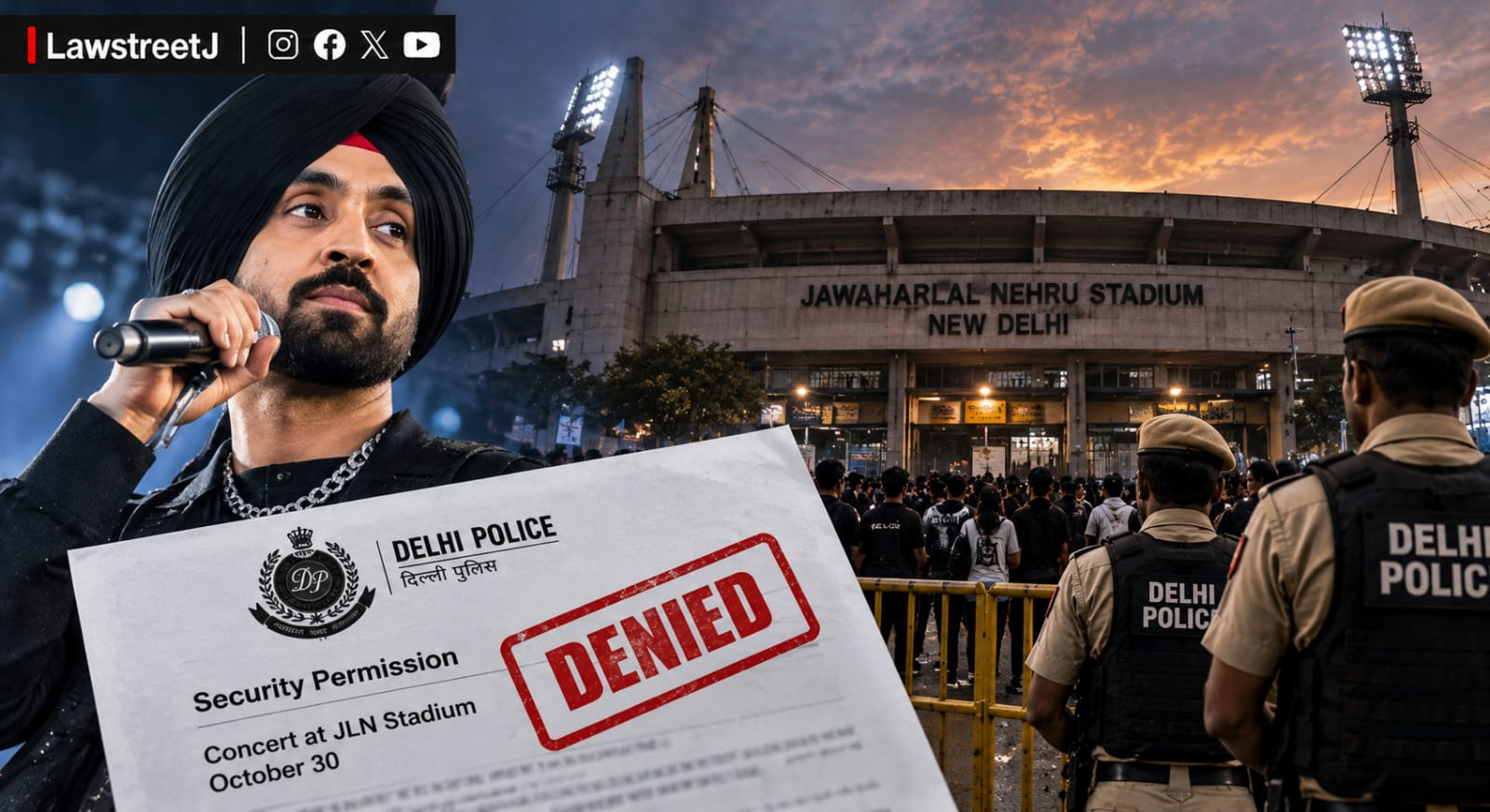
New Delhi — Delhi Police has denied security clearance for Punjabi singer Diljit Dosanjh's concert scheduled at Jawaharlal Nehru Stadium on October 30, 2026, citing security concerns and threat-related inputs during the ongoing festive season. The decision casts uncertainty over the opening leg of Dosanjh's Aura World Tour in India, which was set to begin in the capital before moving to other cities.
The Office of the Deputy Commissioner of Police, South District, communicated the denial to ticketing platform BookMyShow, which had submitted an application on October 14, 2026, seeking permission for the concert. According to a letter cited in reporting on the matter, the DCP's office stated that it had examined the application and declined to grant clearance, citing security concerns amid the festival season as the primary reason.
As of the time of this report, there has been no official confirmation from Diljit Dosanjh, his team, or the concert organisers regarding the denial, and the final status of the Delhi show, including whether it will be rescheduled, relocated, or cancelled outright, remains unclear.
Background: The Tour and the Date Change
The Delhi concert was intended to mark the beginning of the Indian leg of Dosanjh's Aura World Tour, expected to draw large crowds following the strong public response to his earlier Dil-Luminati India Tour in 2024, which also began with a concert at Jawaharlal Nehru Stadium and drew thousands of fans, requiring a deployment of more than 3,000 security personnel at the time.
The October 30 Delhi concert had itself already undergone a change of date. It was originally scheduled for November 1, 2026, but was moved forward to October 30 after concerns were raised about holding the event on the anniversary of the 1984 anti-Sikh violence, which began following the assassination of Prime Minister Indira Gandhi on October 31 of that year. Following the Delhi leg, the Aura World Tour was scheduled to continue to Indore, Ahmedabad, Mumbai, Bengaluru, Lucknow, Chandigarh and Kolkata.
Legal and Regulatory Framework
Large public events and concerts in Delhi require security clearance from the jurisdictional Deputy Commissioner of Police, exercised under the regulatory framework of the Delhi Police Act, 1978, read with the Delhi Police's standing instructions governing permissions for public assemblies, entertainment events and gatherings likely to draw large crowds. This licensing authority allows police to assess, and where necessary decline, event applications based on an evaluation of available intelligence inputs, anticipated crowd size, venue capacity, traffic management requirements, and any specific threat information relevant to the event, the venue, or the period in which it is scheduled to be held.
Such permission is distinct from, though related to, prohibitory-order powers under the Bharatiya Nagarik Suraksha Sanhita, 2023 (which succeeded the Code of Criminal Procedure, 1973), which empower authorities to restrict public gatherings in the interest of maintaining law and order. In the case of ticketed commercial events such as concerts, denial of police security clearance functions as a practical precondition for the event to proceed at a given public venue, since venue operators and organisers, including stadium authorities and ticketing platforms, are not permitted to hold a large public gathering without the requisite police authorisation.
This is not the first instance of a Diljit Dosanjh event facing a licensing setback from local authorities. In November 2024, Maharashtra's excise department cancelled the permit to serve alcohol at a Dosanjh concert in Pune's Kothrud area, following objections raised by local political figures, including a newly elected BJP MLA, who cited concerns about disturbance to residents and traffic congestion.