

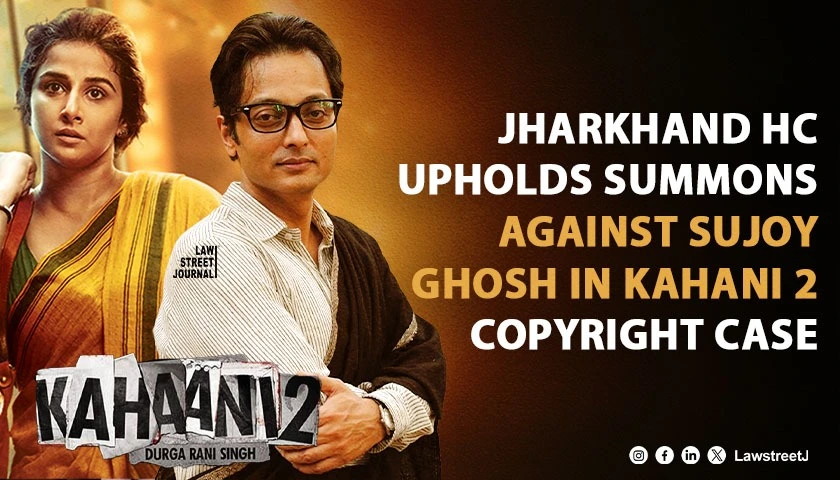
Jharkhand: The High Court of Jharkhand at Ranchi has dismissed a petition filed by a Mumbai-based film producer seeking quashing of criminal proceedings initiated against him under Section 63 of the Copyright Act, 1957, in connection with allegations that he infringed the copyright in a film script written by a Hazaribagh-based complainant while producing the film Kahani 2. The Court held that the inherent power under Section 482 of the Code of Criminal Procedure cannot be exercised to stifle a legitimate prosecution and that no mini trial can be conducted at the stage of deciding such an application.
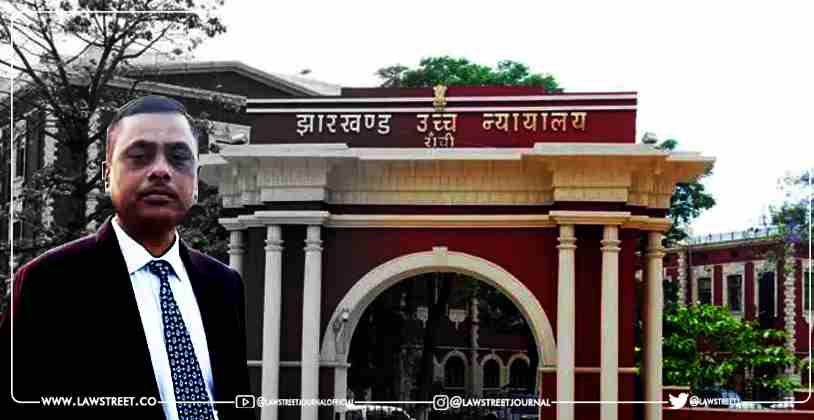
Justice Anil Kumar Choudhary, by an order dated April 22, 2025, in Cr.M.P. No. 3722 of 2018, dismissed the petition filed by Sujoy Ghosh, described as the producer, director, and writer claiming ownership of Western India Film Producer, and declined to quash the order dated June 7, 2018, passed by the learned Chief Judicial Magistrate, Hazaribagh, who had found a prima facie case under Section 63 of the Copyright Act, 1957, and ordered issuance of summons against the petitioner.
The prosecution case was that the complainant, Umesh Prasad Mehta, had written a film script titled Sabak, which was certified by the Notary Public at Hazaribagh for the purpose of obtaining copyright protection for the script. In the process of obtaining copyright, a recommendation from a film producers’ organisation was required, and the complainant accordingly met the petitioner and obtained a recommendation letter from him. A copy of the script was given to the petitioner during this process. The petitioner allegedly assured the complainant that whenever he made a film based on the complainant’s script, he would call him, but subsequently produced the film Kahani 2 using the complainant’s script without his knowledge or consent. The complainant came to know of the alleged infringement after watching the film at a film hub in Hazaribagh. On the basis of the complaint, the statement on solemn affirmation of the complainant, and the statements of enquiry witnesses, the Chief Judicial Magistrate found a prima facie case under Section 63 of the Copyright Act, 1957.
The petitioner contended that the Chief Judicial Magistrate had neither seen the complainant’s script nor watched the film Kahani 2 himself, and therefore could not have found a prima facie case of copyright infringement. Reliance was placed on R.G. Anand v. M/s Delux Films and Others, (1978) 4 SCC 118, wherein the Supreme Court held that one of the surest and safest tests to determine whether there has been a violation of copyright is to see whether the reader, spectator, or viewer, after having read or seen both works, gets an unmistakable impression that the subsequent work appears to be a copy of the original. The petitioner also relied upon Inox Air Products Limited v. State of Andhra Pradesh, 2025 SCC OnLine SC 209, which held that since summoning of an accused in a criminal case is a serious matter, the Magistrate’s order must reflect application of mind to the facts and applicable law. It was further contended that the court at Hazaribagh lacked territorial jurisdiction.
The State and Opposite Party No. 2 opposed the petition and relied upon the decision of the High Court for the State of Telangana in Koratala Siva v. The State of Telangana and Another, Criminal Petition No. 1728 of 2017, contending that if there is a minor change in the storyline while most parts of the work, including the characters and their roles, remain the same, it cannot be said that the offences alleged are not attracted. It was submitted that at the stage of issuing process, the only question is whether there are sufficient grounds for proceeding against the accused, and that sufficient material existed to constitute the offence under Section 63 of the Copyright Act.
The Court held that the inherent power under Section 482 CrPC should not be exercised to stifle a legitimate prosecution and that the High Court should normally refrain from giving a prima facie decision in cases where facts are incomplete and evidence has not been collected. The Court relied upon Inder Mohan Goswami and Another v. State of Uttaranchal and Others, (2007) 12 SCC 1. The Court further held that the High Court is not to examine the merits and demerits of a case or determine the adequacy of evidence for holding the accused guilty while exercising power under Section 482 CrPC, and that possible defences need not be taken into consideration at the time of issuing process unless there is an ex facie legal bar. Reliance was also placed on State of Gujarat v. Afroz Mohammed Hasanfatta, (2019) 20 SCC 539. The Court further referred to State of Uttar Pradesh and Another v. Akhil Sharda and Others, (2019) 20 SCC 531, reiterating that no mini trial can be conducted by the High Court in exercise of power under Section 482 CrPC.
The Court found that there was a direct and specific allegation that the petitioner knowingly infringed the complainant’s copyright, and that the Chief Judicial Magistrate had discharged his limited role at the stage of issuing process by examining the complainant on solemn affirmation and putting questions to the enquiry witnesses. The Court held that the veracity of the statements was to be tested at trial and that, in view of the limited scope for interference with an order issuing process, the petition did not merit acceptance. The petition was accordingly dismissed.
Case Details
- Case Title: Sujoy Ghosh v. The State of Jharkhand and Umesh Prasad Mehta
- Case Number: Cr.M.P. No. 3722 of 2018
- Court: High Court of Jharkhand at Ranchi
- Bench: Hon’ble Mr. Justice Anil Kumar Choudhary
- Citation: 2025:JHHC:12134
- Date of Order: April 22, 2025
- Counsel for Petitioner: Mr. Indrajit Sinha
- Special Public Prosecutor for the State: Mr. P.D. Agrawal
- Senior Advocate for Opposite Party No. 2: Mr. Ajit Kumar with Mr. Sameer Rajan

![Supreme Court Collegium approves new Chief Justices for five key High Courts in India [Read Recommendations]](/secure/uploads/2023/12/lj_8000_380d1135-6f3a-4988-a00a-4d5cd5901815.jpg)
!['Arbitrary, impermissible,' SC quashes HC's resolution raising aggregate cut off marks on district judges appointment [Read Judgment]](/secure/uploads/2024/02/lj_3605_Rule-for-Judge-Selection.webp)