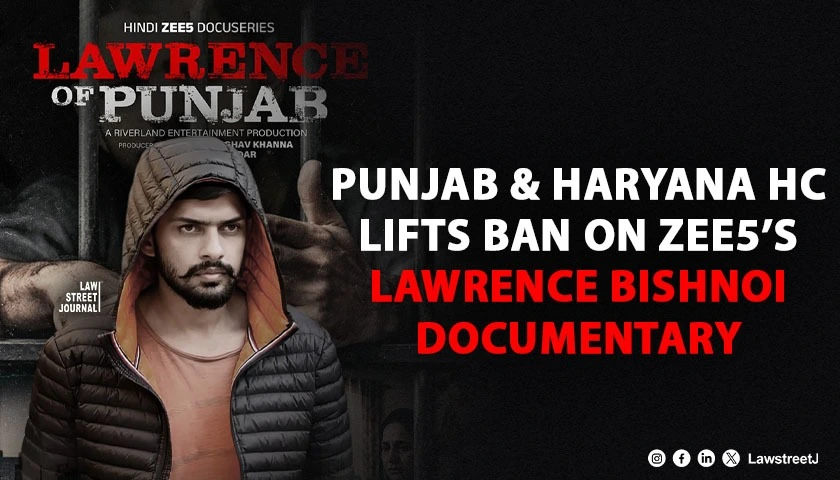
Punjab: The Punjab and Haryana High Court on May 11, 2026, quashed a government advisory that had directed ZEE5, the OTT platform of Zee Entertainment Enterprises Limited, not to release its documentary titled ‘Lawrence of Punjab’. In an oral judgment, Justice Jagmohan Bansal held that the communication issued by the Ministry of Information and Broadcasting on April 24, 2026, lacked a proper statutory basis and that the documentary, on a viewing of its contents, neither glorified any gangster nor posed any threat to public order.
The court, however, imposed one significant condition: as conceded by the petitioner’s senior counsel Mr. Amit Jhanji, the documentary’s title, trailer and poster shall not carry the expressions ‘Lawrence’, ‘Bishnoi’ or ‘Punjab’ before its release.
Background: The Advisory and Its Basis
A teaser poster for the documentary was released on April 11, 2026, followed by a trailer on April 19, 2026. The Ministry of Information and Broadcasting issued an advisory on April 23, 2026, asking the platform to take appropriate action in light of a petition pending before the High Court challenging the documentary. A second and more explicit advisory dated April 24, 2026, directed ZEE5 outright not to release the documentary, citing inputs from Punjab Police and a Central Security Agency, and expressing apprehension that the content was prejudicial to public order and likely to incite cognizable offences.
The blocking advisory was primarily premised on letters from the Director General of Police, Punjab, who cited two interim orders passed by a Division Bench of the same High Court — orders dated December 21, 2023, and January 28, 2026 — which had directed the removal of interviews of gangster Lawrence Bishnoi from social media platforms and instructed the DGP to identify and remove content that glorified crime and criminals. The DGP, relying on those orders and intelligence inputs, wrote to the Ministry seeking the documentary’s blocking. Separately, gangster Lawrence Bishnoi himself filed WP(C) 5613 of 2026 before the Delhi High Court seeking to restrain the documentary’s release; that petition was disposed of in view of the Central Government’s advisory.
The Court Watches the Documentary
Taking an unusual step, Justice Bansal personally watched the documentary on the petitioner’s laptop at his camp office, after the petitioner released a link to it during the hearing. Having done so, the Court concluded that the documentary was not about one particular gangster or gang but was a compilation of publicly available material concerning multiple gangs and their members. The contributors — two retired police officers, two or three journalists, and an advocate — were found to not have glorified crime or criminals at any point. The Court noted that the overall message of the documentary was that the lives of gangsters are short and cause suffering to many.
Advisory Lacked Statutory Basis: Court
The Court examined the legal framework under Sections 69A and 79 of the Information Technology Act, 2000, which empower the Central Government to block public access to digital content if it is satisfied that doing so is necessary in the interest of sovereignty and integrity of India, security of the State, public order, or for preventing incitement to cognizable offences. While the impugned advisory used the language of Section 69A, the Court found that the competent authority had not recorded its own satisfaction as required by the provision; it had merely borrowed the statutory expressions without independently applying its mind.
The Court also found that the advisory misread the earlier Division Bench orders of the High Court. Those orders had directed the removal of two specific Lawrence Bishnoi interviews and content that glorified crime. The documentary, the Court noted, made no reference to those interviews and contained nothing that could be characterised as glorifying crime or criminals and therefore did not violate those orders.
Addressing the Union of India’s invocation of Code of Ethics obligations on OTT platforms, the Court observed that the respondents had failed to identify any specific clause of the Code or the applicable Rules that the documentary had violated.
‘Public Order’ vs. ‘Law and Order’: The Constitutional Distinction
The Court drew upon the Supreme Court’s landmark ruling in Ram Manohar Lohia v. State of Bihar (1965) to distinguish between ‘law and order’, ‘public order’, and ‘security of the State’ — concepts the Court described using the metaphor of three concentric circles, with security of the State being the innermost. The Court held that a disruption must affect the community or public at large to constitute a threat to ‘public order’, and that a mere disturbance of ‘law and order’ does not automatically rise to that level.
Applying this framework, the Court held that since the content discussed in the documentary was already freely available in the public domain, its release could not be said to threaten public order. The Court further noted that numerous Hindi films and web series depicting violence and the gangster lifestyle were already available to the public, making it impossible to conclude that this documentary would incite youngsters toward criminal activity.
The Court also relied on the Supreme Court’s ruling in Director General, Doordarshan v. Anand Patwardhan (2006) 8 SCC 433, which held that a filmmaker’s message cannot be assessed by viewing isolated portions of a work; the content must be evaluated as a whole from the perspective of a reasonable, average viewer.
State of Punjab’s Objections and the Title Concession
The State of Punjab, represented by Advocate General Maninderjit Singh Bedi, had argued vigorously before the Court that the documentary would glorify Lawrence Bishnoi and entice youngsters into criminal activities, and that the very title ‘Lawrence of Punjab’ demeaned the State’s reputation and glorified a specific gangster. The Punjab Government noted that it had already removed more than 2,600 pieces of gangster-related content from social media platforms in compliance with the High Court’s earlier directions.
Counsel for Lawrence Bishnoi (respondent No. 3) separately submitted that using his name would prejudice pending criminal trials against him and that his photographs should not appear in the documentary, trailer or poster. In response to these objections, Mr. Jhanji gave an assurance to the Court on behalf of ZEE5 that the words ‘Lawrence’, ‘Bishnoi’ and ‘Punjab’ would be removed from the title, trailer and poster — an undertaking the Court incorporated as a binding condition of its order allowing the petition.
CASE DETAILS:
Case Title: Zee Entertainment Enterprises Limited v. Union of India and Others
Case Number: CWP-13221-2026 (O&M)
Court: High Court of Punjab and Haryana at Chandigarh
Judge: Justice Jagmohan Bansal (Single Bench)
Date of Decision: May 11, 2026
Petitioner’s Counsel: Mr. Amit Jhanji, Senior Advocate (with Mr. Samir Rathour, Mr. Sanjeev Majra, Mr. Angad Makkar, Ms. Eliza Gupta)
Respondent No. 1 (UoI) Counsel: Mr. Satya Pal Jain, Additional Solicitor General; Mr. Dheeraj Jain, Senior Advocate / Senior Panel Counsel (with Mr. Sahil Garg)
Respondent No. 2 (Punjab) Counsel: Mr. Maninderjit Singh Bedi, Advocate General Punjab (with Mr. P.I.P. Singh, Mr. Ferry Sofat, Additional Advocate Generals, and Ms. Anisha)
Impugned Communication: Ministry of Information & Broadcasting advisory dated April 24, 2026
Key Statutory Provisions: Sections 69A and 79, Information Technology Act, 2000
Key Precedents: Ram Manohar Lohia v. State of Bihar (1965); Director General, Doordarshan v. Anand Patwardhan (2006) 8 SCC 433
Outcome: Petition allowed; advisory set aside; title/trailer/poster to be changed (no use of ‘Lawrence’, ‘Bishnoi’ or ‘Punjab’)

![Police protection to fund manager alleging threat from Kirron Kher & aide: Punjab & Haryana HC [Read Order]](/secure/uploads/2023/12/lj_9007_Police_Kirron_Kher.jpg)
![Most interested witness being the father of deceased, SC upholds acquittal of 6 accused for murder [Read Judgment]](/secure/uploads/2023/12/lj_9904_df2c02a2-d8c5-4dd6-8b58-a59e17b8635b.jpg)
![Supreme Court Collegium approves new Chief Justices for five key High Courts in India [Read Recommendations]](/secure/uploads/2023/12/lj_8000_380d1135-6f3a-4988-a00a-4d5cd5901815.jpg)