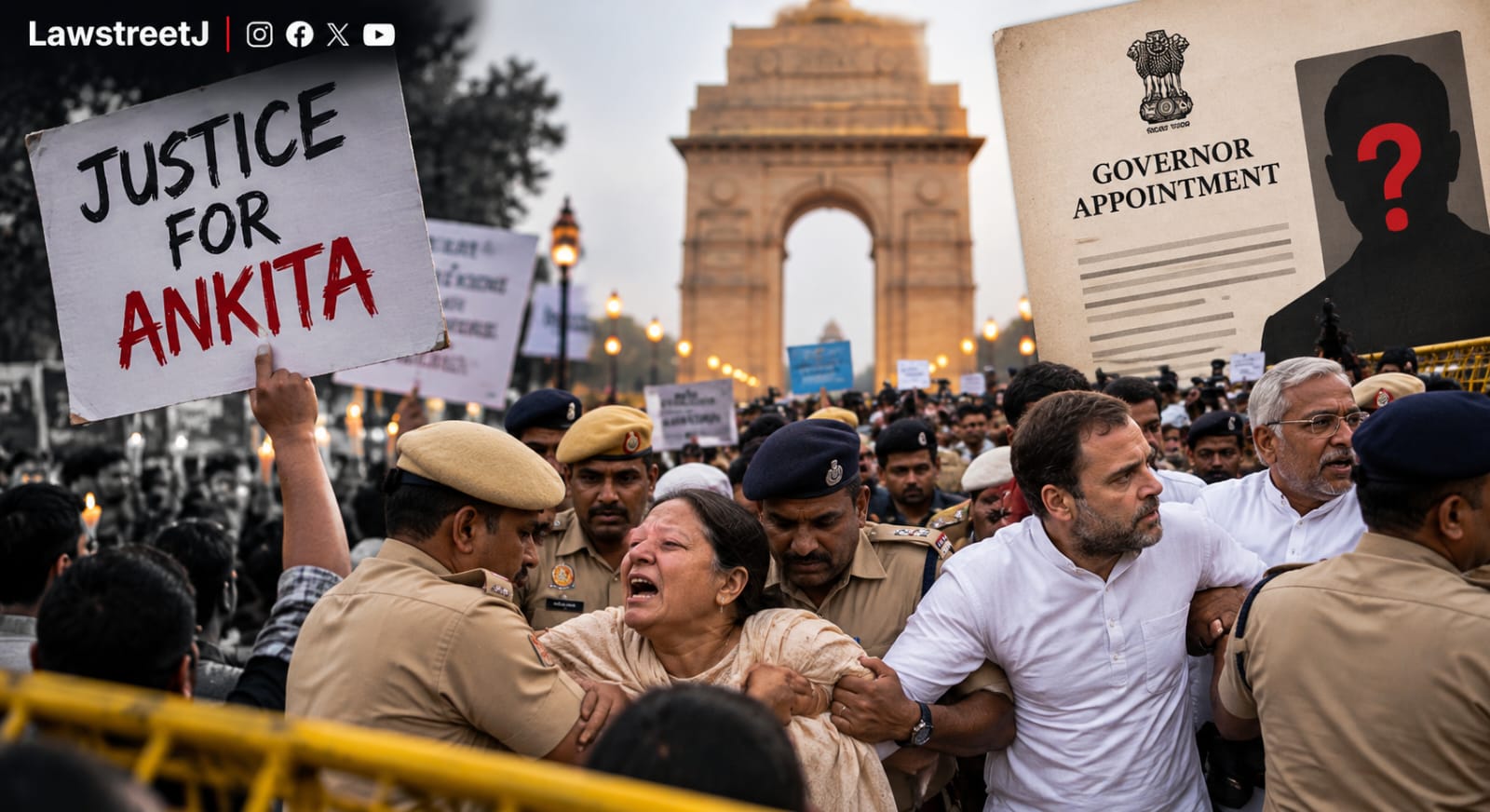
New Delhi — The parents of murdered Uttarakhand receptionist Ankita Bhandari were briefly detained by Delhi Police early Thursday morning during a sit-in protest at India Gate, hours after Leader of the Opposition Rahul Gandhi and Congress leader Priyanka Gandhi Vadra joined their demonstration. The protest centres on the recent appointment of BJP leader Dushyant Kumar Gautam as Governor of Sikkim, whom Bhandari's family and several political figures have alleged is the unidentified "VIP" referenced in the original investigation into her 2022 murder.
What Happened
Delhi Police, along with CRPF personnel, detained Ankita's parents, Virendra Singh Bhandari and Soni Devi, along with several Congress MPs and other protesters, during an overnight sit-in at India Gate at around 4 am on Thursday, October 15, 2026. Those detained alongside the parents included Congress leaders Pawan Khera, Jothimani and Imran Pratapgarhi. The parents were taken to Tilak Marg Police Station and released less than two hours later, according to ANI. Khera, Jothimani and Pratapgarhi reportedly continued their protest inside the police station after being detained.
The detentions came a day after Rahul Gandhi and Priyanka Gandhi Vadra, along with several Congress MPs, visited the protest site on Wednesday, October 14, and met with Ankita's parents. Following the meeting, Gandhi said the family had not received justice in four years, while the person they allege to be the VIP involved had instead been "rewarded with protection and a constitutional position." Congress workers and party leaders had remained at the site following the Gandhis' visit.
Speaking to the media after their release, Ankita's parents said they would continue their agitation until Gautam's appointment as Sikkim Governor was revoked, and warned that if they were prevented from protesting at India Gate, they would begin an indefinite hunger strike at their home in Uttarakhand.
Background: How the "VIP" Allegation Surfaced
The question of the VIP guest's identity has been part of the case since the original investigation, when one of Ankita's friends told police that she was under pressure to "entertain" and provide "special services" to a VIP guest at the Vanantra Resort. This detail featured in early reporting and was reflected in the trial court's verdict, but the VIP's identity was not included in the chargesheet filed against the three convicted men.
The controversy was reignited in late December 2025 when television actor Urmila Sanawar publicly alleged, including through a shared audio recording, that the VIP referenced in the case was Dushyant Kumar Gautam, then BJP National General Secretary and the party's Uttarakhand in-charge, whom she identified as the person referred to by the nickname "Gattu." Sanawar's allegations also implicated former Yamkeshwar district panchayat member Aarti Gaur, and she separately claimed that local political pressure had led to the partial demolition of the Vanantra resort, allegedly destroying evidence connected to the case, a related allegation holds that the demolition was carried out on the instructions of Yamkeshwar MLA Renu Bisht.
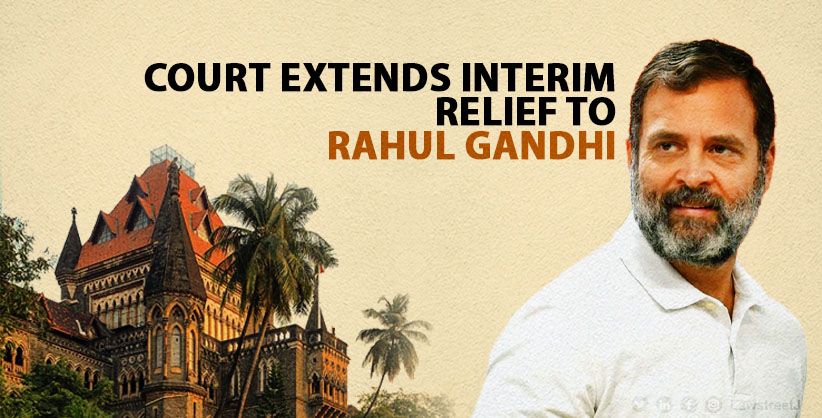
Gautam has consistently denied the allegations, describing them as defamatory and politically motivated, and has stated he sought a formal investigation to clear his name. He subsequently filed a defamation suit, and in April 2026 the Delhi High Court granted him interim relief, directing the Congress, the Aam Aadmi Party and other named defendants to take down social media posts linking him to the case.
Following the renewed controversy, a Padma Bhushan awardee, Anil Joshi, filed a complaint in Dehradun seeking a probe into the VIP allegations, resulting in a fresh FIR, Congress has characterised this FIR as an attempt to shield the alleged VIP rather than pursue the matter.
Legal and Constitutional Framework
India Gate, like other prominent sites in the New Delhi Municipal Council area, falls within a zone subject to heightened security regulation given its proximity to central government installations. Assembly and protest activity in this area is governed by the Delhi Police Act, 1978, and relevant prohibitory-order provisions now under the Bharatiya Nagarik Suraksha Sanhita, 2023, which allow police to regulate or restrict public gatherings in the interest of public order.
The right to peaceful assembly under Article 19(1)(b) of the Constitution remains subject to "reasonable restrictions" under Article 19(3), and the Supreme Court's ruling in Amit Sahni v. Commissioner of Police (2020) has established that authorities may regulate the time, place and manner of protest, including removal of demonstrators from unauthorised or indefinite sit-ins, provided the restriction is reasonable and proportionate. A brief, preventive detention of the kind reported here, followed by release without formal charges within a short period, is consistent with police exercising such regulatory authority rather than initiating a criminal prosecution.
The appointment of state Governors is governed by Article 155 of the Constitution, under which Governors are appointed by the President of India, and Article 156, which provides that a Governor holds office during the pleasure of the President, with a standard term of five years.
Unlike many other constitutional offices, no specific statutory qualification process or parliamentary confirmation is required for gubernatorial appointments beyond the constitutional requirements under Article 157 (citizenship and minimum age of 35) and Article 158 (disqualification from holding other offices of profit during the term). This means that, as a matter of constitutional law, an individual's appointment as Governor can proceed notwithstanding unresolved public allegations against them, provided no court has found such allegations to amount to a disqualifying criminal conviction.
The interim relief granted to Gautam by the Delhi High Court in his defamation suit falls under the framework of civil defamation law in India, which allows a person to seek damages and injunctive relief, including the removal of defamatory content, where they can demonstrate that published statements harm their reputation and are not protected by the defences of truth, fair comment or privilege. An interim order directing the takedown of specific posts pending final adjudication of the suit does not constitute a final finding on the truth or falsity of the underlying allegations; that determination would occur only upon final disposal of the defamation proceedings.
![Calcutta High Court Orders Deployment of Central Forces for West Bengal Rural Polls, Refuses to Quash Election Notification [Read Judgment]](/secure/uploads/2023/06/lj_4030_813c80d6-d15c-43ca-a508-7bec20714039.jpg)
.jpeg)