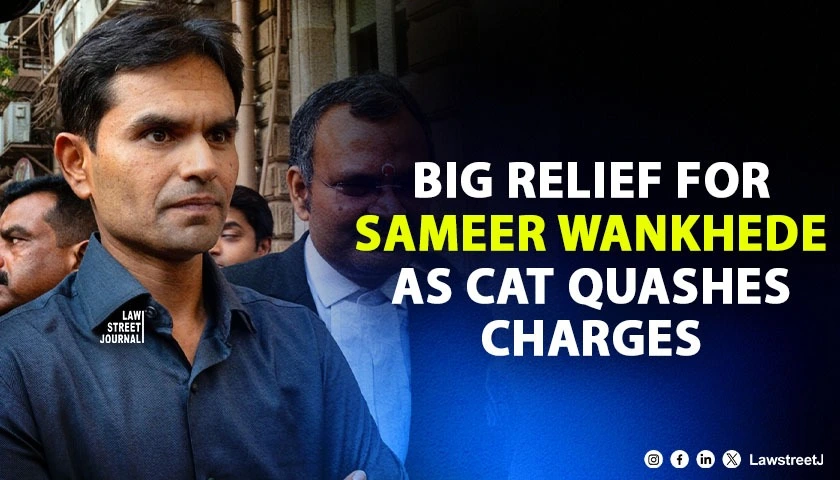
New Delhi: The Central Administrative Tribunal’s Principal Bench in New Delhi has quashed the charge memorandum issued against IRS officer Sameer Wankhede, citing mala fide intent, violation of principles of natural justice, and deliberate disregard of binding judicial orders by the authorities.
Justice Ranjit More (Chairman) and Member (A) Rajinder Kashyap pronounced the order on January 19, 2026, in O.A. No. 3258 of 2025, granting substantial relief to the decorated officer who had served as Zonal Director of the Narcotics Control Bureau (NCB), Mumbai.
The case arose from a charge memorandum dated August 18, 2025, issued by the Central Board of Indirect Taxes and Customs, alleging that Wankhede, despite being formally detached from the NCB on January 2, 2022, had “wilfully and deliberately sought sensitive and confidential information” from the then Departmental Legal Advisor.
The Tribunal noted Wankhede’s exceptional career profile, observing:
“The applicant has a highly distinguished career in law enforcement spanning the Customs Department, the National Investigation Agency (NIA), the Directorate of Revenue Intelligence (DRI), and the Narcotics Control Bureau (NCB).”
The Tribunal further detailed his honours, including the Union Home Minister’s Medal for Excellence in Investigation (2021), Maharashtra Samman (2021), and the DG, DRI Disc Medal (2019).
While examining the charge memorandum, the Tribunal found multiple fatal flaws and procedural violations. The judgment stated:
“From the perusal of the impugned Charge Memorandum dated 18.08.2025, we find that in Annexure-IV it is stated that ‘List of Witnesses by whom the Articles of Charges are proposed to be sustained’ — ‘NIL’.”
Citing the Delhi High Court’s judgment in Union of India v. Shameem Akhtar, the Tribunal reiterated that “a charge-sheet not supported by any list of witnesses or evidentiary foundation is unsustainable in law.”
On mala fide intent, the Tribunal made scathing observations, noting:
“The chain of events unmistakably demonstrates that the impugned Charge Memorandum bears no real nexus with the purported allegations but appears to be retaliatory action by the respondents arising out of a number of decisions in matters concerning the applicant.”
The Tribunal therefore held such conduct to be ex facie demonstrative of malice in law, personal vendetta, and a colourable exercise of power.
With respect to the timing of the proceedings, the Tribunal observed that the respondents, in gross disregard of an existing stay order restraining them from taking any further action, nevertheless proceeded to initiate major penalty proceedings against the applicant.
The Tribunal held:
“This action on the part of the respondents is full of high-handedness and was taken in tearing haste with the intention to somehow or other fix the applicant.”
On judicial overreach, the Tribunal further observed that the deliberate issuance of the impugned Charge Memorandum in the teeth of the subsisting interim direction of the Tribunal constituted wilful disobedience and gross contempt.
The Tribunal also discerned clear indicia of a predetermined intent, noting that the CVC advice dated 11.08.2025 was, on the very same day, mechanically and hastily forwarded for further action, with the forwarding order conspicuously bearing the endorsement “Urgent – Out Today.”
With regard to parallel criminal proceedings pending before the Bombay High Court, the Tribunal held that the call transcriptions relied upon for issuing the impugned Charge Memorandum constituted the very substratum of the criminal case. It reiterated the settled position of law that where continuation of a departmental inquiry has the potential to prejudice the defence of an employee in a criminal proceeding founded on identical facts, disciplinary proceedings merit deferment.
Examining the substance of the allegations, the Tribunal recorded that in the relevant conversation, Shri Japan Babu had unequivocally stated that the charge sheet filed against Mr. Aryan Khan was altered a day prior to its filing and had been prepared from outside the office without his knowledge. The Tribunal further found that the impugned Charge Memorandum deliberately and conveniently omitted reference to these crucial portions of the recorded proceedings, wherein Shri Japan Babu had categorically stated that the original draft was changed overnight.
Relying on the principles enunciated in State of Punjab v. V.K. Khanna, the Tribunal emphasised that where the issuance of a charge-sheet is tainted by malice or mala fide intent, or where the authority concerned is so biased that the inquiry would be reduced to a mere farcical exercise, courts are justified in intervening at the earliest stage to prevent harassment and humiliation of a public servant.
The Tribunal therefore held:
“The cumulative pattern shows administrative victimisation, not bona fide disciplinary regulation. Discipline cannot be weaponised to coerce, settle scores, or punish dissent.”
In its final order, the Tribunal directed:
“The impugned Charge Memorandum dated 18.08.2025 is quashed and set aside with all consequential benefits in accordance with law and the rules on the subject.”
However, the Tribunal exercised restraint on costs, stating:
“We refrain from imposing heavy costs on the respondents, with the hope that they will mend their ways and establish an administrative mechanism that upholds the Rule of Law.”
Case Title: Sameer Dnyandev Wankhede v. Union of India



![Husband Can Also Claim Alimony/Maintenance From Wife: Bombay High Court Orders Woman To Pay Alimony To Ex-Husband [Read Order]](/secure/uploads/2022/04/lj_2823_Divorce.jpg)