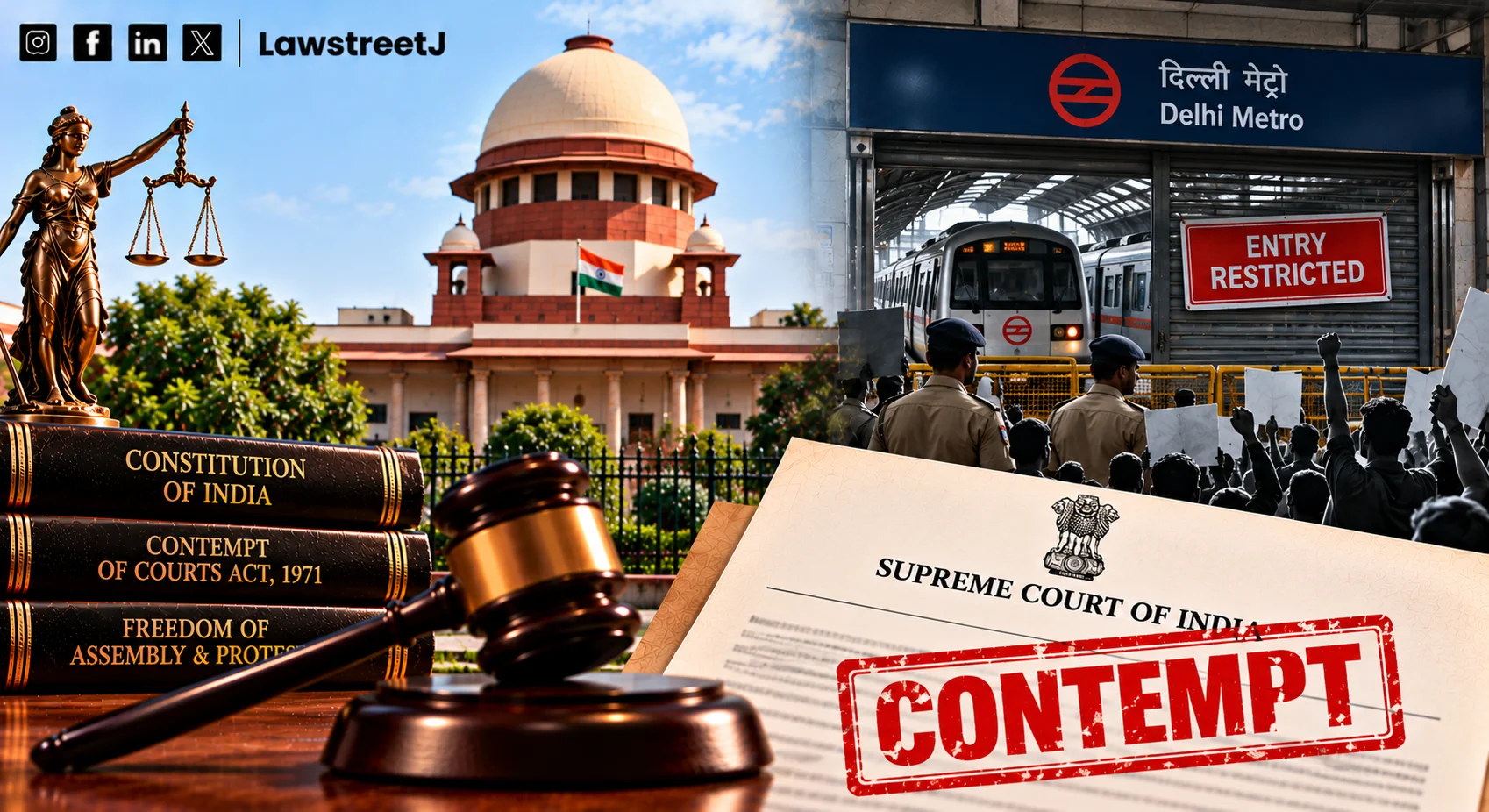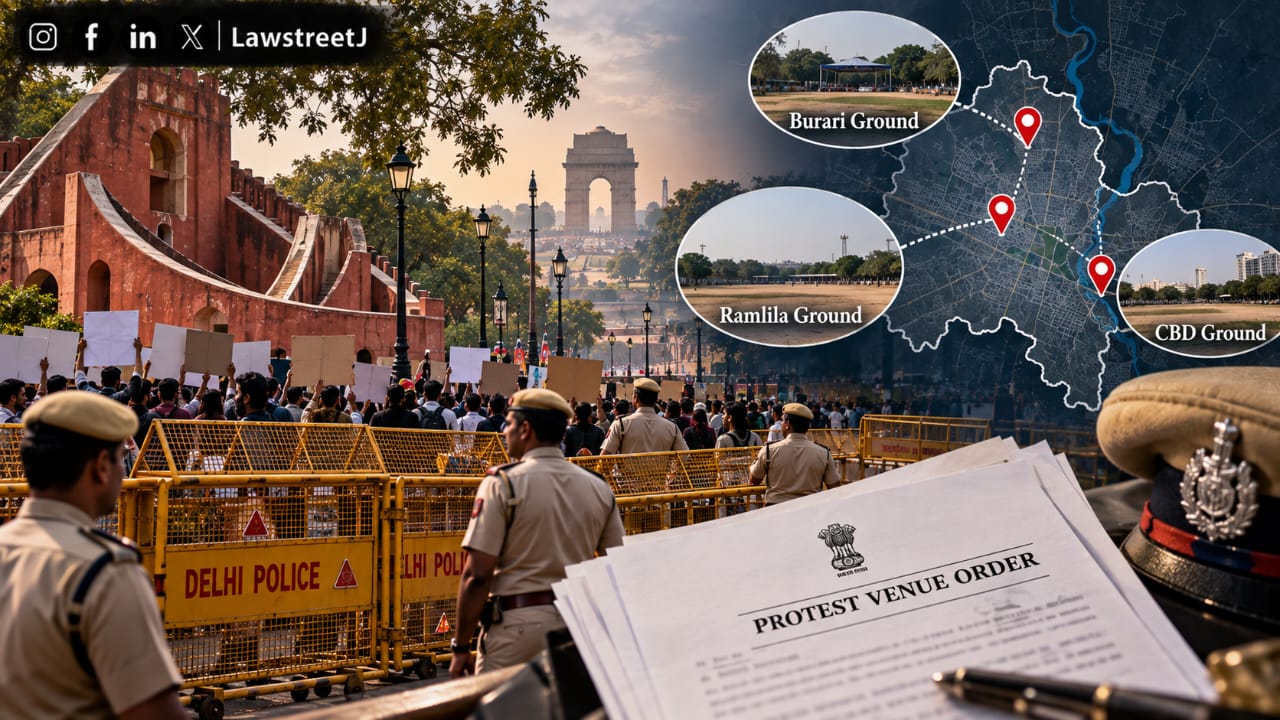

New Delhi — Delhi Police has formally denotified Jantar Mantar as the capital's designated site for protests and demonstrations, replacing it with three new venues Ramlila Ground, Burari Ground and CBD Ground in East Delhi, under a standing order issued by Police Commissioner Anurag Kumar on October 11, 2026. The move follows weeks of large-scale demonstrations at the site against the Special Intensive Revision of electoral rolls and demands for the resignation of Chief Election Commissioner Gyanesh Kumar.
The standing order, signed by Delhi Police Commissioner Anurag Kumar, states that Jantar Mantar has been de-notified as a protest venue based on the recommendations of a committee constituted by the Union Ministry of Home Affairs to examine alternative venues for citizens' protests and demonstrations.
The order reads: "Based on the Committee's recommendations, Jantar Mantar as a protest venue has been de-notified. Three new venues viz Ramlila Ground, Burari Ground and CBD Ground, East Delhi have been designated as new venues for organizing protest/demonstrations." The order states that detailed and revised standard operating procedures for organising protests at the three newly designated venues will be issued separately. The order modifies an earlier standing order dated April 28, 2022, under which Jantar Mantar had been the designated protest site.
The denotification comes amid sustained protests at Jantar Mantar organised by the Cockroach Janta Party, led by Abhijeet Dipke, demanding the resignation of CEC Gyanesh Kumar over allegations relating to the Special Intensive Revision of electoral rolls. Delhi Police had denied permission for CJP's planned October 10 demonstration at Jantar Mantar, and reports from that day described large-scale detentions of protesters, organisers and journalists, prompting a statement of concern from the UN Human Rights Office, which the Indian government rejected as unwarranted interference. Heightened security arrangements had already been visible around the site in the days preceding the October 11 order.
Background: Jantar Mantar's History as a Protest Site

Jantar Mantar, an 18th-century astronomical observation site in central Delhi, became the capital's principal designated protest venue following a 1993 Delhi High Court ruling that barred demonstrations at Delhi's Boat Club lawns, which had served as the city's primary protest ground until then.
The shift followed the self-immolation of student Rajiv Goswami during protests against the Mandal Commission's recommendations in 1990, after which authorities moved to designate Jantar Mantar as the alternative site. Over the following three decades, Jantar Mantar hosted numerous high-profile demonstrations, including protests following the 2012 Delhi gang rape case, farmers' agitations, and the 2023 wrestlers' protest against the former Wrestling Federation of India chief. Access to the site has periodically been restricted during specific periods, including under the Delhi Disaster Management Authority's Covid-era protocols, but it had, until this order, remained the capital's formally designated venue for public protest for roughly 33 years.
The question of whether Jantar Mantar should continue to serve as Delhi's protest site had already been before the courts prior to this order. The Supreme Court had earlier agreed to hear a public interest litigation questioning the continued use of Jantar Mantar as a protest venue, citing disruption to area residents and the movement of essential supplies, while the Delhi High Court had separately been examining issues connected to the site following the July 2026 protests and subsequent allegations of police conduct during those demonstrations. Following the October 11 denotification order, the Delhi High Court is set to hear a separate plea challenging the closure of Jantar Mantar as a protest site, filed in response to the Police Commissioner's order.
Legal and Constitutional Framework
The right to peaceful assembly and protest is guaranteed under Article 19(1)(b) of the Constitution, which protects the right of citizens to assemble peaceably and without arms, subject to "reasonable restrictions" the State may impose under Article 19(3) in the interests of public order and the sovereignty and integrity of India. This right does not, under Indian constitutional jurisprudence, guarantee protesters the ability to assemble at any specific location of their choosing, the Supreme Court, in Amit Sahni v. Commissioner of Police (2020), held that while peaceful protest is constitutionally protected, public spaces cannot be occupied indefinitely, and authorities retain the power to regulate the time, place and manner of public assembly in the interest of public order and the rights of other citizens, provided such regulation is reasonable and not used to extinguish the right itself.
The power to designate or denotify specific sites for public assembly in Delhi flows from the Delhi Police Act, 1978, read with the Police Commissioner's authority to issue standing orders regulating public gatherings, and from provisions under the Bharatiya Nagarik Suraksha Sanhita, 2023 (which replaced the Code of Criminal Procedure), governing the maintenance of public order, including prohibitory orders restricting assembly in specified areas. Because Jantar Mantar falls under the jurisdiction of the New Delhi Municipal Council area, which houses Parliament, government secretariats and diplomatic missions, decisions regarding its use for public assembly have historically involved coordination between the Delhi Police, the Ministry of Home Affairs, and the Lieutenant Governor's office, reflecting the area's distinct security considerations as the seat of the Union government, as distinguished from use restrictions in other parts of Delhi.
The constitutionality and reasonableness of denotifying a long-standing, judicially-linked protest site following a Ministry of Home Affairs committee's recommendation, rather than through a standalone legislative or judicial process, are among the questions expected to be examined in the pending Delhi High Court proceedings. Courts reviewing such administrative orders under Article 19(3) typically examine whether the restriction is proportionate to the stated public-order objective, whether adequate alternative venues have been provided for the effective exercise of the right to assembly, and whether the process followed in arriving at the decision meets the standards of fairness expected of executive action affecting a fundamental right.

![NewsClick received funds from Chinese firms to create false narratives: Delhi police FIR [Read Order]](/secure/uploads/2023/10/lj_9371_b4600c46-2a07-4866-b478-1c7683cd8363.jpg)
![Delhi High Court asks RBI, MHA to respond on various aspects of fraudulent digital bank transactions [Read Order]](/secure/uploads/2023/11/lj_3880_WhatsApp_Image_2023-11-29_at_4.49.08_PM.jpeg)

![Parliament security breach: Former DCP LN Rao calls for SOP for crime reporting [Watch Video]](/secure/uploads/2023/12/lj_6987_fb4a149e-b55e-447b-90cd-ab83b39cdc46.jpg)