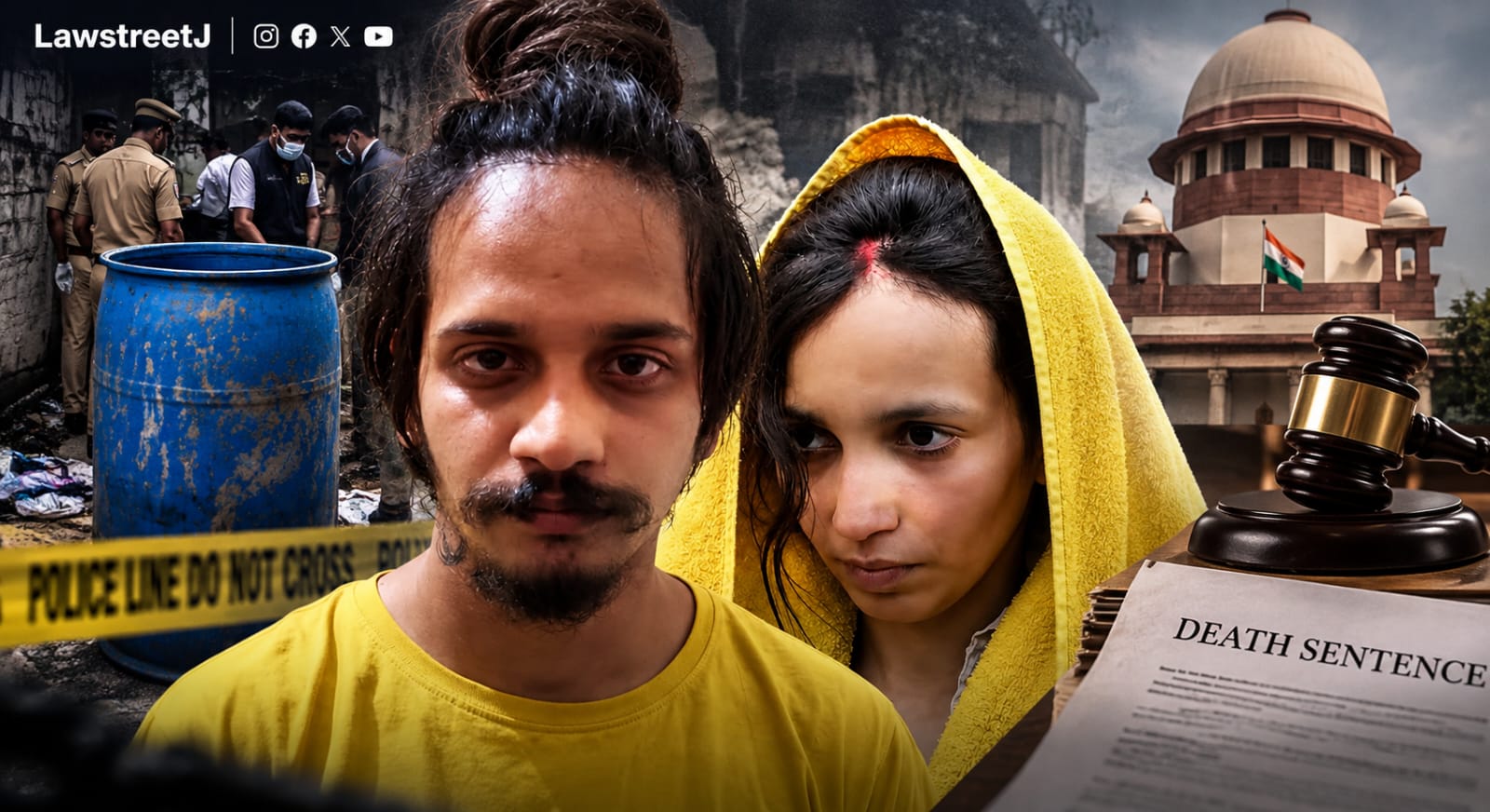
Meerut — A Meerut court has sentenced Muskan Rastogi and her lover Sahil Shukla to death for the murder of her husband, former Merchant Navy officer Saurabh Rajput, in the case that became widely known as the "Blue Drum Murder Case" after his dismembered body was found sealed inside a cement-filled drum. The sentencing follows the pair's conviction for murder last month.
Saurabh Rajput was killed on the night of March 3-4, 2025, at his home in the Indiranagar locality of Brahmapuri, Meerut district. According to the prosecution's case, his wife, Muskan Rastogi, sedated him by lacing his food, after which her lover, Sahil Shukla, arrived at the house. The two then stabbed Rajput to death and dismembered his body in the bathroom, severing his head and hands. The body parts were placed inside a blue plastic drum, which was sealed with a cement mixture.
Investigators stated that Muskan had allegedly been planning the murder since November 2023. Police claimed Rajput was killed not for any occult or "tantra-mantra" reason, as initially speculated in some reports, but because he was seen as an obstacle to Muskan and Sahil's relationship. After the killing, the couple reportedly fled to Himachal Pradesh before Muskan informed her family of what had happened, which led to the police being alerted and the case being registered.
Arrest and Investigation
Muskan Rastogi and Sahil Shukla were arrested on March 18, 2025, and sent to Meerut jail two days later. The case was investigated by the Brahmapuri police station, with the investigation led by station in-charge Ramakant Pachauri. Police filed a 1,000-page chargesheet in the court of Additional Civil Judge (Senior Division) Anuj Kumar Thakur, naming both accused under Sections 103(1) (punishment for murder) and 238(A) (causing disappearance of evidence of an offence, or giving false information to screen an offender) of the Bharatiya Nyaya Sanhita, 2023, India's revised criminal code that replaced the Indian Penal Code. The chargesheet contained statements from approximately 34 witnesses.
During the course of the prolonged judicial custody period, Muskan was found to be pregnant, a development confirmed by jail medical officials. She gave birth to a baby girl at a local medical college hospital while in custody, after which she and her newborn daughter were shifted together to Barrack 12A of Meerut jail, a barrack housing other female prisoners and young children. Members of her late husband's family publicly stated they wanted a DNA test conducted to confirm the paternity of the newborn child.
Conviction and Sentencing
The Meerut court convicted Muskan Rastogi and Sahil Shukla of murder and of concealing Saurabh Rajput's body in a verdict delivered in September 2026, following the conclusion of the trial.
On Wednesday, October 14, 2026, the same court pronounced the sentence, awarding the death penalty to both convicts. Both Muskan and Sahil reportedly attended the sentencing proceedings via video conferencing from jail. The prosecution had sought the death penalty for both accused throughout the sentencing arguments, with a public prosecutor noting to media that while the minimum punishment in such cases is typically life imprisonment, the maximum punishment available is death, and the prosecution had pressed for the latter given the nature of the crime.
The murder conviction was secured under Section 103(1) of the Bharatiya Nyaya Sanhita, 2023, which prescribes punishment for murder and corresponds to the erstwhile Section 302 of the Indian Penal Code, carrying a sentence of death or life imprisonment, along with a fine. The additional charge under Section 238(A) of the BNS, concerning causing the disappearance of evidence of an offence or screening an offender, corresponds to the erstwhile Section 201 IPC and relates specifically to the dismemberment and concealment of Rajput's body in the cement-filled drum.
A trial court's imposition of the death penalty in India does not take immediate legal effect. Under Section 366 of the Code of Criminal Procedure, 1973 (now reflected in corresponding provisions of the Bharatiya Nagarik Suraksha Sanhita, 2023, for cases registered after its commencement), a death sentence passed by a Sessions Court must be submitted to the jurisdictional High Court for confirmation, and the sentence cannot be executed unless and until it is confirmed by the High Court. This "confirmation" process involves an independent judicial review of the entire record of the case by the High Court, separate from any appeal the convicted persons may themselves choose to file against their conviction or sentence.
Any imposition of the death penalty in India is also governed by the Supreme Court's "rarest of rare" doctrine, established in Bachan Singh v. State of Punjab (1980) and refined in subsequent judgments, under which capital punishment may be upheld only where a court finds that the alternative of life imprisonment is unquestionably foreclosed, after weighing the aggravating circumstances of the crime against any mitigating factors specific to the convicted persons. The eventual confirmation proceedings before the Allahabad High Court, which holds appellate jurisdiction over Meerut's trial courts, will involve a review of the case against this standard.



.jpeg)