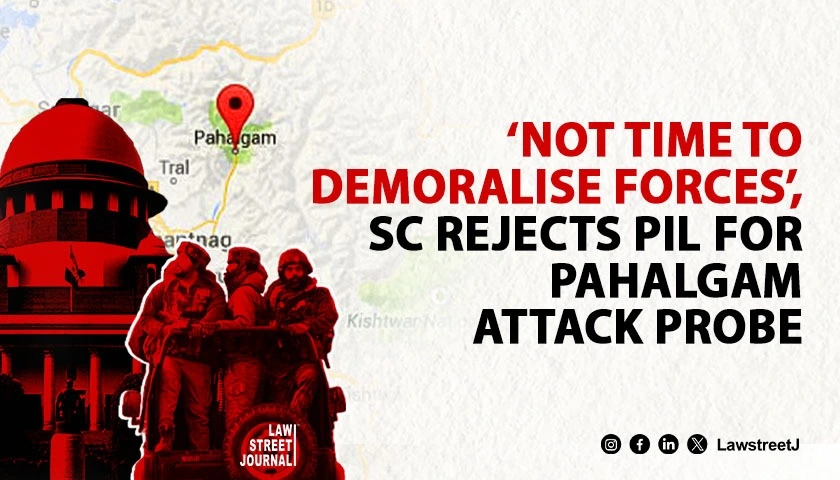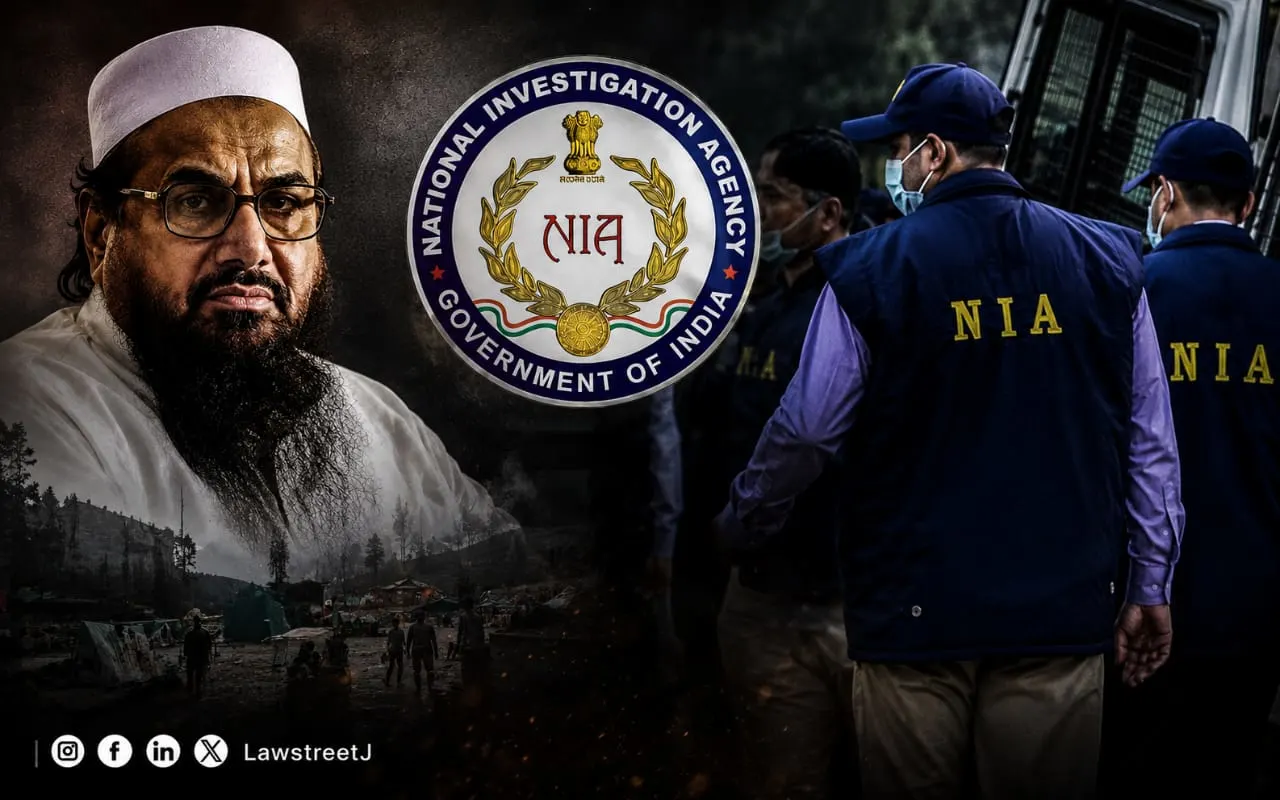
New Delhi / Jammu | The National Investigation Agency filed a supplementary chargesheet on July 6, 2026 before the NIA Special Court in Jammu, naming Pakistan-based terrorist and Lashkar-e-Taiba chief Hafiz Saeed as a key accused in the April 22, 2025 Pahalgam terror attack that killed 26 people, 25 innocent tourists and one local civilian at the Baisaran meadows in the Anantnag district of Jammu and Kashmir.
The NIA has charged Saeed in his individual capacity and simultaneously as the supreme commander of the banned LeT and its active proxy organisation, The Resistance Front. He has been charged under various sections of the Bharatiya Nyaya Sanhita 2023 and the Unlawful Activities (Prevention) Act 1967, including the penal section for waging war against India and hatching a cross-border conspiracy. "NIA continues to probe the case to unravel the complete conspiracy by Pakistan, which has been actively sponsoring terrorism on Indian soil from across the border," the agency stated.
The Two Chargesheets: What Each Established
The NIA's legal proceedings against those responsible for the Pahalgam attack have now proceeded in two distinct stages, each adding a layer to what the agency describes as a Pakistan-directed, cross-border terror conspiracy.
The first chargesheet was filed on December 15, 2025. It named Pakistani handler Sajid Jatt as an accused, along with three terrorists, Faisal Jatt alias Suleman Shah, Habeeb Tahir alias Jibran, and Hamza Afghani, who carried out the actual killings at Baisaran on April 22, 2025. All three perpetrators were subsequently killed by security forces during Operation Mahadev at Dachigam near Srinagar on July 29, 2025. The first chargesheet also named two locally arrested accused, Parvaiz Ahmad and Bashir Ahmad Jothar, who were arrested in June 2025 for harbouring the terrorists involved in the attack. It additionally charged the proscribed LeT/TRF terrorist organisation as a legal entity for its role in planning, facilitating, and executing the attack, a significant legal step that treats the organisation itself, not merely its members, as a criminal entity before Indian courts.
The supplementary chargesheet filed on July 6, 2026 builds on that foundation by formally naming Hafiz Saeed, the founder and supreme commander of LeT and TRF, as the overarching conspirator responsible for directing both organisations. The chargesheet presents him as the individual who guided and supported the activities that culminated in the Baisaran massacre, operating from across the international border in Pakistan.
Who Is Hafiz Saeed: A Legal and Security Profile
Muhammad Hafiz Saeed is the founder of Lashkar-e-Taiba, one of the largest and most lethal terrorist organisations operating in South Asia, and of its parent organisation Jamaat-ud-Dawa. He is designated a global terrorist by the United Nations Security Council and by the United States, which has maintained a ten million dollar bounty on him since 2012. The European Union, the United Kingdom, and several other governments have similarly designated him and his organisations.
Pakistan designated LeT as a banned terrorist organisation under international pressure, particularly following the November 2008 Mumbai attacks, in which LeT operatives killed 166 people across multiple locations in India's commercial capital for which Saeed has been widely held responsible by Indian authorities and international intelligence agencies. Despite that designation, Saeed has continued to operate openly in Pakistan, holding press conferences, leading public gatherings, and directing the activities of Jamaat-ud-Dawa, which Pakistani authorities have at various points described as a charitable organisation.
In 2022, a Pakistani anti-terrorism court sentenced Saeed to 31 years of imprisonment on terror financing charges. He is currently serving that sentence inside Pakistan. The NIA's chargesheet, by naming him as a key accused in the Pahalgam case, adds a new layer of Indian legal proceedings against him, proceedings that, while they cannot currently be directly enforced against a person in Pakistani custody, carry significant diplomatic and international legal weight.
The Resistance Front, named alongside LeT in both chargesheets, first emerged in October 2019 following the revocation of Article 370. Indian security agencies have consistently identified TRF as a shadow proxy of LeT, designed to provide plausible deniability for attacks claimed in Jammu and Kashmir. TRF initially claimed responsibility for the Pahalgam attack before retracting the claim shortly after, a sequence investigators cited as indicative of coordinated information management by Pakistani handlers.
The Drone Arms Drops: What the Chargesheet Revealed About Logistics
Among the most operationally significant revelations in the NIA's investigation is the documented use of cross-border drones to supply the terror cell with weapons, cash, and ammunition, penetrating as deep into Kashmir as Baramulla district in north Kashmir without being detected by multi-tiered security cordons.
The NIA chargesheet documented a specific drone-drop incident in early 2024 at Gogal Dara forest in Baramulla district, in which a drone delivered a payload that included 20 pistols, Rs 15 lakh in cash, and triangle-shaped bombs, Chinese-manufactured grenades to the terror cell. Gogal Dara forest, located in Baramulla district, is in the direct line of sight from across the Line of Control, making it a tactically viable drop zone for UAVs operating from Pakistani territory.
The chargesheet documents how the attackers moved through mountainous terrain and through populated areas for months before striking the tourist hub at Baisaran, a journey that, the NIA says, should have triggered early warning systems at multiple points but did not. Security experts analysing the chargesheet have pointed to this as evidence of a critical decline in the effectiveness of ground-level intelligence gathering across the Valley during the 2022 to 2024 period.
The Intelligence Collapse: HUMINT and the Gujjar-Bakerwal Problem
The chargesheet's most strategically uncomfortable revelation is not about the attackers, it is about the security apparatus that failed to detect them.
Security experts reviewing the NIA's findings have identified a critical drop in human intelligence, HUMINT, gathering between 2022 and 2024 as the primary reason the terror cell was able to move freely through the valley, receive aerial weapons drops, and scout targets at Baisaran without triggering early warning systems.
Analysts believe that an over-reliance on technical intelligence at the expense of cultivating ground-level human networks during this period created an operational vacuum. Technical surveillance, satellite imagery, electronic intercepts, drone monitoring, can identify known individuals and monitor known infrastructure. What it cannot do, without human networks embedded in the local landscape, is track new operatives who have not previously come to the attention of agencies, moving through terrain that is vast, heavily forested, and intimately familiar to locals.
The role of the Gujjar and Bakerwal nomadic tribes in this context is specifically cited in security analyses of the chargesheet findings. With a combined population of approximately 23 lakh, these communities have for decades been among the most valuable sources of human intelligence in the Pir Panjal ranges and the broader mountainous terrain of the Jammu region. Their knowledge of mountain passes, forest trails, grazing routes, and seasonal movements makes them uniquely positioned to notice strangers moving through the terrain and historically, they have shared that knowledge with security forces.
The relationship between security forces and these communities deteriorated between 2022 and 2023, with many established intelligence sources abandoned and stable communication infrastructure allowed to degrade. Analysts believe this breakdown in trust and the consequent loss of the human intelligence feed that the Gujjar and Bakerwal communities had provided for decades, created exactly the kind of operational vacuum that allowed the Pahalgam attackers to move undetected for months.
Security experts reviewing the chargesheet's findings have called for a systematic review of counter-terrorism tactics, including a deliberate effort to rebuild trust with these communities and reinstate ground-level intelligence networks that were allowed to lapse.
The Legal Charges: BNS, UAPA, and Waging War Against India
Hafiz Saeed has been charged under sections of the Bharatiya Nyaya Sanhita 2023, India's new criminal code that replaced the Indian Penal Code and under the Unlawful Activities (Prevention) Act 1967. Among the most significant provisions invoked is the charge of waging war against India, which carries severe penalties under Indian law and reflects the NIA's determination to frame the Pahalgam attack not merely as a terrorist incident but as an act of state-backed aggression directed from Pakistani soil.
The UAPA, under which Saeed has been charged, is India's primary counter-terrorism statute. It provides for designation of individuals and organisations as terrorists, allows for extended pre-trial detention, and places the burden of proof differently from ordinary criminal proceedings in certain respects, a framework specifically designed to address the evidentiary challenges that arise when accused persons and their networks are operating across international borders.
The NIA's statement accompanying the supplementary chargesheet made its institutional position explicit: the agency continues to probe the case to "unravel the complete conspiracy by Pakistan, which has been actively sponsoring terrorism on Indian soil from across the border." That framing, treating the attack as part of a Pakistani state-sponsored conspiracy rather than as the act of independent non-state actors, is consistent with the Indian government's broader diplomatic position in the aftermath of the attack and Operation Sindoor.
What Comes Next: A Case Built Across Borders
The NIA has indicated that the investigation remains open. Further chargesheets may be filed as additional evidence is identified or as further accused persons are apprehended. The two locally arrested accused, Parvaiz Ahmad and Bashir Ahmad Jothar, remain in custody and are subject to ongoing trial proceedings.
The three perpetrators who carried out the killings at Baisaran, Faisal Jatt, Habeeb Tahir, and Hamza Afghani are dead, killed during Operation Mahadev in July 2025. Hafiz Saeed is currently serving a 31-year sentence in Pakistani custody. The practical enforcement of the NIA's charges against him and the broader diplomatic consequences of a formal Indian legal indictment naming the LeT chief as a key accused in a mass casualty attack will be determined not in courtrooms alone but in the ongoing diplomatic and international legal conversations between India, Pakistan, and the international community.
The filing of the supplementary chargesheet on July 6 represents the most significant formal legal step India has taken since Operation Sindoor in establishing, before a court of law, the chain of command responsibility for the April 22, 2025 attack that set in motion one of the most consequential security responses in the region's recent history.
![SC's full court condemns terrorist attack on tourists in Pahalgam [Read Press Release]](/secure/uploads/2025/04/lj_8423_SCs_full_court_condemns.webp)