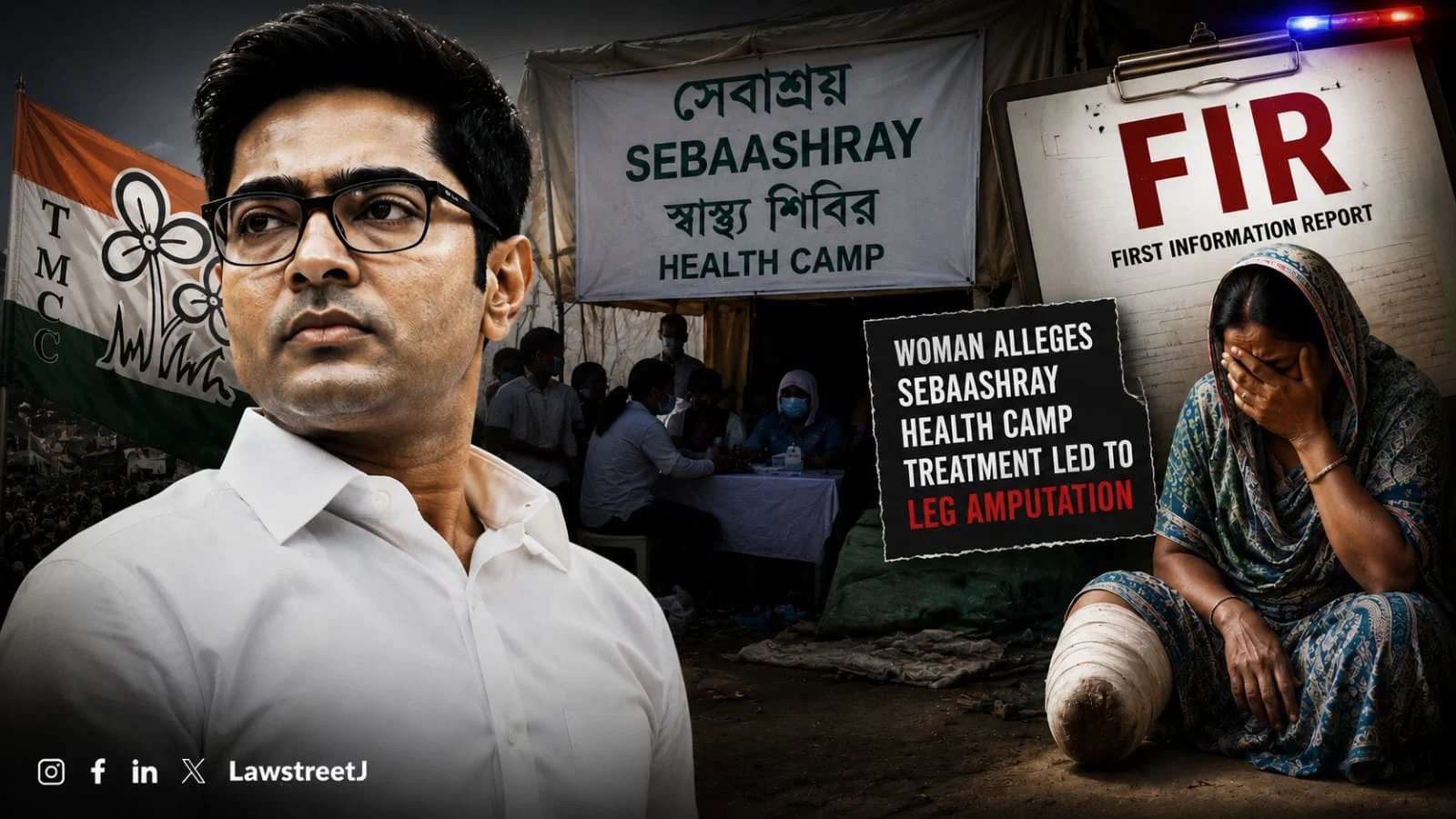
Kolkata | A third First Information Report has been registered against Trinamool Congress Member of Parliament Abhishek Banerjee, the Diamond Harbour MP and nephew of Chief Minister Mamata Banerjee, after a woman from South 24 Parganas alleged that treatment she received at a Sebaashray health camp led to a series of medical complications that ultimately resulted in the amputation of her leg. The FIR was registered at Rabindranagar Police Station in South 24 Parganas. An official at the station confirmed that the complaint had been registered against Banerjee and ten others, and that investigation was underway.
The case is the third FIR filed against Banerjee in connection with alleged irregularities at Sebaashray health camps, following two earlier complaints that had already placed the flagship community health outreach initiative under formal legal scrutiny. West Bengal's Health Department has now intervened, with state Health Minister Sharadwat Mukhopadhyay asking the victim's family to visit Swasthya Bhawan, the health department headquarters in Salt Lake, on Monday with all relevant medical documents for a detailed official review.
What Is Sebaashray and Who Launched It
The Sebaashray initiative was launched by Abhishek Banerjee on January 2, 2026, when the Trinamool Congress was in power in West Bengal. It was unveiled as a community healthcare outreach programme aimed at providing free or subsidised medical treatment, particularly for economically disadvantaged residents of rural and semi-urban Bengal who lack easy access to hospitals and specialists.
Banerjee, as the Diamond Harbour MP, is the political face of the initiative. He was not personally providing medical treatment, Sebaashray operates through camps staffed by doctors and medical personnel recruited by the initiative's organisers. However, his name is formally identified in the FIR as the figure responsible for the programme under whose banner the alleged negligence occurred, along with ten other individuals associated with the camp's operations.
Maloti Biswas: What the Complaint Alleges
The third FIR was registered based on a complaint filed by Maloti Biswas, identified in some reports as Malati Biswas, a resident of Maheshtala in South 24 Parganas district. According to her police complaint and statements made by her family, the sequence of events unfolded as follows.
Biswas attended a Sebaashray health camp in her area approximately two months ago with a complaint of knee pain, which doctors at the camp identified as osteoarthritis. She was examined and prescribed medicines, which she began taking. Her condition, rather than improving, deteriorated following the prescription and treatment she received at the camp.
As her condition worsened, she approached a second Sebaashray "model" camp seeking further treatment. At the second camp, she alleged, doctors demanded a large sum of money for continued treatment, an allegation directly at odds with the programme's stated purpose of providing free or affordable community healthcare. When Biswas declined to pay the demanded amount, she alleged she was referred to a government hospital rather than receiving further treatment at the camp.
Biswas was subsequently referred to M.R. Bangur Government Hospital. She was then admitted to the Calcutta National Medical College and Hospital on March 19, where she underwent a total knee replacement surgery on April 25. Following the surgery, she developed an acute post-operative vascular complication in her right leg. Doctors found the damage to the leg to be irreversible. An above-knee amputation was performed on May 27.
In her police complaint, Biswas and her husband have alleged that the medical negligence at the initial Sebaashray camp, specifically the medicines prescribed and the standard of care provided, set in motion the chain of events that ultimately led to the amputation. They also alleged that the family subsequently tried to contact the Sebaashray organisers regarding what had happened, but was unable to reach them.
The Previous Two FIRs: A Pattern Under Scrutiny
The Rabindranagar police station FIR is the third complaint registered against Banerjee in connection with Sebaashray health camp operations, a pattern that has placed the initiative under sustained legal scrutiny within months of its launch.
The first two FIRs had been filed in connection with alleged irregularities at other Sebaashray camps, the details of which have been reported across various outlets though the specific charges in those cases have not been confirmed in full by the police. The registration of a third FIR specifically alleging that a patient lost a limb following camp treatment has significantly intensified both the media attention and the political pressure surrounding the programme.
The cumulative legal picture, three FIRs in the space of months, involving separate incidents at separate camps operating under the same Sebaashray banner, raises questions about the quality control, regulatory oversight, and accountability mechanisms built into the initiative's operating framework. Community health camps in India operate under a complex regulatory environment that intersects the Indian Medical Council Act, state medical regulation bodies, and the National Health Mission's guidelines for health camps, a framework that, if not rigorously applied to private and politician-launched initiatives, can leave patients without the formal protections available in registered medical institutions.
The Political and Legal Dimensions
Abhishek Banerjee is one of the most powerful political figures in West Bengal and the Trinamool Congress's most prominent second-generation leader. His Diamond Harbour Lok Sabha constituency has been one of the TMC's safest seats, and he has been the party's national general secretary. His political standing means that the accumulation of FIRs carries consequences well beyond the legal proceedings themselves, it has generated sustained opposition attacks on both him and the TMC government.
The BJP and the Left Front have both raised the Sebaashray FIRs in the Bengal legislature and in the media. Opposition legislators have called for a complete suspension of all Sebaashray health camp operations pending an independent review, and have demanded that Banerjee be questioned by police in connection with all three complaints.
The registration of an FIR in India initiates a police investigation but does not constitute a charge sheet or a judicial finding of guilt. The police are required to investigate the complaint, record statements from the accused and witnesses, examine medical records, and determine whether there is sufficient material to file a charge sheet before a magistrate. At that stage, the matter moves into the court's jurisdiction.
In the Biswas case specifically, the medical chain of events, from osteoarthritis presentation at a health camp to a total knee replacement at a government medical college to a post-operative vascular complication resulting in amputation, involves multiple institutions and medical practitioners, making the establishment of specific criminal medical negligence a legally complex exercise. The FIR names Banerjee and ten others, but the investigation will need to establish which individuals' specific acts or omissions caused the harm alleged, and whether those acts constitute criminal negligence under Section 304A of the Bharatiya Nyaya Sanhita 2023, the provision covering death or serious injury caused by a rash or negligent act not amounting to culpable homicide.
The Health Department's Response
West Bengal Health Minister Sharadwat Mukhopadhyay has stepped in directly. He personally spoke to the complainant and asked her family to visit Swasthya Bhawan on Monday with all medical records and documents relevant to her treatment. The Health Department has separately launched a broader review of the Sebaashray health camp operations.
The minister's personal engagement is notable, it reflects both the political sensitivity of the case, given Banerjee's prominence within the TMC, and the seriousness with which the Health Department is treating the allegation that a patient lost a limb following treatment at a state political leader's community health initiative.
The outcome of the departmental review and whether it leads to a suspension of Sebaashray operations, a revision of the camp's medical protocols, or formal referrals for regulatory action is expected to become clearer in the coming days as the investigation and review processes proceed simultaneously.
.jpg)