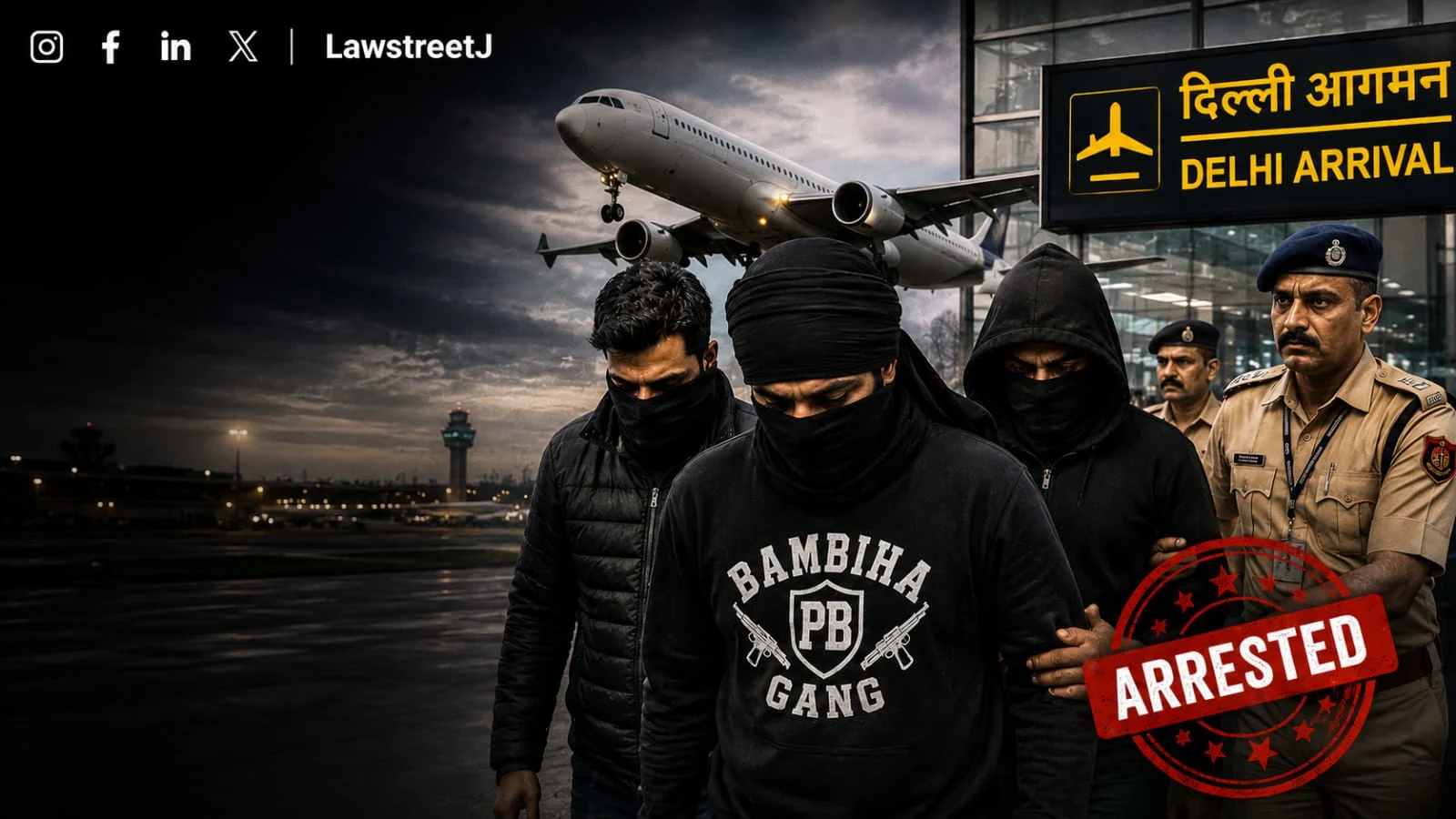

NEW DELHI / CHANDIGARH - Indian agencies have secured the deportation of three alleged Bambiha gang operatives from Malaysia, with Punjab Police arresting the trio upon their arrival at Indira Gandhi International Airport in New Delhi before transferring them to Punjab for further investigation. The development, announced by Union Home Minister Amit Shah on X on Monday, brings the total number of fugitive criminals returned to India in 2026 alone to 51, a figure Shah attributed to coordinated inter-agency operations under the government's anti-crime and drug control frameworks.
Shah wrote on X: "Indian agencies got three absconding Indian gangsters apprehended in Malaysia, deported them to India, and sent them to police custody. The fugitives, namely Jaspreet Singh, Ajay Singh, and Pawandeep Singh, are linked to the Bambiha Gang and are accused of multiple crimes, including extortion, cross-border arms and narco-trafficking, and a foiled grenade attack in Ludhiana. Under Modi Ji's vision of a safe and secure India, our agencies have facilitated the deportation of 51 hardened criminals in 2026 alone."
The three, Jaspreet Singh, Ajay Singh, and Pawandeep Singh were apprehended in Malaysia with the assistance of Malaysian authorities through coordinated action between Indian security and intelligence agencies and their Malaysian counterparts. The deportation was the culmination of a process that identified the three individuals as absconding from active criminal proceedings in India, located them in Malaysia, and secured their return through diplomatic and law enforcement channels.
The Charges and the Gang They Are Linked To
All three deported individuals face serious criminal allegations that span multiple categories, extortion, cross-border arms trafficking, narco-trafficking, and a foiled grenade attack in Ludhiana, Punjab. The Ludhiana grenade attack charge is particularly significant, given that grenade attacks on public places have been one of the most frequently documented tactics used by Punjab's gang networks to intimidate rivals, businesses targeted for extortion, and law enforcement.
The Bambiha gang takes its name from Davinder Bambiha, a Punjab criminal who was killed in a police encounter in 2016. Following his death, the gang fragmented but continued to operate, with different factions maintaining their grip on extortion networks, weapons supply chains, and narcotics distribution across Punjab and in cross-border operations. Many senior gang members and financiers have been identified as operating from foreign soil including Pakistan, Canada, and Southeast Asian countries coordinating criminal activities in India from abroad.
The arrest of gang-linked individuals operating from Malaysia illustrates the geographic spread of the problem. Cross-border narco-trafficking and arms supply chains require overseas coordination, and the gang's ability to direct operations inside Punjab while its key figures remained beyond the immediate reach of Indian law enforcement has been one of the most significant operational challenges for Punjab Police and the central agencies.
All three individuals have been placed in police custody and transferred to Punjab, where the cases against them are being investigated.
51 Criminals in 2026: The Wider Deportation Campaign
Monday's deportation is the latest addition to a growing 2026 tally that the Ministry of Home Affairs has been building through a combination of bilateral extradition cooperation, Interpol notices, and diplomatic pressure.
The deportations are in furtherance of the Vision Document on Drug Control 2026-2029, unveiled by Home Minister Shah, under which sustained efforts are underway to identify, locate, and bring back narcotics fugitives and hardened criminals operating from abroad through coordinated action with national and international agencies.
Among the significant returns preceding Monday's Bambiha gang deportation: drug kingpin Mohammad Salim Dola was deported from Turkiye in April 2026 under Operation Global-Hunt. Navin Chichkar was returned from Malaysia in an earlier operation. Kamlesh Parekh, wanted in a major financial fraud case involving losses worth hundreds of crores to a bank consortium led by the State Bank of India, was returned from the UAE on May 1. He had been tracked through an Interpol Red Notice, detained by UAE authorities, and handed over to Indian officials after completion of legal procedures.
On August 14, just ten days before Monday's Malaysia deportation, Virender Singh Basoya arrived at IGI Airport under NCB custody after being brought back from the UAE. Basoya, described by the NCB as a "key overseas operative" and alleged conspirator, had been coordinating gang activities from abroad and facilitating the export of Mephedrone consignments from India to other countries. He had been arrested in the UAE in June 2026 pursuant to an Interpol Red Notice issued at the request of the NCB, and was returned to India after approximately two months of legal processing in the UAE.
India-Malaysia Criminal Cooperation
The fact that Malaysia has now been the source country for more than one criminal deportation to India in 2026 signals a deepening of law enforcement cooperation between the two countries.
Malaysia has historically been a destination for Indian fugitives seeking to exploit the absence of a formal extradition treaty between the two countries. The India-Malaysia relationship on criminal cooperation has operated through other legal and diplomatic channels including Interpol notices, mutual legal assistance treaties, and bilateral diplomatic engagement rather than a formal extradition framework.
The successful deportation of Navin Chichkar earlier in 2026 and now the three Bambiha gang operatives suggests that Indian agencies have developed effective working relationships with their Malaysian counterparts through these alternative channels, producing results that a formal extradition treaty would normally facilitate.
The deportation coordination involves multiple Indian agencies the Ministry of External Affairs, the Ministry of Home Affairs, Punjab Police, the NCB, and the Central Bureau of Investigation, operating together across the diplomatic and law enforcement domains to locate, apprehend, and secure the return of individuals wanted in India. The 51 criminals returned in 2026 represent the output of that multi-agency, multi-country system operating at a higher tempo than in previous years.
What Comes Next
The three Bambiha gang members are now in Punjab Police custody and will be formally charged in the criminal cases that triggered their designation as absconding fugitives. The charges, extortion, cross-border arms and narco-trafficking, and the Ludhiana grenade attack will be the basis for the prosecution that now proceeds in the Indian legal system.
The MHA has indicated that efforts to bring back additional narcotics fugitives and hardened criminals operating from abroad are continuing, with the 51-criminal figure being a running total rather than a closed count. As that number grows through the remainder of 2026, the deportation programme built on the Vision Document on Drug Control and executed through coordinated bilateral and multilateral law enforcement engagement will continue to define one of the more active dimensions of India's internal security operation in the current year.
This report is based on verified information from ANI, India TV News, Asianet Newsable, PGurus, India Post, the Ministry of Home Affairs, and Home Minister Amit Shah's verified X account. The deportation was announced on August 24, 2026.

![Only Central Govt empowered to undertake census, Centre tells Supreme Court [Read Affidavit]](/secure/uploads/2023/08/lj_7449_9c75a532-6157-429f-be90-4805dbb8a2ee.jpg)